Klimt's Landscapes and the Attersee
Gustav Klimt painted more than 50 landscapes, creating the majority of them during summer holidays at Lake Attersee between 1900 and 1916. These works feature square compositions, close-up foliage, reflective water, and quiet forest interiors.
Klimt the landscape painter
Gustav Klimt painted landscapes throughout the second half of his career, producing more than 50 nature scenes between the late 1890s and his death. After a sharp public controversy surrounding his University of Vienna faculty paintings, Klimt made a deliberate choice. He stopped accepting public commissions entirely. Instead, he directed his creative energy toward private portraits and outdoor scenery.
Today, readers looking at Klimt landscapes find an unexpected side of the Austrian artist. Rather than gold leaf and mythological figures, these pictures present quiet woods, apple orchards, farmhouse gardens, and open water. The figures that dominate his decorative allegories are absent. In their place, Klimt constructed calm surfaces built from hundreds of small brushstrokes.
Landscape painting was not an afterthought for Klimt. It served as a personal refuge from the demands of Viennese society. Working outdoors allowed him to observe light, water, and foliage directly, creating paintings that balanced natural observation with strict decorative order.
Summers at the Attersee
Klimt produced the vast majority of his landscape paintings during his summer retreats to Lake Attersee in Upper Austria. Between 1900 and 1916, he left his Vienna studio every year to spend the warm months by the water. These extended stays gave him uninterrupted time to paint outdoors.
His summer holidays followed a steady geography around the lake. In 1900, he began staying at Litzlberg near Seewalchen at the northern end of the lake. During these vacations, he frequently stayed at the lakeside villa of court master carpenter Friedrich Paulick. Between 1908 and 1910, Klimt rented Villa Oleander in Schörfling am Attersee together with the Flöge family. The villa was leased from Countess Khevenhüller, who owned nearby Kammer Castle.
His companion on these trips was fashion designer Emilie Flöge. In 1903, Klimt gave her his oil painting Pear Tree, though he continued to work on the canvas after presenting it to her. By 1914, Klimt moved his summer base to the southern shore, staying at the Forester’s House in Weissenbach until 1916. He recorded that building directly in two separate paintings. Today, you can explore prints of these lakeside subjects in our Attersee collection.
How Klimt painted a landscape
Klimt approached nature with unusual visual tools. To find his compositions, he used a square cardboard viewfinder of his own invention. Walking along the lake shore or through the woods, he looked through the cutout to isolate a patch of trees, a building facade, or a section of water. Today, metal information steles on the Klimt theme path at Lake Attersee include square viewing holes so visitors can frame the scenery exactly as Klimt did.
He also used opera glasses and a handheld telescope. These lenses compressed distant scenery, flattening hills, trees, and buildings into stacked, decorative layers. The telescope eliminated deep horizon lines and pulled distant objects into the foreground. Art critic Karen Wilkin observed that this approach gave his landscapes an underlying geometric structure, paired with inventive palettes and repetitive brush marks.
Klimt broke with academic tradition by choosing square canvases rather than wide horizontal formats. Pear Tree (1903), measuring 101 by 101 cm, was one of the first landscapes painted in this Pointillist-influenced style. The square format equalized the visual weight in all directions, turning foliage, trunks, and water into textured patterns. While he started these works outdoors, he did not finish every canvas by the lake. Klimt’s catalogue raisonné contains about twelve paintings completed in his Vienna studio on Feldmühlgasse after his summer holidays ended.
The main landscapes
Klimt’s landscape output divides into clear subjects: castle views, lake surfaces, dense forests, village architecture, and flower gardens.
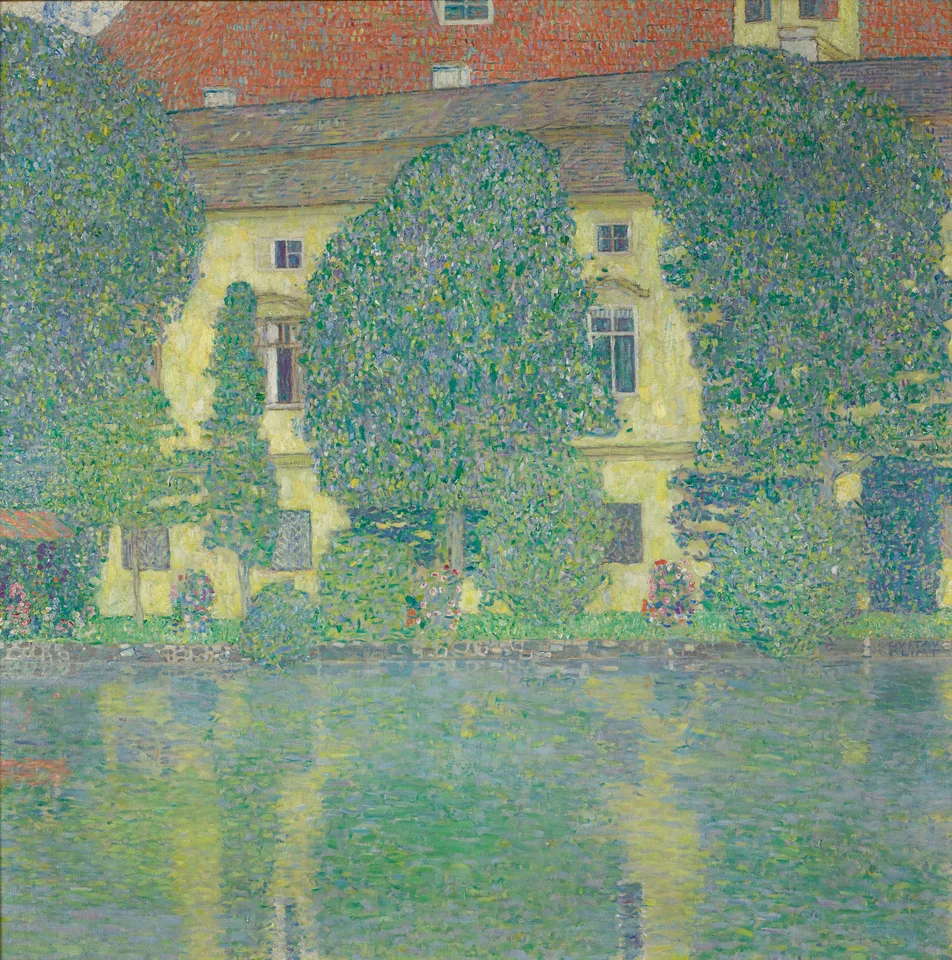
Between 1908 and 1910, Klimt created a four-part series showing Kammer Castle. The opening canvas, Schloss Kammer on the Attersee I (1908), presents the yellow castle sitting low on the water line. The National Gallery Prague acquired the painting in 1910 under the title Schloss by the Water. In 1909, he completed Park at Kammer Castle, now in the Neue Galerie in New York, and followed it in 1912 with Avenue in the Park of Schloss Kammer, preserved in the Belvedere collection in Vienna.
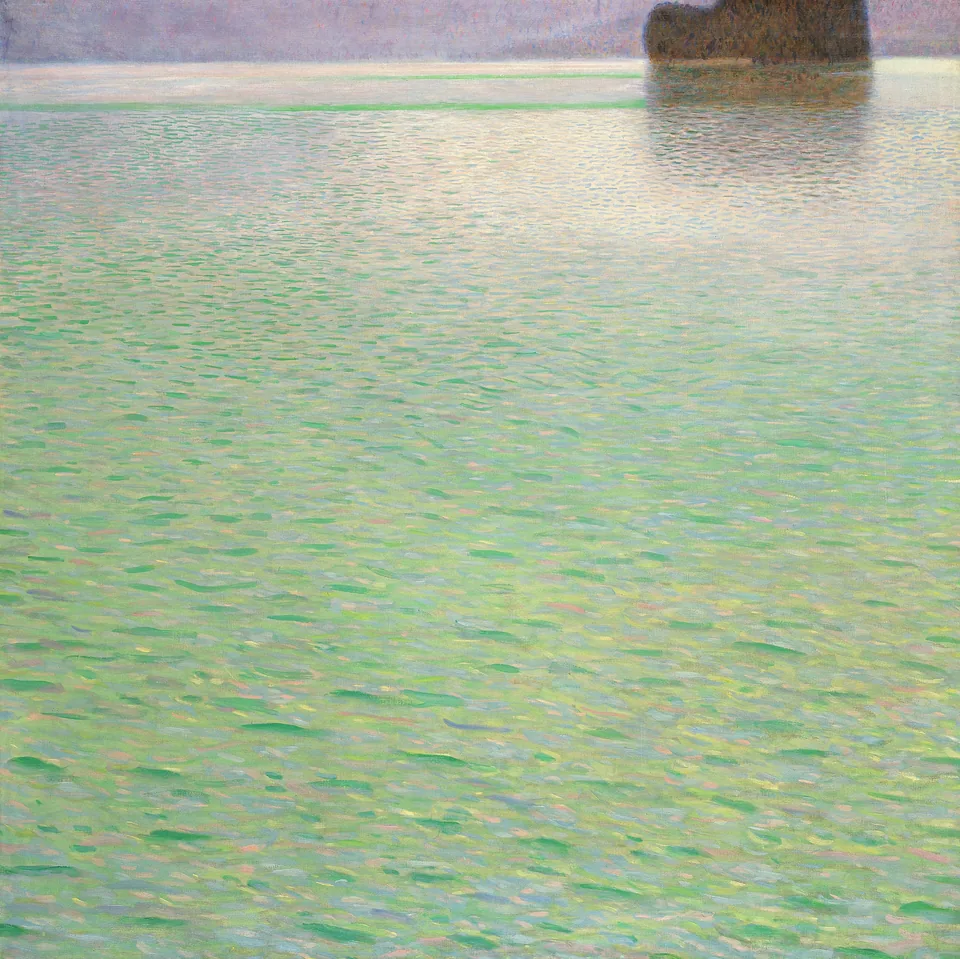
His water paintings began with On Lake Attersee in 1900, measuring 80.2 by 80.2 cm, now held by the Leopold Museum in Vienna. In this work, turquoise and deep green water fills almost the entire frame, leaving only a sliver of distant shore at the top. In 1901, he painted Insel im Attersee, a 100.5 by 100.5 cm canvas that later sold at a New York auction in September 2022.
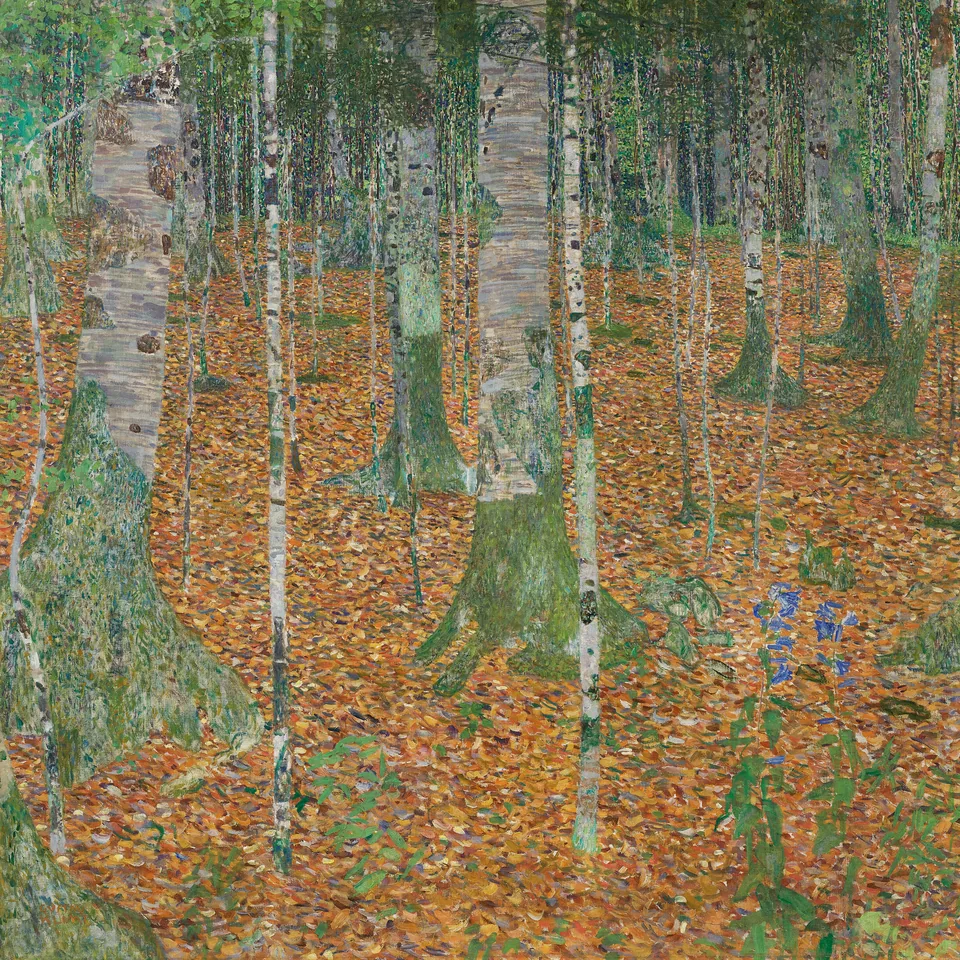
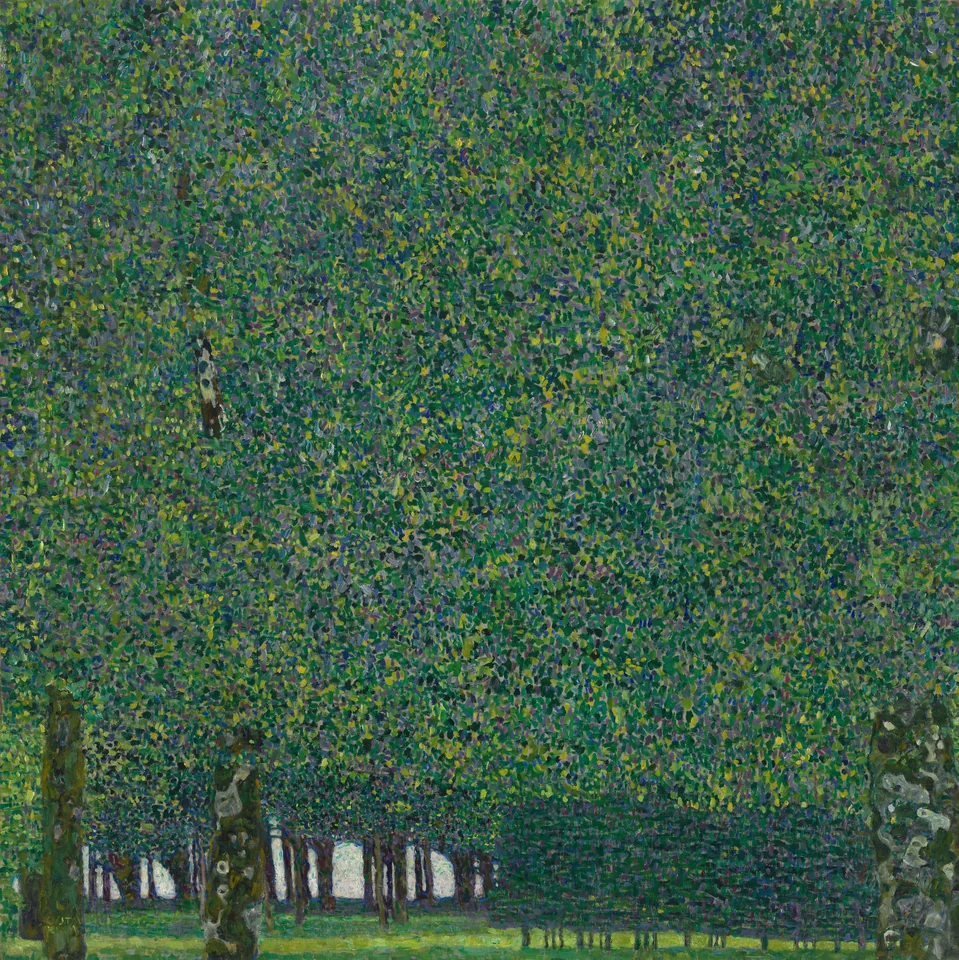
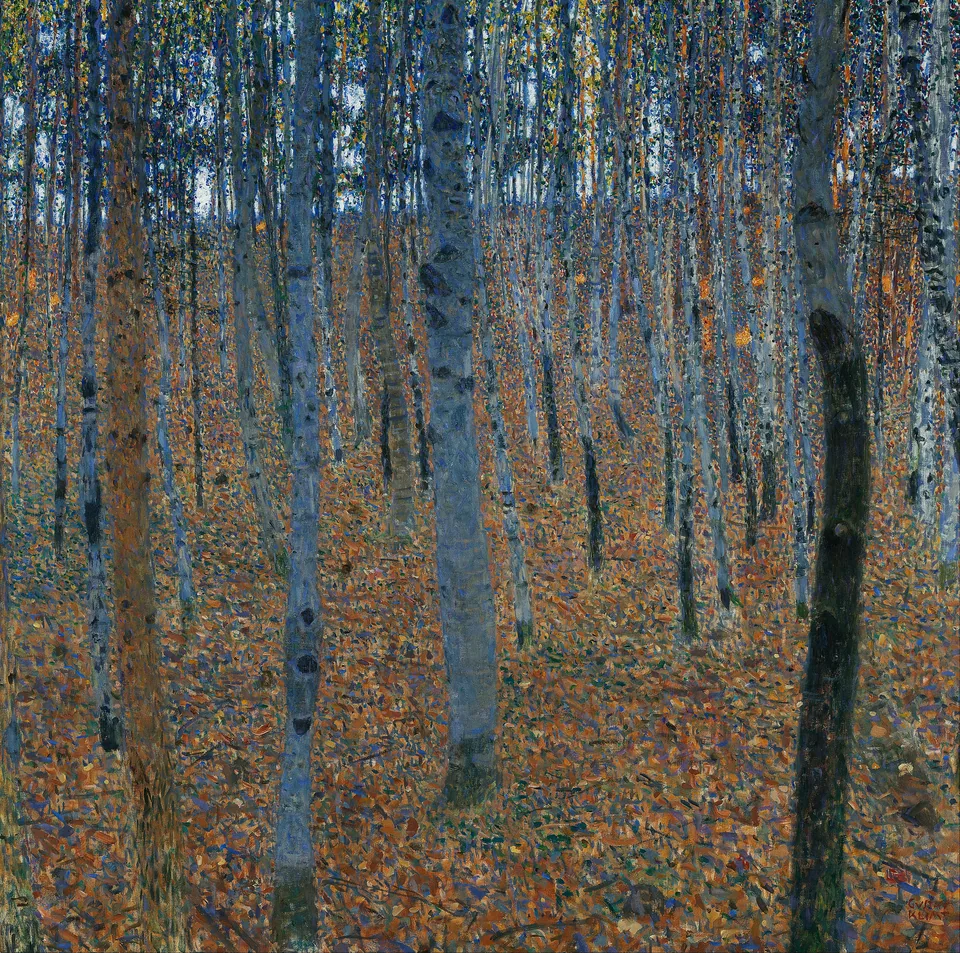
His forest interiors present rhythmic rows of tree trunks. Buchenwald (1902) hangs in the Galerie Neue Meister in Dresden on a 100 by 100 cm canvas, showing copper beech leaves blanketing the forest floor. In Birch Forest (1903), Klimt arranged slender silver trunks across a carpet of fallen leaves. The painting, measuring 110.1 by 109.8 cm, was formerly in the Paul G. Allen Collection and sold at auction in New York in November 2006. MoMA in New York holds Der Park, painted in 1909 or 1910, where a dense canopy of foliage fills the canvas with tiny dots of green paint.
Toward the end of his life, Klimt painted the village of Unterach on the southern shore. He produced Church in Unterach in 1916, alongside Forest Slope in Unterach am Attersee, a 110 by 110 cm composition showing rooftops pressed against a steep hillside. Another view, Houses at Unterach on the Attersee, was sold at auction in November 2006.
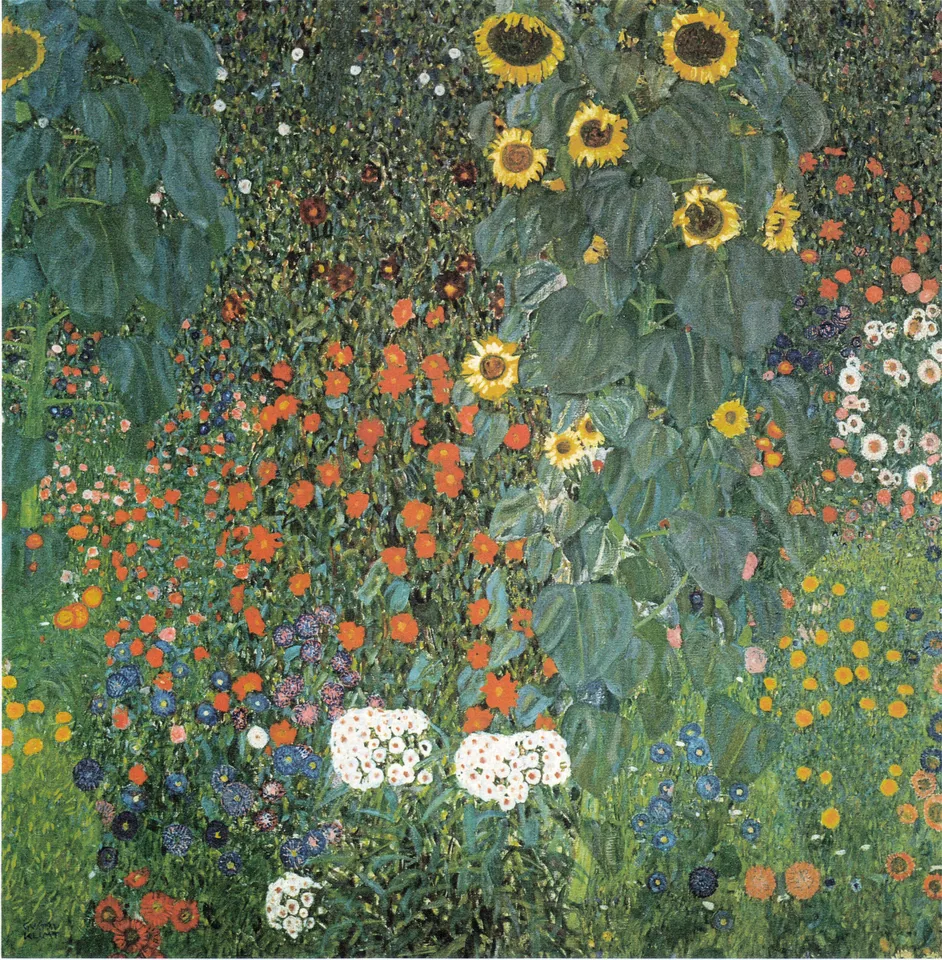
Klimt also loved domestic plants, which you can see in our flowers and gardens collection. In Bauerngarten mit Sonnenblumen, dated to 1906 or 1907 depending on the museum record, bright blooms fill the frame from corner to corner. The canvas belongs to the Belvedere in Vienna. In 2017, another garden view, Bauerngarten (1907), sold at auction in London, ranking at the time as Klimt’s most expensive landscape sold at auction.
Lake Garda and other places
Lake Attersee was not the only body of water Klimt visited. In the summer of 1913, he traveled south to Lake Garda in northern Italy. The Mediterranean light and stone architecture prompted three square paintings, each measuring 110 by 110 cm.
Church in Cassone depicts the village church tower rising above stacked stone roofs, framed by cypress trees. In Malcesine am Gardasee, Klimt observed the lakeside town from the water, compressing medieval houses, towers, and reflections into a dense mosaic of color. He also completed Italian Garden Landscape in 1913, an oil painting preserved today at the Kunsthaus Zug in Switzerland, featuring bright flower beds against lush green foliage.
Back in Vienna, Klimt occasionally looked to local parkland for subjects. In 1916, he painted Schoenbrunn landscape, capturing the manicured hedges and trees of the imperial palace grounds. He also painted Litzlberg am Attersee in his studio on Feldmühlgasse around 1914 or 1915, working from memory and sketches of his previous summer holiday.
Living with a Klimt landscape
A Klimt landscape brings balance, color, and quiet order into a home. Because Klimt designed these compositions inside square formats, they fit naturally over sideboards, above low sofas, or in entryways where horizontal panoramas feel stretched.
The deep greens, soft blues, and earthy ochres of his forest and lake scenes pair well with rooms that use natural wood, linen, and warm neutral walls. His garden scenes provide concentrated points of color, grouping red poppies, yellow sunflowers, and white blossoms against dark leaves.
All our prints are printed and shipped by ArtsyWall in three formats: Premium Canvas, Framed Canvas, and Archival Paper. For advice on matching sizes and frame finishes to your room, read our Klimt print buying guide.
Questions and answers
Did Klimt paint landscapes?
Gustav Klimt painted more than 50 landscapes over his career. After the public controversy over his University of Vienna faculty paintings, he stopped accepting state commissions and concentrated on portraits and outdoor scenery. He produced most of these nature scenes during his annual summer holidays between 1900 and 1916, choosing square canvases to show forests, gardens, and lake views.
Where did Klimt paint his landscapes?
Gustav Klimt painted most of his landscapes around Lake Attersee in Upper Austria. He stayed in northern villages such as Litzlberg, Kammer, and Schörfling before moving to Weissenbach in the south. In 1913, he also spent time at Lake Garda in Italy, painting town views and gardens. He finished or painted about a dozen other outdoor works in his Vienna studio.
Why are Klimt's landscapes square?
Klimt used square canvases to balance vertical and horizontal lines across his compositions. To find motifs around Lake Attersee, he looked through a handheld square cardboard viewfinder. Art critic Karen Wilkin noted that this square format gave his landscapes an underlying geometric structure. The shape allowed Klimt to build flat planes of color without the broad panorama of a traditional landscape.
What is the Attersee?
Lake Attersee is a large lake in Upper Austria where Gustav Klimt spent his summer vacations from 1900 until 1916. Klimt stayed at lakeside villas and cottages, using the surrounding water, woods, and local buildings as subjects for his art. Today, a visitor center and a dedicated walking path around the lake mark the locations where he created his landscape paintings.