The Beethoven Frieze: Klimt's Wall Painting at the Secession
The Beethoven Frieze is a monumental wall painting created by Gustav Klimt for the 1902 Vienna Secession exhibition, interpreting Ludwig van Beethoven's Ninth Symphony across three walls.
What the Beethoven Frieze is
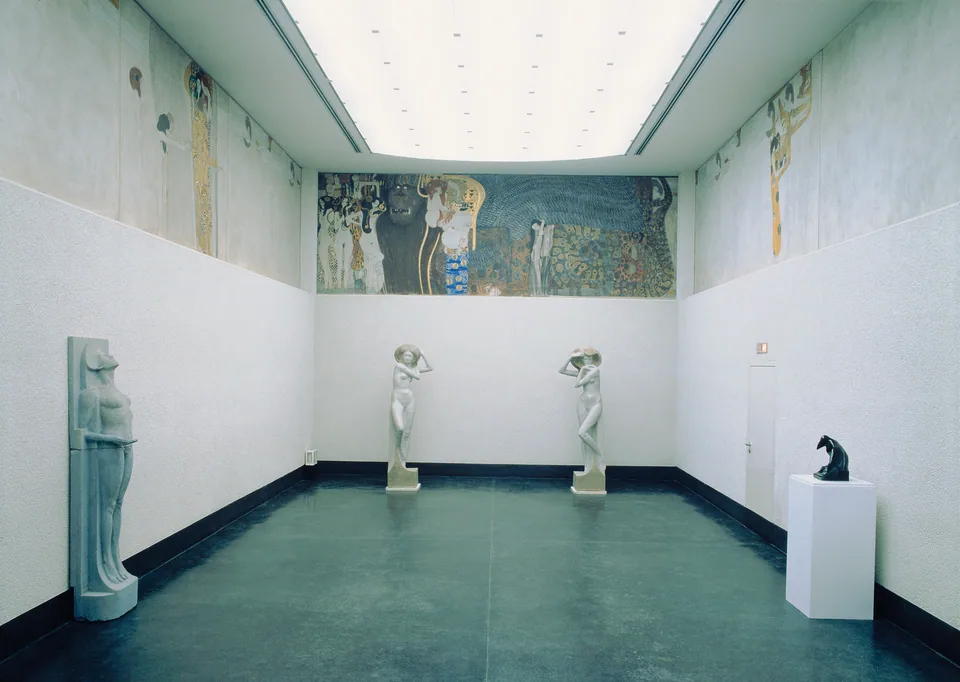
The Beethoven Frieze is a monumental wall painting that Gustav Klimt created for a Vienna exhibition in 1902. Measuring over thirty-four meters wide and standing more than two meters high, the cycle spreads across three walls in a U-shape. Klimt executed the painting directly on plaster, using casein paint, chalk, graphite, and gold leaf. The total structure weighs about four tons.
Because organizers planned the work as an ephemeral installation, Klimt left large areas of the raw plaster exposed. The unpainted plaster provides a pale ground that contrasts with dark graphite lines and bright metallic sheets. This extensive surface gilding anticipated Klimt’s golden phase, during which metal leaf became central to his studio canvases.
The physical scale creates an expansive environment for the viewer. Standing in front of the frieze, you look up at figures arranged in rhythmic bands near the top of the wall. The lower sections remain open, allowing the bare plaster to guide your eyes along the room.
The 1902 Beethoven exhibition
Klimt created the frieze for the Fourteenth Exhibition of the Vienna Secession, an artist group he helped found. The 1902 show celebrated the seventy-fifth anniversary of the death of Ludwig van Beethoven. Architect Josef Hoffmann designed the interior as a unified artistic environment, or Gesamtkunstwerk, bringing together architecture, painting, and sculpture under one roof.
At the physical core of Hoffmann’s installation stood a monumental polychrome sculpture of Beethoven carved by Max Klinger. Klimt designed his frieze to wrap around the upper walls of an adjoining side gallery, framing Klinger’s seated figure through open doorways. Today, Klinger’s sculpture sits in the Museum der bildenden Künste in Leipzig rather than in Vienna.
Music played an active role in the exhibition’s opening events. On April 14, 1902, conductor Gustav Mahler led a performance on the eve of the public opening. Mahler arranged the concluding choral movement from Beethoven’s Ninth Symphony, the ‘Ode to Joy’, for a large wind ensemble and timpani to suit the acoustic properties of the Secession hall.
Art historians frequently connect Mahler to the visual figures in the gallery. The standing golden knight on the frieze’s first wall is often interpreted as an allegorical portrait of Mahler himself. Through this link, Klimt tied the musical director of Vienna to the heroic struggles depicted across the room.
Reading the frieze wall by wall
The narrative of the cycle translates Beethoven’s Ninth Symphony into visual form, following an interpretive program inspired by composer Richard Wagner. You read the story sequentially, beginning on the long wall to the left, moving across the short end wall, and concluding on the right wall.
On the left wall, the narrative begins with ‘The Longing for Happiness’. Pale, floating female figures drift along the upper edge, representing the human soul in search of fulfillment. Below them, naked figures representing suffering humanity kneel and stretch out their hands. They plead with an armored golden knight to fight on their behalf, supported by two female figures personifying Ambition and Compassion.
The central wall shifts from quiet yearning to open confrontation under the title ‘Hostile Forces’. In the middle sits Typhoeus, an ape-like giant with snake tails and feathered wings, flanked by the three Gorgons. Mask-like heads hovering near Typhoeus embody Sickness, Madness, and Death.
To the right of Typhoeus, Klimt depicted personifications of human vices: Lust, Unchastity, Intemperance, and Nagging Grief. Enclosed within these figures are visual allusions to physical and moral decay, including references to lust and syphilis. Art historians note that these raw, angular figures prefigure the expressive treatment of human bodies seen years later in Pablo Picasso’s Les Demoiselles d’Avignon.
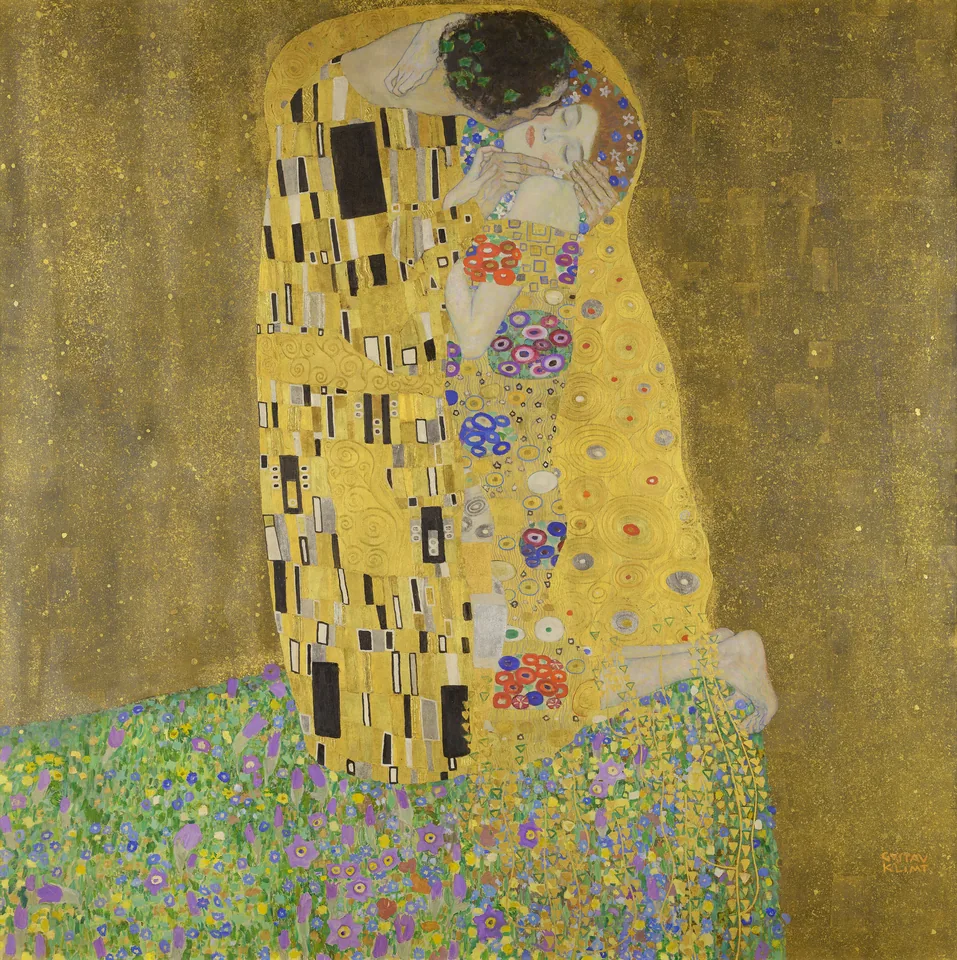
The right wall brings the struggle to a peaceful conclusion through Poetry and the Arts. A solitary female figure plucks a lyre, directing humanity away from physical torment toward creative expression. Beyond her, a paradise choir sings in decorative robes, leading directly to an embracing couple. This final embrace visualizes the climactic line of Beethoven’s Ninth Symphony, representing a kiss for all humanity.
Prints of these narrative panels are available in our collection of friezes. Prints are printed and shipped by ArtsyWall in three formats: Premium Canvas, Framed Canvas, and Archival Paper.
From temporary wall to permanent display
Secession organizers never intended the frieze to survive past the 1902 exhibition. Because Klimt applied light materials directly onto fragile wall plaster, the entire cycle faced demolition once the show ended. Art collector Carl Reininghaus stepped in to save the artwork, purchasing the frieze. Different accounts place this purchase in 1903 or 1907.
To preserve the painting, workers sawed the walls into seven separate sections. In gratitude for rescuing the cycle from destruction, Klimt gave Reininghaus more than one hundred preparatory sketches. In 1915, Austrian industrialist August Lederer purchased the frieze upon the encouragement of his wife, Serena Lederer. The Lederer family retained the work until the German annexation of Austria in 1938.
During the annexation, Nazi authorities expropriated the property of the Jewish Lederer family, forcing Serena Lederer to flee to Hungary. Sources give different accounts of where the frieze spent World War II. German records state it was stored at Schloss Thürnthal, while Allied records state recovery teams found it stored inside the salt mine at Altaussee in 1945.
After the war, Austrian authorities returned ownership of the damaged cycle to Serena’s son, Erich Lederer. However, the Austrian Federal Monuments Office blocked his export applications under national heritage protection laws. In 1973, Erich Lederer agreed to sell the frieze to the Republic of Austria at a price below its estimated market value in exchange for export licenses for other Klimt works.
Because workers had cut the frieze from the wall and moved it multiple times, the plaster sustained severe damage. Restorer Manfred Koller of the Federal Monuments Office led a comprehensive, state-funded restoration campaign that lasted ten years. He stabilized the brittle plaster, cleaned the paint surface, and consolidated the delicate gold leaf.
In 2013, the heirs of Erich Lederer submitted a formal restitution claim for the cycle under amended Austrian restitution laws. They argued that the post-war export ban had coerced Lederer into the 1973 agreement. In March 2015, the Austrian Art Restitution Advisory Board rejected the claim, determining that Erich Lederer had negotiated the sale voluntarily and that the legal transfer remained valid.
How to see the Beethoven Frieze
To see the cycle in person, you can visit the Secession Building in central Vienna. If you are planning a tour of Austrian museums, our guide on where to see Klimt maps out the key locations holding his work. The frieze has occupied its current position in the basement of the Secession hall since 1986.
The display room was custom-built in 1985 as a climate-controlled gallery beneath the main exhibition floor. The Österreichische Galerie Belvedere owns the frieze and placed it on permanent loan to the Secession to ensure proper environmental stability. The room reconstructs the original U-shaped layout, allowing you to walk along the walls in the same sequence visitors experienced in 1902.
Walking along the basement gallery lets you inspect the physical textures of Klimt’s materials up close. You can see the chalk marks, graphite outlines, and thin washes of casein paint set against the raw white plaster. The reflective surfaces of the gold leaf still catch the gallery light, giving the narrative figures a distinct, luminous presence.
Questions and answers
Where is the Beethoven Frieze?
The Beethoven Frieze is located in the Secession Building in Vienna, Austria. It hangs in a dedicated, climate-controlled basement exhibition space created specifically for the cycle in 1985. The artwork belongs to the Belvedere collection, which placed the restored wall painting on permanent loan to the Secession for public display starting in 1986.
What does the Beethoven Frieze represent?
The Beethoven Frieze represents humanity's search for joy, translating Ludwig van Beethoven's Ninth Symphony into visual allegories based on Richard Wagner's commentary. Across three connected walls, the cycle illustrates suffering figures petitioning an armored knight, the destructive hostile forces that threaten mankind, and the ultimate arrival at spiritual redemption through poetry, music, and an embracing choir.
Why did Klimt paint the Beethoven Frieze?
Gustav Klimt painted the Beethoven Frieze for the Fourteenth Vienna Secession exhibition held in 1902. The artists organized the event to commemorate the seventy-fifth anniversary of Ludwig van Beethoven's death. Klimt designed the large picture cycle as an ephemeral decorative frieze to frame a monumental polychrome statue of the composer created by sculptor Max Klinger.
Can you see the Beethoven Frieze in Vienna?
You can see the Beethoven Frieze in Vienna inside the Secession Building, where it has been open to visitors since 1986. The frieze stands in a specially constructed basement gallery designed to preserve its fragile materials. Viewers can observe all three walls of the monumental cycle arranged in their original U-shaped layout beneath controlled lighting conditions.