Woman in Gold: Klimt's Portrait of Adele Bloch-Bauer
Woman in Gold is the common name of Gustav Klimt's Portrait of Adele Bloch-Bauer I, completed in 1907. The painting hangs today on permanent public display at the Neue Galerie New York.
What the painting shows
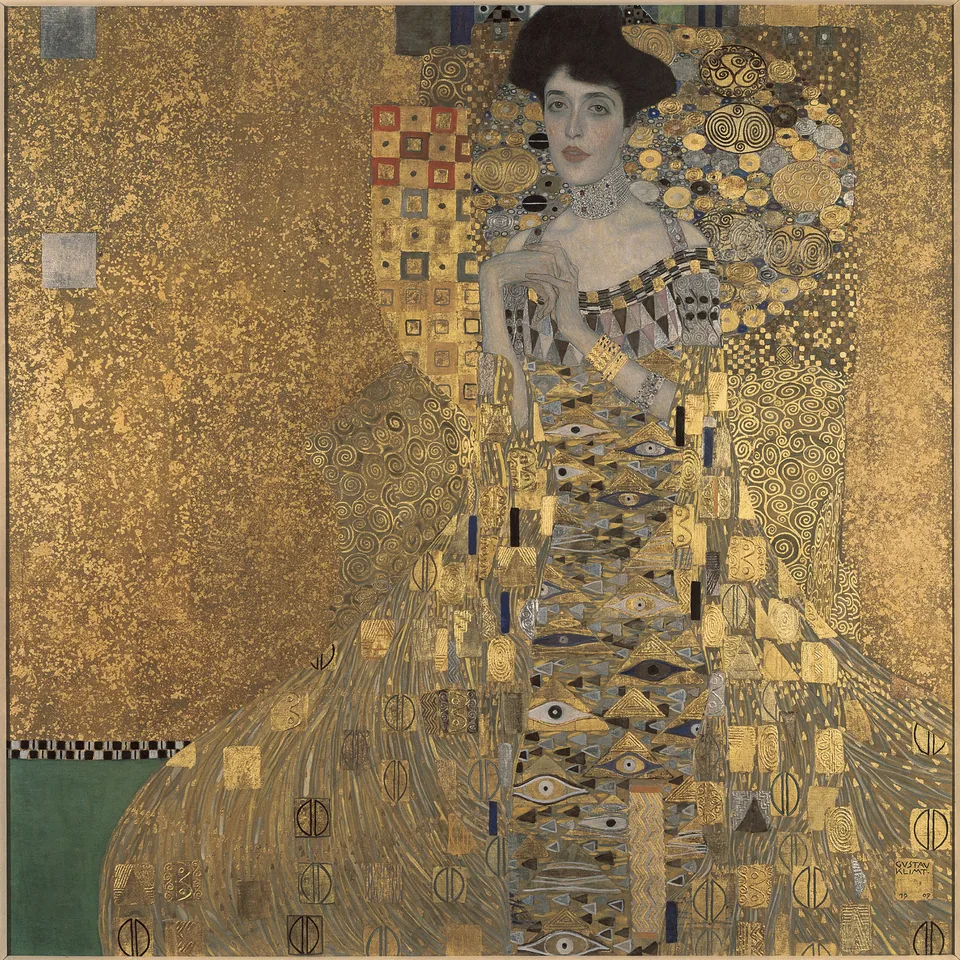
Woman in Gold is the common name of Portrait of Adele Bloch-Bauer I, painted by Gustav Klimt between 1903 and 1907, which hangs today at the Neue Galerie New York. Klimt created the portrait using oil paint, silver leaf, and gold leaf on canvas. The canvas is square and measures 138 by 138 cm. Architect Josef Hoffmann designed the gold-leaf frame that surrounds the composition.
When you look at the portrait, you see Adele Bloch-Bauer sitting against a field of gold. Her dark hair rises in an upswept roll above pale skin, rosy cheeks, and dark eyes. Her hands are clasped lightly in front of her chest, with her fingers curved in an unusual position. The realistic treatment of her head, throat, and hands contrasts with the flat, decorative shapes across the rest of the canvas.
Klimt executed much of the portrait using an elaborate technique of applying gold and silver leaf. He created bas-relief decorative motifs across the surface using gesso under the metallic leaf. You can observe rows of shapes resembling eyes, along with triangles, squares, and spirals on her gown. These decorative motifs merge into the golden background, making the chair and dress blend into one flat surface.
Klimt drew his inspiration for this gold ornamentation after studying early-Christian Byzantine mosaics at the Basilica of San Vitale in Ravenna in December 1903. In Ravenna, he observed walls covered in glass and gold tesserae. This encounter influenced his famous /golden-phase/, during which metallic leaf defined his primary work. The gold surfaces in the painting capture light from different angles, giving the work a shifting appearance as you move past it.
Who Adele Bloch-Bauer was
Adele Bauer was born in Vienna, Austria-Hungary, on August 9, 1881. Her parents were Moritz Bauer, a director of railways and banks, and Jeannette Honig Bauer. On December 19, 1899, eighteen-year-old Adele married Ferdinand Bloch, a banker and sugar manufacturer. Both Adele and Ferdinand changed their surnames to Bloch-Bauer upon their marriage.
In mid-1903, Ferdinand Bloch-Bauer commissioned Gustav Klimt to paint a portrait of Adele as an anniversary present for her parents. Klimt completed the painting between 1903 and 1907. This commission started an enduring relationship between the family and the artist.
Adele Bloch-Bauer hosted regular salons at her Vienna residence. She brought together intellectuals, politicians, and artists, including Gustav Mahler and Richard Strauss. Her home served as an important meeting place for the cultural figures of Vienna.
Adele holds a singular position among the subjects described in our guide on /klimt-women/. She is the only verified person painted twice in full length by Gustav Klimt. In 1912, Ferdinand commissioned a second full-length portrait of his wife.
Adele died of meningitis on January 24, 1925, in Vienna. Two years before her death, in her 1923 will, Adele asked Ferdinand to bequeath her two portraits and four landscapes by Klimt to the Austrian State Gallery upon his death. Ferdinand kept the paintings during his lifetime, retaining legal ownership of the collection.
Seized, renamed and hung in the Belvedere
Ferdinand Bloch-Bauer fled Vienna in March 1938 after the Nazi Anschluss. He eventually moved into exile in neutral Switzerland. He had to leave behind his estate and his private art collection in Vienna.
The Nazi regime falsely accused Ferdinand Bloch-Bauer of tax evasion, freezing his assets and issuing a property seizure order in May 1938. Nazi officials used these false charges to confiscate his property, bank holdings, and artwork under state control.
Nazi lawyer Friedrich Führer was appointed administrator of Ferdinand’s estate. German Wikipedia identifies the state-appointed administrator of Ferdinand Bloch-Bauer’s property as lawyer Erich Führer. The administrator cataloged the collection and distributed pieces to Nazi leaders including Adolf Hitler and Hermann Göring. Göring seized Adele Bloch-Bauer’s jewelled choker, which Ferdinand had given to Maria Altmann as a wedding present, and gave it to his wife Emmy.
In December 1941, administrator Friedrich Führer transferred Portrait of Adele Bloch-Bauer I and the landscape Apfelbaum I to the Galerie Belvedere in exchange for another artwork. The Galerie Belvedere renamed the painting to the German title Dame in Gold. This change was made to remove references to the Jewish subject of the portrait.
Ferdinand Bloch-Bauer died in Switzerland in November 1945. German Wikipedia records that Ferdinand died in Zurich on November 13, 1945. In an August 1945 will that revoked previous wills, Ferdinand left his estate to his nephew and two nieces.
Following the war, the Austrian government kept the stolen artworks in state custody. Post-war Austrian authorities required the Bloch-Bauer heirs to surrender both Adele portraits and two landscapes to the Galerie Belvedere to secure export permits for other artworks. The Galerie Belvedere retained the Klimt paintings based on the precatory clause in Adele Bloch-Bauer’s 1923 will.
Maria Altmann and the fight to get it back
In 1998, Austrian investigative journalist Hubertus Czernin discovered that Ferdinand Bloch-Bauer had never donated the Klimt paintings to the Galerie Belvedere. Czernin’s research revealed that the Austrian state had used export restrictions to coerce the family after the war. The archival documents proved that the paintings had remained Ferdinand’s legal property.
Maria Altmann, Ferdinand’s niece, hired lawyer E. Randol Schoenberg to reclaim five Klimt paintings stolen by the Nazis from her family. Altmann lived in California and sought the full return of her family’s heritage. Schoenberg opened talks with the Austrian government to secure the restitution of the collection.
Altmann initially pursued legal remedies within Austria. Altmann dropped her lawsuit in Austria because statutory court filing fees, proportional to the paintings’ estimated value, were prohibitively expensive. After withdrawing the Austrian filing, Altmann and Schoenberg turned to the legal system in the United States.
In 2000, Altmann filed a civil lawsuit against Austria and the Galerie Belvedere in a United States federal court under the Foreign Sovereign Immunities Act. Austria argued that American courts had no right to judge actions taken by foreign nations decades in the past. The case moved through federal appeals until it reached the Supreme Court.
In June 2004, the U.S. Supreme Court held in Republic of Austria v. Altmann that the Foreign Sovereign Immunities Act applied retroactively. This ruling allowed Altmann’s lawsuit against Austria to proceed in American federal court. Austria was forced to defend its possession of the artworks or reach an alternative resolution.
Maria Altmann and the Austrian government agreed to submit the restitution claim to a binding three-member Austrian arbitration panel. On January 16, 2006, the Austrian arbitration panel ruled that five Klimt paintings had been stolen and must be returned to the Bloch-Bauer heirs. German Wikipedia dates the Austrian arbitration tribunal’s restitution decision to January 15, 2006.
The arbitration panel determined that Ferdinand Bloch-Bauer, not Adele, was the legal owner of the paintings. Because Ferdinand paid for and owned the canvases, Adele’s precatory will was non-binding on his estate. The legal title had passed directly to Ferdinand’s heirs under his 1945 will.
Austria returned the five Klimt paintings to Maria Altmann and the heirs, and they were exported from Austria in March 2006. German Wikipedia notes the five paintings were transported to Los Angeles on February 14, 2006, following Austria’s decision not to exercise its purchase option. From April to June 2006, the five reclaimed Klimt paintings were exhibited together at the Los Angeles County Museum of Art.
Where the Woman in Gold hangs today
In June 2006, Ronald Lauder purchased Portrait of Adele Bloch-Bauer I, paying what was at the time a record price for a painting. Lauder placed Portrait of Adele Bloch-Bauer I in the Neue Galerie New York, the museum he co-founded in 2001, where it remains on permanent public display.
You can visit the Neue Galerie on Fifth Avenue in Manhattan to view the portrait in person. Seeing the painting in person lets you observe how the silver and gold leaf catch the gallery light. You can learn about other institutions displaying Klimt’s work in our guide covering /where-to-see-klimt/.
In November 2006, Christie’s auctioned the remaining four returned Klimt paintings for the family heirs. That sale returned four rare canvases to private and museum collections around the world. Original works by Klimt appear at auction only rarely, as we explore in our article on how collectors /buy-original-klimt/.
Adele Bloch-Bauer II
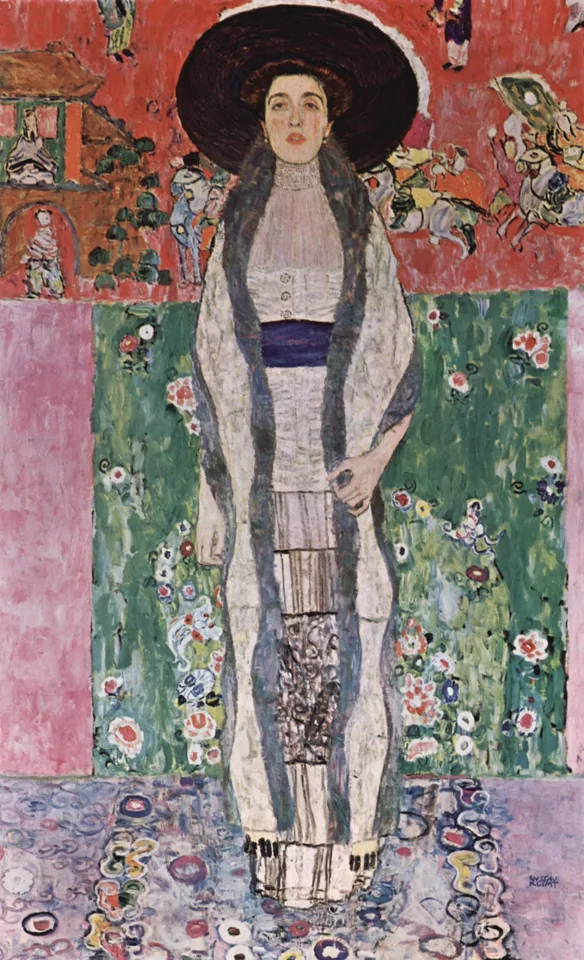
In 1912, Ferdinand Bloch-Bauer commissioned Gustav Klimt to paint a second portrait of his wife, titled Portrait of Adele Bloch-Bauer II. Portrait of Adele Bloch-Bauer II is an oil painting on canvas measuring 190 cm in height and 120 cm in width. It shows Adele standing in full length wearing a wide-brimmed dark hat and a long dress.
Adele Bloch-Bauer is the only verified person painted twice in full length by Gustav Klimt. The second portrait displays vibrant colors, floral patterns, and loose brushstrokes that reflect the later career of /gustav-klimt/. The heavy gold leaf of the previous decade gave way to an open, colorful palette.
In November 2006, Christie’s sold Portrait of Adele Bloch-Bauer II at auction to buyer Oprah Winfrey. Winfrey held the portrait in her private collection for nearly a decade. During her ownership, she allowed the public to see the work by lending it to a major institution.
Oprah Winfrey placed Portrait of Adele Bloch-Bauer II on a long-term loan to the Museum of Modern Art in New York from 2014 to 2016. During the summer of 2016, Oprah Winfrey sold Portrait of Adele Bloch-Bauer II to an unidentified Chinese buyer. German Wikipedia reports that Adele Bloch-Bauer II was purchased by a Chinese billionaire in 2017.
Portrait of Adele Bloch-Bauer II was reunited with Portrait I at the Neue Galerie from September 2016 to January 2017 for an exhibition on Vienna’s Golden Age. This temporary show allowed visitors to view both full-length portraits of Adele together in the same room.
The film Woman in Gold
The 2015 biographical drama film Woman in Gold was directed by Simon Curtis and written by Alexi Kaye Campbell. Woman in Gold is based on the true story of Maria Altmann’s nearly decade-long legal fight to reclaim Gustav Klimt’s Portrait of Adele Bloch-Bauer I from Austria.
Helen Mirren starred as Maria Altmann and Ryan Reynolds starred as her lawyer E. Randol Schoenberg in Woman in Gold. Tatiana Maslany portrayed the younger Maria Altmann, while Antje Traue played Adele Bloch-Bauer in flashbacks. The film’s cast also includes Daniel Brühl, Katie Holmes, Max Irons, Charles Dance, Elizabeth McGovern, and Jonathan Pryce.
While the movie reflects real events, it contains several historical inaccuracies. Journalist Olga Kronsteiner noted that Austrian journalist Hubertus Czernin discovered the crucial documents and alerted Altmann, contrary to the film’s depiction of Schoenberg initiating the research.
The courtroom scenes also depart from the historical record. The film depicts Chief Justice William Rehnquist being persuaded by Schoenberg, whereas Rehnquist dissented from the decision and Justice David Souter asked the portrayed oral argument questions. In personal history, Altmann did not abandon her ailing father in 1938 as shown in the movie; she remained in Vienna until he died of natural causes in July 1938.
Questions and answers
Where is the Klimt painting Woman in Gold now?
Portrait of Adele Bloch-Bauer I, known as the Woman in Gold, hangs today at the Neue Galerie New York. Ronald Lauder acquired the painting in 2006 and placed it in the museum he co-founded in 2001. Visitors can view the work there on permanent public display alongside other Austrian and German artworks in Manhattan.
Who owns the Woman in Gold painting now?
Ronald Lauder purchased Portrait of Adele Bloch-Bauer I in June 2006 and placed it on permanent display at the Neue Galerie New York. Lauder co-founded the Neue Galerie in 2001. The painting remains in the museum collection in New York, where the public can see it rather than in a private, closed residence.
Who was Adele Bloch-Bauer?
Adele Bloch-Bauer was a Viennese salon host born to Moritz Bauer and Jeannette Honig Bauer in 1881. In 1899, she married Ferdinand Bloch, a banker and sugar manufacturer. She hosted intellectuals, politicians, and artists such as Gustav Mahler and Richard Strauss at her Vienna home before dying of meningitis on January 24, 1925.
Is the movie Woman in Gold a true story?
The 2015 film Woman in Gold is based on the true story of Maria Altmann reclaiming Gustav Klimt's Portrait of Adele Bloch-Bauer I from Austria. However, the film altered several facts. For instance, journalist Hubertus Czernin discovered the key archival documents rather than lawyer E. Randol Schoenberg, and Maria Altmann stayed in Vienna until her father died in July 1938.
Which Klimt did Oprah own?
Oprah Winfrey owned Gustav Klimt's 1912 painting Portrait of Adele Bloch-Bauer II. Christie's auctioned the second portrait in November 2006 to Winfrey. She placed the canvas on a long-term loan to the Museum of Modern Art in New York from 2014 to 2016, before selling it to an unidentified Chinese buyer in 2016.