Emilie Flöge: Klimt's Companion and Muse
Emilie Flöge was an Austrian couturière, fashion designer, and the lifelong companion of Gustav Klimt. She ran Vienna's Schwestern Flöge salon and inspired some of Klimt's most celebrated portraits.
Who Emilie Flöge was
Emilie Flöge was an Austrian fashion designer, businesswoman, and the lifelong companion of Gustav Klimt. She led one of Vienna’s most progressive fashion salons and introduced loose reform clothing that freed women from corsets. When you study the Viennese avant-garde, Flöge stands out as a creative professional who built an independent commercial career.
She was born Emilie Louise Flöge in Vienna on 30 August 1874. Her father, Hermann Flöge, was a master turner and manufacturer of Meerschaum pipes. She grew up with two older sisters, Pauline and Helene, and a brother named Hermann.
Flöge began her career as a seamstress. In 1894, she worked at a dressmaking school opened by her sister Pauline. Her technical skill developed rapidly over the following years. In 1899, Emilie and Pauline won a dressmaking competition and earned a commission to make a batiste exhibition dress. That same year, Flöge handmade the wedding dress for the mother of Maria Altmann. These early successes established her reputation as a skilled couturière.
Emilie Flöge and Klimt
The connection between Emilie Flöge and Gustav Klimt started through family ties in 1891. In that year, Emilie’s sister Helene married Klimt’s brother, Ernst Klimt. When Ernst died in December 1892, Gustav was appointed Helene’s guardian and the guardian of her infant daughter. Klimt became a frequent visitor at the Flöge home when Emilie was eighteen years old.
Their friendship developed into a lifelong bond. English Wikipedia describes Flöge as the life companion of Gustav Klimt. German Wikipedia notes that while many assume Flöge was Klimt’s companion and muse, there is no direct evidence to prove it. Biographers describe their connection as an intellectual and emotional intimacy rather than a physical relationship.
Klimt portrayed Flöge in numerous drawings and studies after 1891. She occupies a distinct position among the women in Klimt’s paintings. Her presence influenced his approach to pattern, ornament, and modern female identity.
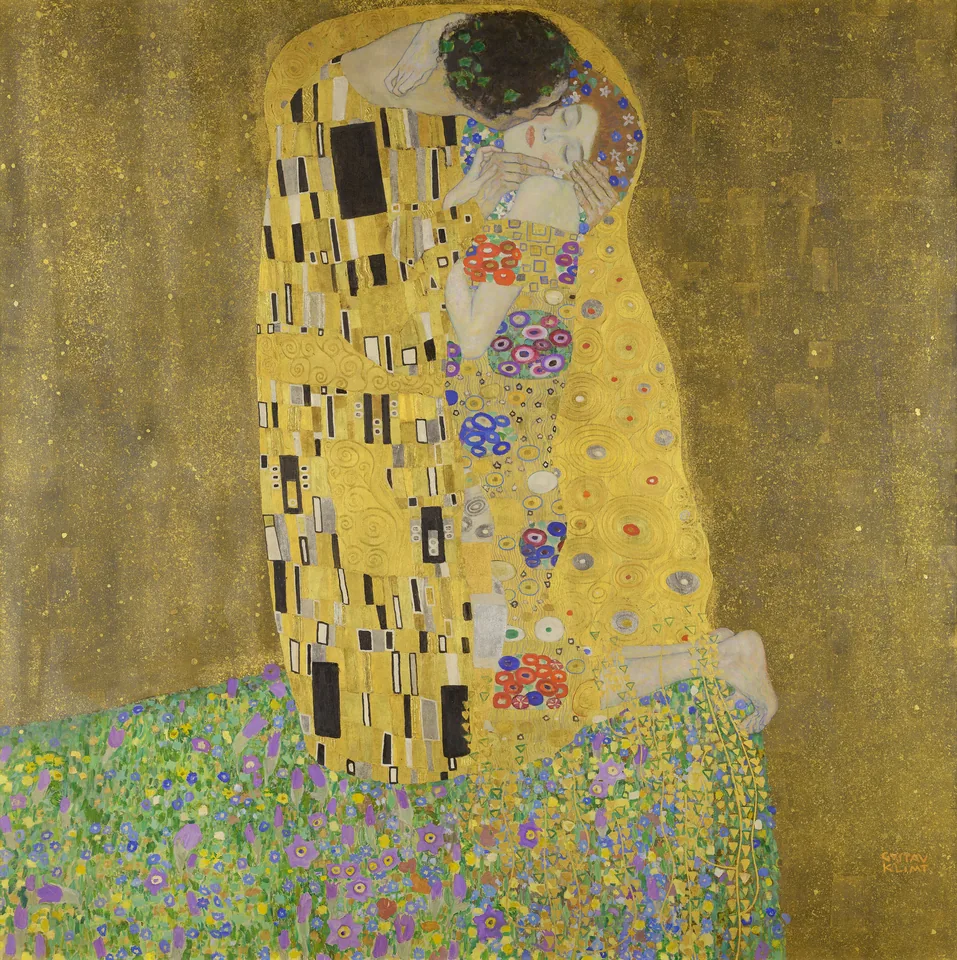
Art experts frequently debate whether Klimt pictured Flöge in his most famous canvas. Experts consider that Klimt depicted Emilie Flöge and himself as the lovers in The Kiss. Other historians disagree and note that the sheet does not settle the question. It is not known with certainty whether Flöge modeled for the woman in that painting.
The Schwestern Flöge fashion salon
In 1904, Emilie Flöge established the haute couture salon Schwestern Flöge with her sisters Helene and Pauline. The salon operated at Casa-Piccola-Haus at Mariahilfer Strasse 1b in central Vienna. The architect Josef Hoffmann designed the salon’s interior in the Jugendstil manner. Flöge used this setting to present garments designed in the style of the Wiener Werkstätte.
The boutique grew into a major commercial enterprise. At its peak, the salon employed up to 80 seamstresses. Flöge traveled to Paris and London to observe new fashion developments from designers such as Coco Chanel and Christian Dior. Klimt helped her business by introducing Flöge to wealthy upper-class Viennese women whose portraits he painted, providing her with a prosperous clientele.
Flöge became celebrated for designing bespoke reform dresses. These garments had high bodices, wide billowing sleeves, and loose silhouettes worn without corsets. The Viennese feminist movement promoted the reform dress because it improved women’s health and physical mobility.
Historical records present differing views on who designed these garments. German sources state that Klimt designed several reform dresses for the salon. English sources state that Klimt drawing garments is often discounted in favor of the Flöge sisters designing them themselves. Because the market for reform garments was small, Flöge earned her primary living by producing conventional styles. The salon operated successfully until 1938, when the Anschluss forced Flöge to close her doors after losing her core clients.
The 1902 portrait
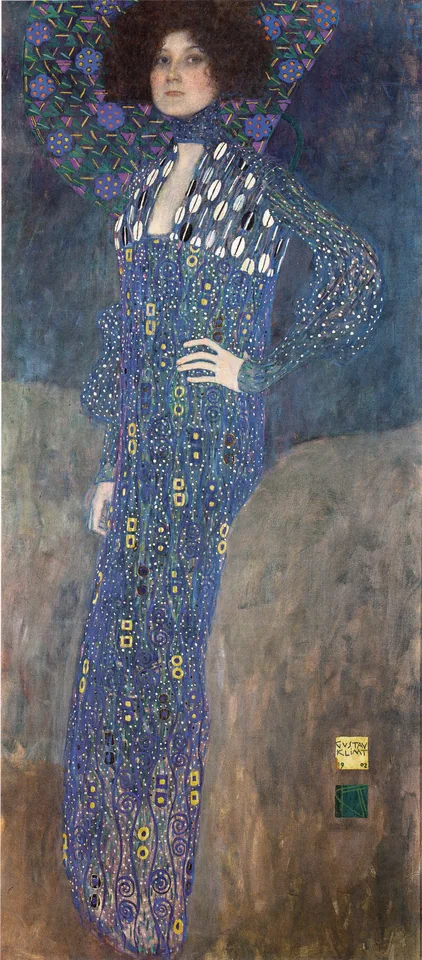
Klimt began his full-length Portrait of Emilie Flöge in 1902 and completed it by the summer of 1908. The oil painting measures 181 centimeters high and 84 centimeters wide. It shows Flöge standing in a tall, narrow composition against a mottled background.
Flöge wears a long, blue-mottled reform dress of her own design. Klimt filled the blue fabric with rows of spirals, small dots, and gold squares. He applied genuine silver and gold leaf directly to the decorative bands of the garment. Flöge looks directly at the viewer with her hands resting lightly near her hips, creating a calm and confident silhouette.
The painting debuted in November 1903 at the Vienna Secession’s Klimt Kollektiv exhibition under the title Bildnis einer Dame. Neither Flöge nor Klimt felt satisfied with the finished piece. Flöge did not like the portrait, and her family declined to hang it in their residence. Klimt promised to paint another portrait of Emilie Flöge, but he never produced one.
In 1904, Klimt offered to sell the painting to the Imperial and Royal Ministry of Culture and Education. He sold it in the summer of 1908. English Wikipedia notes that he sold it to the Lower Austria Museum, while German Wikipedia states it was sold to the Historical Museum of the City of Vienna. The portrait transferred to Vienna’s municipal collections in 1921 and remains on permanent display at the Vienna Museum.
If you want this portrait for your home, prints are printed and shipped by ArtsyWall in Premium Canvas, Framed Canvas, and Archival Paper. The tall proportions fit well on narrow walls, entryways, or adjacent to full-height windows.
Summers at the Attersee
Gustav Klimt spent his summers with the Flöge family at Lake Attersee in upper Austria. Records document that Klimt and Flöge spent the summers from 1910 to 1916 together at the lake. The rural landscape provided both of them a quiet retreat from their demanding work in Vienna.
While at the lake, Klimt stepped away from commissioned portraiture to paint outdoor scenes. He painted orchards, church towers, and the shimmering surface of the water, which you can read about in our guide to Klimt’s landscapes and the Attersee. Flöge accompanied him on these walks and boat excursions.
Numerous photographs document Klimt together with Emilie Flöge and her family during these holidays. The images show Klimt in his dark blue painting robe and Flöge in loose, patterned reform dresses. These private snapshots record their easy companionship away from urban society.
After Klimt’s death
Gustav Klimt suffered a stroke and died on 6 February 1918. His reported final words before passing were, “Emilie must come.” His death brought an end to a close personal partnership that had spanned more than a quarter of a century.
Flöge inherited half of Klimt’s estate, while the artist’s family received the other half. In her home, Flöge kept a locked room dedicated to Klimt’s memory. Inside, she preserved many of his personal belongings alongside hundreds of his drawings.
From 1938 until her death, Flöge lived and worked on the top floor of 39 Ungargasse in Vienna. In the final days of World War II, a fire broke out at the Ungargasse building. The fire destroyed Flöge’s collection of historical garments as well as the personal objects from Klimt’s estate.
Emilie Flöge died in Vienna on 26 May 1952 at the age of seventy-seven. Historical sources differ slightly on her burial place. English records state that she was buried in the Flöge-Donner family grave at the Protestant Cemetery in Simmering on 30 May 1952. German records state that she was laid to rest in the Flöge sisters’ family grave in the Protestant section of Vienna Central Cemetery.
Questions and answers
Who was Emilie Flöge?
Emilie Flöge was an Austrian couturière, fashion salon owner, and the close life companion of Gustav Klimt. Born in Vienna in 1874, she managed the haute couture salon Schwestern Flöge with her sisters Helene and Pauline. She became famous for designing loose reform dresses without corsets, and she collaborated closely with Klimt until his death in 1918.
Was Emilie Flöge Klimt's wife?
No, Emilie Flöge was never married to Gustav Klimt. Historical records describe her as Klimt's life companion, but their relationship was an emotional and intellectual bond rather than a physical or legal marriage. Flöge first met Klimt through her sister Helene, who married Klimt's brother Ernst in 1891. Flöge remained an independent businesswoman throughout her lifetime.
Where is the portrait of Emilie Flöge?
The 1902 Portrait of Emilie Flöge hangs on permanent display at the Vienna Museum in Austria. Gustav Klimt began the life-size painting in 1902 and completed it by 1908. After the artist sold the canvas in 1908, it entered Vienna's municipal art collections in 1921. Visitors can see the original oil painting, which features silver and gold leaf detailing, in the museum today.
Is Emilie Flöge in The Kiss?
Historical sources do not confirm whether Emilie Flöge is depicted in The Kiss. Many art experts consider that Gustav Klimt painted Emilie Flöge and himself as the lovers in the 1907–1908 work. Other scholars dispute this idea because Klimt left no written record identifying the couple. Her role as the female figure in the painting remains an open debate among art historians.