Select the painting to see it full screen and zoom in.
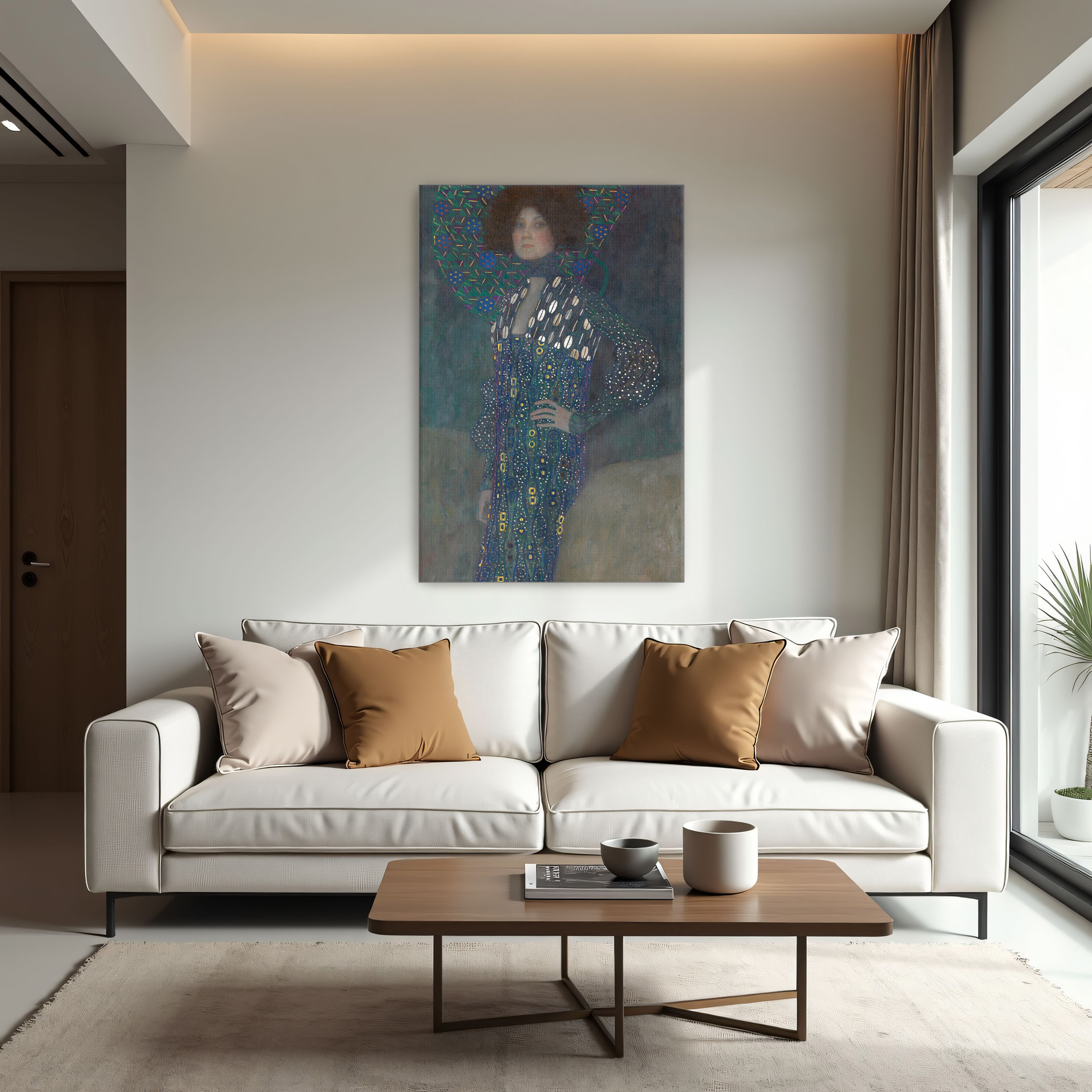
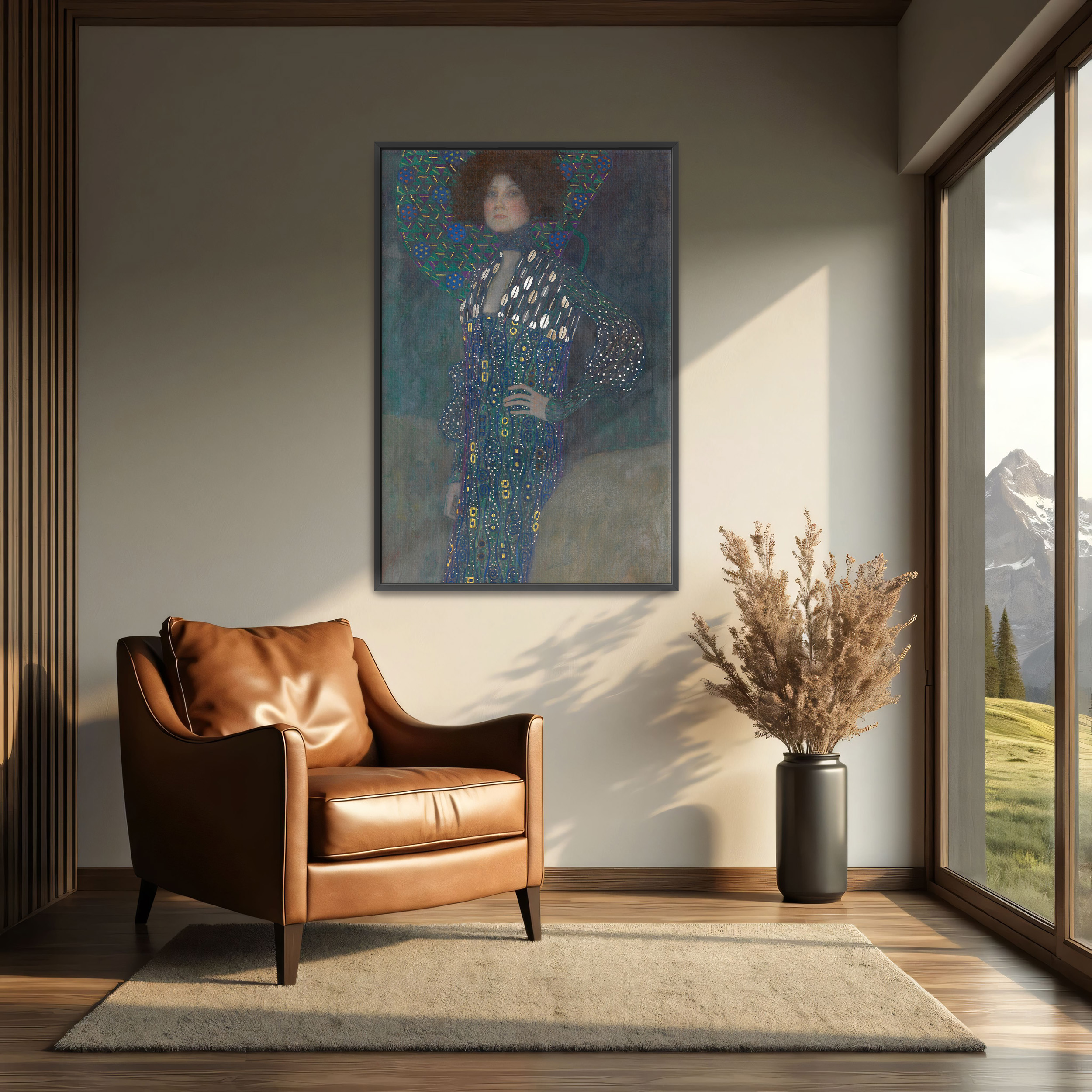
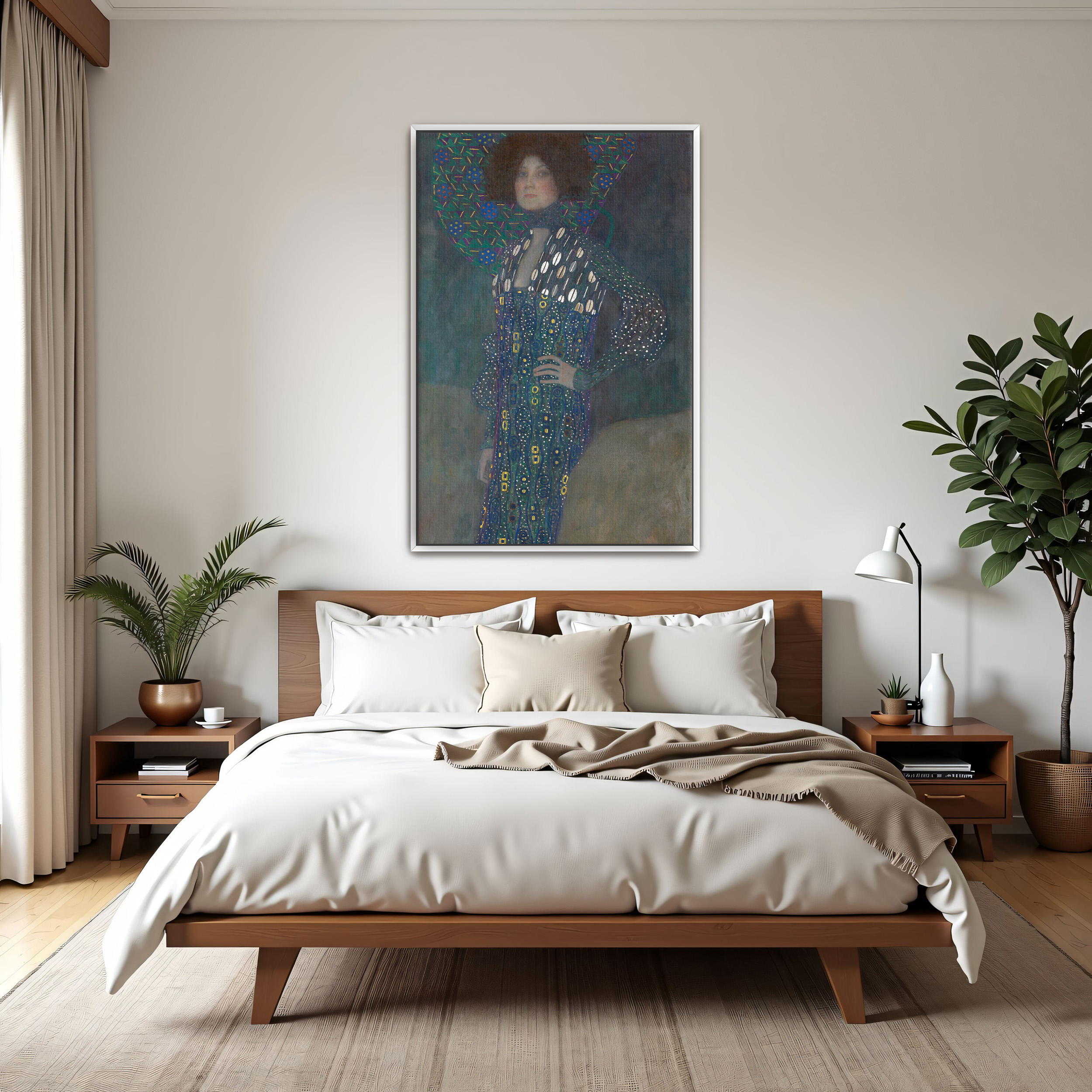
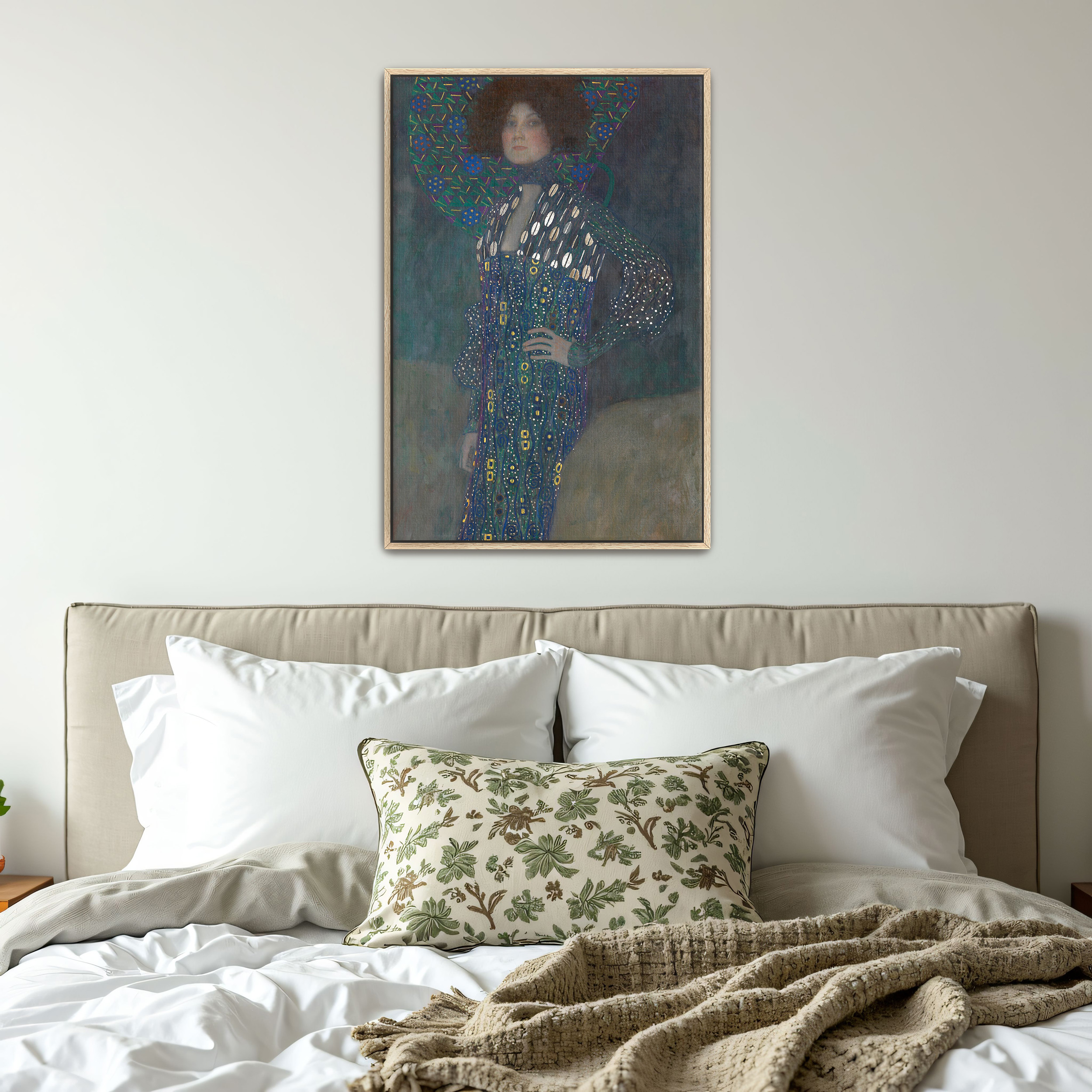
Portrait of Emilie Flöge as a print, in a room
What the painting shows
Portrait of Emilie Flöge by Klimt is an oil on canvas begun in 1902 and completed by the summer of 1908. Klimt presents his close companion Emilie Flöge standing in a tall, life-size composition measuring 181 by 84 centimeters. Her elongated, two-dimensional silhouette stands out against an unspecified, muted blue-green background.
Flöge wears a long, blue-mottled robe of her own design. The garment represents the reform dress movement, which offered women an artistic, loose-fitting alternative to tight corsets. Klimt covered the blue fabric with dense ornamentation, painting delicate spirals, gold squares, and field patterns of yellow and white dots. Along the collar and chest, he set vertical rows of black and white oval motifs. Klimt also applied individual decorative pieces in genuine silver and gold leaf directly to the canvas, anticipating techniques from his upcoming gold period.
Her finely modeled, naturalistic face contrasts sharply with the flat geometry of her body. Flöge rests her left hand on her hip and looks directly out at you, framed by a wide crown of dark hair. Behind her head sits a decorative floral halo filled with green, red, and blue flowers. Art historian Angela Wenzel notes this element resembles a Japanese leaf fan that balances the foreground figure. In the lower right corner, two small squares rest on the ground. One contains Klimt’s painted signature and the date 1902, while the other holds his monogram. Frank Whitford pointed out that these blocks recall Japanese seal stamps and demonstrate how Japanese woodblock prints shaped Klimt’s visual language.
Because this work was not a paid commission, Klimt felt free to abandon conventional formulas found in traditional society portraits. When exhibited in 1903, art critic Ludwig Hevesi praised the painting as reflecting a blue-coloured world of majolica and mosaic. Critic Berta Zuckerkandl observed that the wreath of blossoms around the head carried a Byzantine colour mysticism.
Who the sitter was
Emilie Flöge was a prominent Austrian fashion designer, business owner, and model. She met Klimt around 1891, when his brother Ernst Klimt married her sister Helene. Following Ernst’s sudden death in December 1892, Gustav became the legal guardian of his brother’s young daughter and began spending regular summers with the Flöge family at Lake Attersee.
Over the following decades, Klimt and Flöge formed a lasting partnership based on emotional and intellectual intimacy. Klimt dated this canvas 1902, when Flöge was twenty-eight years old. Although fashionable Viennese women visited their studios to order similar garments after seeing the portrait, Klimt felt he had failed to capture her true charm. Neither Klimt nor Flöge was completely satisfied with the result. Flöge’s family disliked the work and declined to hang it in their home, though some art historians dispute that account. Klimt promised to paint Flöge a second time, but he never produced another portrait of her. After Klimt died in 1918, Flöge preserved many of his personal belongings and hundreds of his studio drawings in a locked room.
Where to see it
The original painting hangs today in the Wien Museum in Vienna, Austria. Klimt first exhibited the canvas in November 1903 at the Vienna Secession’s eighteenth exhibition, where it appeared under the title Bildnis einer Dame. It appeared again in 1908 at the Kunstschau exhibition.
Klimt offered to sell the portrait to the Imperial and Royal Ministry of Culture and Education in 1904, but the purchase fell through because of the high price. By the summer of 1908, Klimt sold the finished canvas to the Lower Austria Museum. The painting transferred to the municipal collection of Vienna in 1921, when the city became an independent Austrian province, and it remains on permanent display in the museum.
Choosing a print
Prints of this portrait are printed and shipped by ArtsyWall in Premium Canvas, Framed Canvas and Archival Paper.
- Premium Canvas reproduces the painting on gallery-wrapped canvas stretched over solid wood bars. The textured weave matches the original oil surface and allows the swirling blue robes and decorative gold squares to run cleanly to the edges.
- Framed Canvas encases the stretched canvas inside a wood floating frame. The small surrounding gap accents the tall, narrow proportions of Flöge’s pose, giving the deep blue tones an orderly border in finishes such as black, walnut, or gold.
- Archival Paper offers a fine art cotton rag surface with a smooth watercolor feel. It delivers sharp clarity on Klimt’s fine linework, highlighting the delicate brushstrokes in Flöge’s face, the floral halo, and the intricate Japanese-style signature seals.
Details of Portrait of Emilie Flöge
Questions about Portrait of Emilie Flöge
Who was Emilie Flöge?
Emilie Flöge was a leading Austrian fashion designer, model, and the life companion of Gustav Klimt. She played a major role in rethinking women's dress for the modern age through artistic reform garments. Flöge and Klimt shared an intense emotional and intellectual bond that lasted from the 1890s until Klimt died in 1918.
When did Klimt paint Portrait of Emilie Flöge?
Gustav Klimt began Portrait of Emilie Flöge in 1902 and completed the painting by the summer of 1908. He inscribed the date 1902 on the canvas when Flöge was twenty-eight years old, though he did not consider the work finished at that point. He first exhibited an early version in Vienna in 1903.
Where is Portrait of Emilie Flöge by Klimt?
Portrait of Emilie Flöge by Gustav Klimt is in the collection of the Wien Museum in Vienna, Austria. The museum acquired the painting through Vienna's municipal collections in 1921, following an earlier purchase by the Lower Austria Museum in 1908. The oil painting remains on permanent display in the galleries of the Vienna Museum.