The Stoclet Frieze and the Tree of Life
The Stoclet Frieze is a three-part dining room mosaic designed by Gustav Klimt for the Palais Stoclet in Brussels. At its center curls the famous Tree of Life, connecting panels that represent Expectation and Fulfilment.
What the Stoclet Frieze is
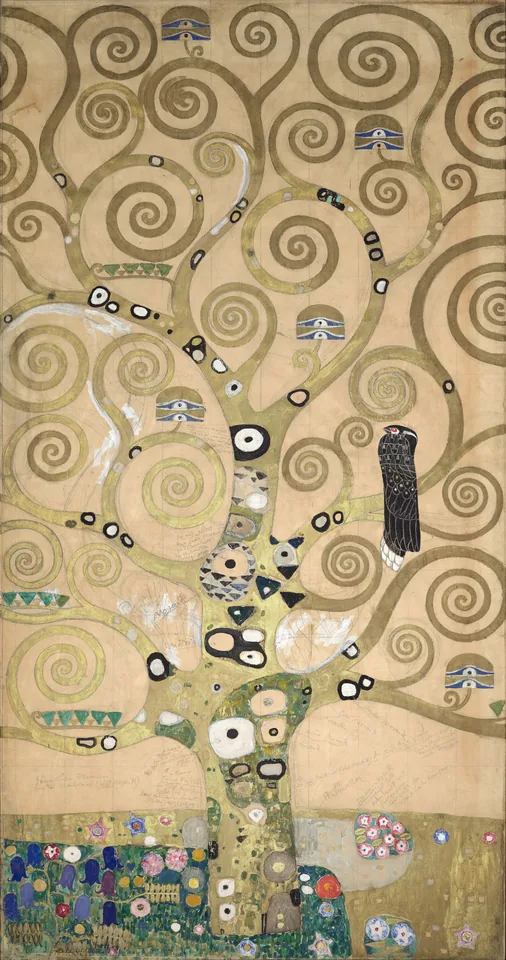
The Stoclet Frieze is a three-part mosaic cycle designed by Gustav Klimt for the dining room walls of the Stoclet Palace in Brussels. At the center of its long panels stands the swirling Tree of Life, which spreads its spiraling golden branches across the room. Klimt designed the work between 1905 and 1911, creating one of his most complex decorative cycles during his golden phase.
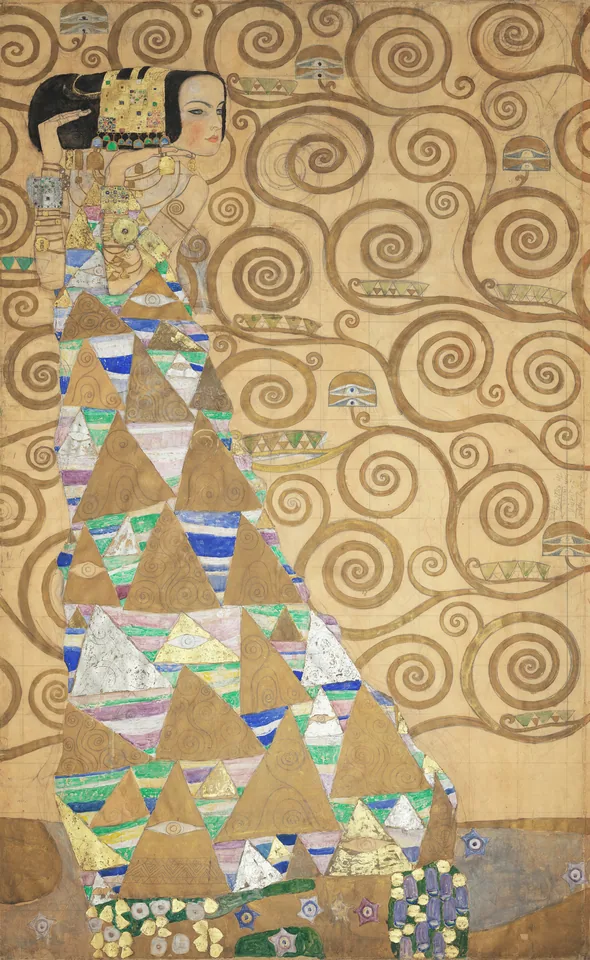
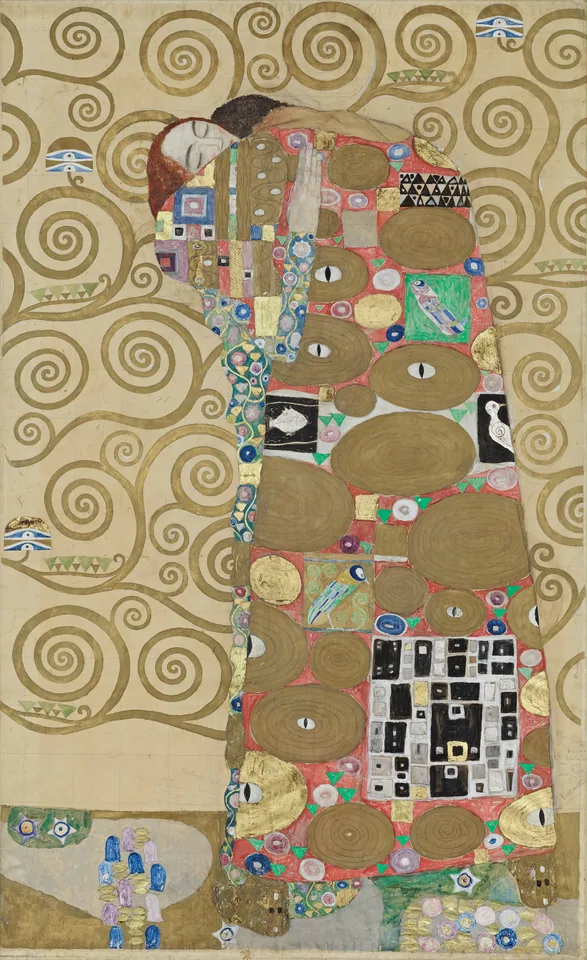
The composition runs across the dining room, using two large wall mosaics that face one another and a smaller geometric panel set on the short end wall. On one long wall, the Tree of Life frames a solitary dancer known as Expectation. On the opposite wall, the branches wrap around an embracing couple known as Fulfilment. Between them on the dividing short wall sits a panel featuring the Golden Knight.
The commission came directly from Fritz Wärndorfer, the business manager of the Wiener Werkstätte arts collective. Wärndorfer engaged Klimt to collaborate with architect Josef Hoffmann on a private residence for the Belgian collector Adolphe Stoclet. Today, art lovers frequently look to Klimt’s decorative wall cycles when selecting friezes for their living spaces.
The Palais Stoclet in Brussels
Belgian financier and art collector Adolphe Stoclet and his wife Suzanne commissioned the Stoclet Palace to showcase their expansive art collection. Stoclet met Austrian architect Josef Hoffmann in Vienna, where Stoclet was directing railroad construction projects. The couple initially considered building their home on the Hohe Warte in Vienna, but they relocated to Brussels in 1904 following the unexpected death of Stoclet’s father.
On April 8, 1905, Adolphe Stoclet bought a building site on Avenue de Tervueren in Brussels. He granted Hoffmann an unlimited budget and complete artistic freedom to construct a modern city mansion. The building took shape between 1905 and 1911 in the Vienna Secession architectural style, serving as the first residential project undertaken by the Wiener Werkstätte collective.
Hoffmann designed the palace as a Gesamtkunstwerk, or total work of art, coordinating every exterior and interior feature into a unified aesthetic whole. The exterior features asymmetrical rectangular blocks clad in smooth white Norwegian Turili marble slabs, edged with gilded bronze and sculpted metal mouldings. A central stair tower rises nearly 20 metres above the avenue, crowned by four copper or bronze sculptures of male nudes created by the sculptor Franz Metzner.
Inside the mansion, the Wiener Werkstätte designed every physical element to match Hoffmann’s clean geometric forms. Craftsmen produced custom furniture, light fittings, bathroom fixtures, and door handles, while Hoffmann even planned matching gowns for Madame Stoclet. Leading workshop figures contributed to the decor, including Carl Otto Czeschka, Ludwig Heinrich Jungnickel, Leopold Forstner, and Koloman Moser. Belgian artists George Minne and Fernand Khnopff provided additional artworks for the interior.
The Stoclets had assembled an extensive collection of antiquities from across the world. Their home contained Egyptian sculpture, Chinese ceramics and jades, Byzantine icons, Persian and Armenian miniatures, and Western medieval panel paintings. Art historian M.E. Warlick notes that Klimt must have been delighted to find the Stoclets’ eclectic collection matched many of his own recent interests. The diverse artifacts influenced the motifs, colors, and stylized human figures that Klimt incorporated into the dining room walls.
The three panels: Expectation, the Tree of Life and Fulfilment
The Stoclet Frieze consists of three distinct mosaic compositions placed directly into the architecture of the dining room. Two long murals measure 200 centimetres in height and 738 centimetres in length according to German records, though Wikidata records their width as 730 centimetres. The third panel is a narrower mosaic measuring 200 centimetres high by 89 centimetres wide, positioned on the short wall between the two long panels.
The dominant visual element across both long walls is the Tree of Life. Its spiraling golden branches curl into spirals, spirals, and loops that fill the background from floor to ceiling. Dark birds perch among the spirals, while stylized flowers, geometric rosettes, and triangular leaves sprout along the golden vines. The branches unite the room, creating a rhythmic pattern that links the human figures on opposite sides of the space.
On the left wall stands the panel known as Expectation. A single standing woman, styled like an exotic dancer, faces sideways with her hands raised in a stylized pose. Her garments feature dense geometric patterns, triangles, and eye-shaped Egyptian motifs that mirror the spiraling branches behind her. Her dark hair and sharp profile stand out against the pale background and the golden curls of the tree.
Directly across the room on the opposite long wall sits the panel representing Fulfilment. Here, Klimt placed an embracing couple locked in a close hold, wrapped together in a single decorated cloak. The woman’s face tilts upward as the man leans over her, their bodies merged into an arrangement of circles, squares, and floral patches. The motif recalls Klimt’s oil paintings from the same period, where human intimacy merges with flat decorative ornament.
Between Expectation and Fulfilment, on the short wall that divides the room, stands the Golden Knight. This panel breaks from the organic coils of the tree, presenting an abstract, strictly geometric figure. Its sharp rectangular shapes and metallic surfaces form a visual anchor between the curving rhythms of the long walls.
How it was made
Gustav Klimt began design work on the dining room cycle in 1905, soon after Stoclet acquired the property. He worked slowly, making substantial revisions to his preliminary sketches in 1908 before approving the final mosaic execution in 1909. Because the frieze was integral to the architecture, every detail had to match the proportions of Hoffmann’s marble interior panels.
To build the actual mosaics, the Wiener Werkstätte hired Leopold Forstner and his Viennese mosaic workshop. Forstner oversaw an assembly of specialist craftsmen, including goldsmiths, metalworkers, ceramists, and enamel workers. The artisans laid out luxury materials into the design, embedding marble slabs, fired ceramics, gilded tiles, colored enamel, pearls, and semi-precious stones. Supplementary records on Wikidata note the inclusion of bronze, silver, gold, and platinum within the metalwork.
The Wiener Werkstätte tested every room of the palace before transport. Craftsmen assembled each interior space in Vienna to test its aesthetic balance, lighting, and fit. Klimt refused to allow any public display of the completed frieze in Vienna, though he did arrange a private viewing for his friend Berta Zuckerkandl. In 1911, the mosaic sections were shipped to Brussels and installed inside the Stoclet dining room in Klimt’s presence.
If you want to bring these designs into your own home, you can choose reproductions printed and shipped by ArtsyWall. They offer Klimt’s decorative panels in three standard formats: Premium Canvas, Framed Canvas, and Archival Paper. These prints preserve the clear lines, spiraling branches, and rich contrast of Klimt’s original Brussels mosaics.
Where to see the Stoclet Frieze
The finished mosaic cycle remains inside the dining room of the Palais Stoclet at Avenue de Tervueren in Brussels. Adolphe Stoclet lived in the mansion until his death on November 3, 1949, after which the property passed to his daughter-in-law Annie Stoclet. Following Annie Stoclet’s death in 2002, her four daughters inherited the palace. The building remains in the private ownership of the Stoclet family and is closed to visitors, having never been opened to the public.
Government bodies have moved to protect the property and expand access. English records note that the palace was classified as a historical monument in 1976, while German sources date the monument protection to 1979, with the surrounding gardens added in 2005. In 2009, UNESCO inscribed the Palais Stoclet as a World Heritage Site. In 2024, the Brussels Parliament approved a motion mandating that the palace open to the public for at most 15 days each year.
While the dining room in Brussels remains largely inaccessible, you can study Klimt’s preparatory work in person. The Museum of Applied Arts (MAK) in Vienna holds Klimt’s full-scale, eight-part working drawings for the Stoclet Frieze. Klimt created these cartoons by applying gold leaf and silver leaf directly onto heavy packing paper of various thicknesses, adding his own handwritten annotations along the margins.
The MAK carried out a multi-year restoration of the working drawings ahead of the 150th anniversary of Klimt’s birth. Today, the drawings hang in the Jugendstil and Art Déco section of the MAK study collection. The museum also preserves Klimt’s painted study titled The Tree of Life, Stoclet Frieze, completed in 1909. English sources record this study at 195 by 102 centimetres, while Wikidata lists the cartoon on cardboard at 200 by 102 centimetres. For travelers mapping museum itineraries, our guide on where to see Klimt paintings highlights other public collections that display his major decorative projects.
Questions and answers
Where is Klimt's Tree of Life?
The original Tree of Life mosaic is located inside the dining room of the Palais Stoclet, a private mansion in Brussels, Belgium. Gustav Klimt designed the mosaic between 1905 and 1911 as part of the Stoclet Frieze. The full-scale working drawings and a 1909 painted study for the Tree of Life hang in the Museum of Applied Arts (MAK) in Vienna, Austria.
Can you visit the Stoclet Palace?
You cannot currently visit the Stoclet Palace because it is a private residence closed to the general public. The mansion has remained privately owned by the Stoclet family since its completion. In 2024, the Brussels Parliament approved a motion mandating that the building open to the public for at most 15 days per year, but access has historically remained restricted.
What is the Stoclet Frieze made of?
The Stoclet Frieze consists of luxury mosaic materials set into wall panels, including marble, ceramic, gilded tiles, enamel, pearls, and semi-precious stones. Leopold Forstner's workshop assembled these elements alongside metalwork and enamel specialists. Historical records also note that the mosaic incorporates precious metals such as platinum, bronze, silver, and gold to form its shimmering decorative surfaces.
Where are the working drawings for the Stoclet Frieze?
Klimt's full-scale working cartoons for the Stoclet Frieze belong to the Museum of Applied Arts (MAK) in Vienna. The artist prepared these eight panels on thick packing paper using silver leaf, gold leaf, and handwritten notes. Visitors can view the restored cartoons and a 1909 Tree of Life study in the Jugendstil and Art Déco gallery of the museum's study collection.