Klimt and the Vienna Secession
The Vienna Secession was a progressive union of artists formed in 1897 by Gustav Klimt and fellow creatives who broke away from the conservative Vienna Künstlerhaus to build an independent home for modern art.
What the Vienna Secession was
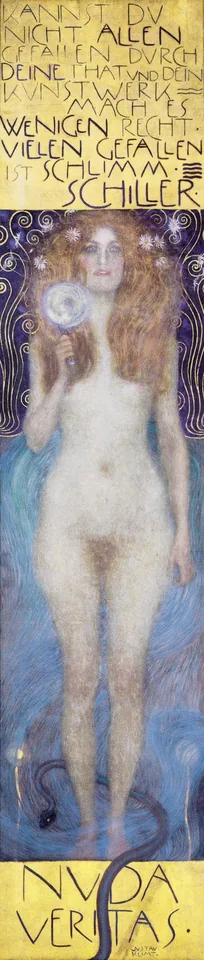
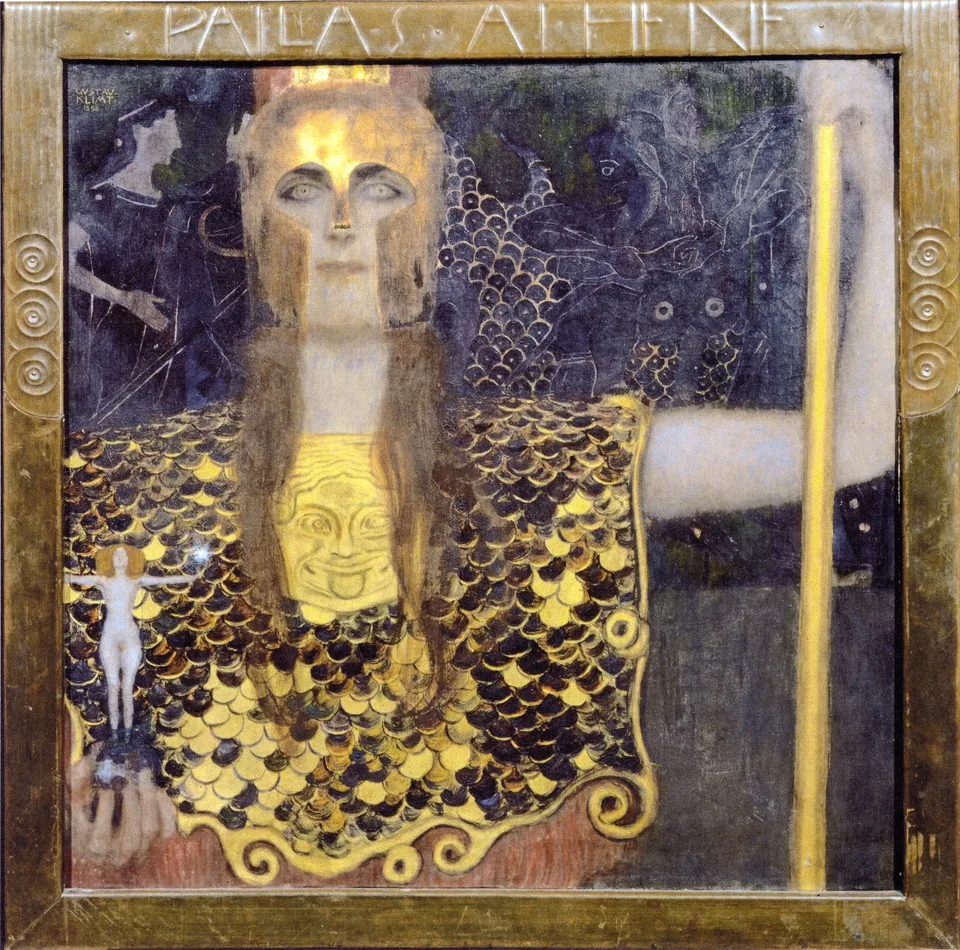
The Vienna Secession was an association of Austrian visual artists founded on 3 April 1897 in Vienna. The group emerged as an organized breakaway from the conservative, Historicist-oriented Vienna Künstlerhaus. The artists took their name from the Munich Secession, which had formed earlier in 1892. At their initial gathering of fifty members, the group elected painter Gustav Klimt as their first president.
The founders included leading figures across painting, design, and architecture. Alongside Klimt stood Koloman Moser, Josef Hoffmann, Joseph Maria Olbrich, Max Kurzweil, Wilhelm Bernatzik, and Edmund von Hellmer. Additional founding artists included Josef Engelhart, Ernst Stöhr, Wilhelm List, Adolf Hölzel, and Anton Nowak. The eighty-five-year-old painter Rudolf von Alt was chosen as the Secession’s Honorary President in 1897. The architect Otto Wagner joined the organization shortly after its founding.
The Secession brought together painters, sculptors, and architects who wanted to revitalize Central European visual culture. They rejected rigid academic standards and established an independent platform for exhibition. By stepping away from the dominant institutions of the Austro-Hungarian capital, the group created space for original work and international exchange.
Why Klimt and his friends broke away
The primary motivation for the breakaway was deep dissatisfaction with the traditional Viennese art establishment. Klimt and his peers opposed the domination of the Vienna Academy of the Arts, the Vienna Künstlerhaus, and state salons. The Künstlerhaus favored Historicism and operated as a commercial venue that prioritized established tastes over artistic exploration.
The founders had specific cultural goals. They aimed to dispute artistic nationalism, exchange ideas directly with foreign artists, and renew the decorative arts. They also worked toward the concept of a Gesamtkunstwerk, a total work of art unifying painting, architecture, and decorative craftsmanship.
The dispute was fundamentally about the purpose of creative work. Writing in the journal Ver Sacrum, author Hermann Bahr explained that the movement was a confrontation between commerce and art rather than an aesthetic debate. Klimt and his colleagues wanted creative independence away from commercial marketplace constraints.
The Secession building
To hold their exhibitions, the artists needed their own independent venue. On 17 November 1897, the municipal council of Vienna granted the group a building plot on the Wienzeile, situated between the Naschmarkt and the Academy of Fine Arts. The industrialist Karl Wittgenstein financed the construction of the new pavilion.
The Secession building was designed by Otto Wagner’s student Joseph Maria Olbrich and completed in 1898. It became the first dedicated gallery of contemporary art in Vienna. Olbrich designed a clean, geometric white pavilion topped with a distinctive openwork dome made of gilded laurel leaves.
Every part of the exterior expressed the philosophy of the movement. Above the entrance, the building carries the Secession motto: ‘To every age its art, to every art its freedom.’ Beneath this motto stands a carved sculpture of three gorgons, representing painting, sculpture, and architecture. Beside the entrance door, the motto Ver Sacrum, meaning ‘Sacred Spring’, expresses hope for a new artistic flourishing.
Ver Sacrum and the exhibitions
The group established its own publication alongside its exhibition hall. Founded in 1897, the magazine Ver Sacrum served as the publication of the Secession. It showcased highly stylised graphic art, original typography, and essays on modern culture.
The Secession held its first exhibition in 1898. Honorary President Rudolf von Alt led a delegation that invited Emperor Franz Joseph to attend the opening exposition. The public response confirmed the city’s interest in contemporary artistic forms.
Over the following years, the group introduced modern European trends to the Austrian public. Between 1899 and 1903, the Secession exhibited works by French Impressionists and Post-Impressionists, including Claude Monet, Édouard Manet, Edgar Degas, Pierre-Auguste Renoir, Camille Pissarro, and Henri de Toulouse-Lautrec. In 1903, the Secession presented an exhibition titled ‘Entwicklung des Impressionismus in Malerei und Plastik’, which displayed works by Paul Cézanne in Austria for the first time.
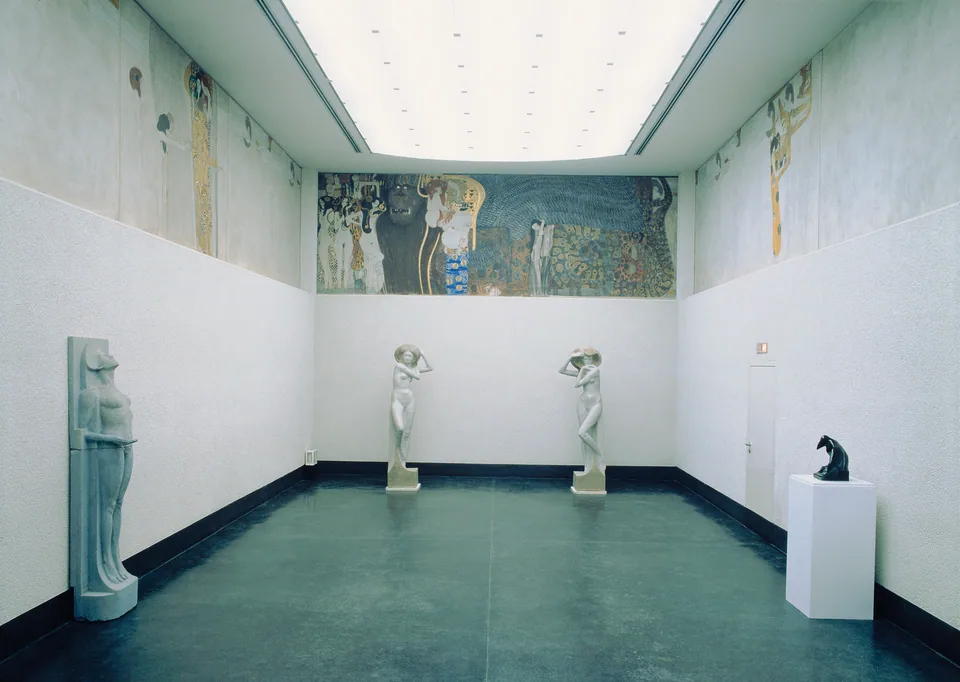
The group’s most ambitious project took place in 1902 during the 14th Secession exhibition. Arranged by architect Josef Hoffmann, the entire show was dedicated to the composer Ludwig van Beethoven. A statue of Beethoven sculpted by Max Klinger stood at the center of the exhibition hall, surrounded by Klimt’s monumental Beethoven Frieze. Klimt painted the frieze as a wall mural in the first room of the gallery, combining narrative figures with patterns that anticipated his later golden phase.
The Secession also stimulated decorative arts throughout Vienna. In 1903, Josef Hoffmann and Koloman Moser founded the Wiener Werkstätte to reform applied arts. Artist Carl Otto Czeschka designed for the Wiener Werkstätte and exhibited with the Secession, although he never joined the Secession to protect his exhibition freedom.
The Klimt group leaves
Tensions within the Secession began to mount as artists argued over the status of decorative work. Internal division arose over the 1904 St. Louis world exhibition, focusing on whether decorative arts deserved equal status with traditional fine arts like easel painting. Naturalist painters in the group resisted giving equal standing to applied arts.
The internal rift escalated in 1905 over commercial representation. Secession member Carl Moll proposed purchasing the commercial Galerie Miethke to sell members’ work. Klimt and his supporters backed the proposal, but they lost the membership vote by a single ballot.
The narrow defeat triggered an immediate fracture. On 14 June 1905, Gustav Klimt, Josef Hoffmann, Koloman Moser, Otto Wagner, and several other artists resigned from the Vienna Secession. Josef Engelhart took over the leadership of the remaining, more conservative members. In 1906, Klimt organized his allies into an independent group known as the Kunstschau or Klimtgruppe, which included Otto Wagner and Carl Moll.
Visiting the Secession today
The Secession building remains standing on the Wienzeile between the Naschmarkt and Karlsplatz, continuing its role as an exhibition hall. You can view the white cube, the gilded laurel dome, and the entrance inscriptions as Olbrich originally conceived them.
Inside, visitors can see Klimt’s monumental mural in person. The Republic of Austria has owned the Beethoven Frieze since 1975, displaying it permanently in a basement climate-controlled room. The frieze covers three walls and gives you a direct look at Klimt’s large-scale decorative work.
If you want to explore more of Klimt’s art across the city, look through our guide on where to see Klimt. You can study how the Secession transformed his career from a traditional decorative painter into a pioneer of modern Viennese art.
Questions and answers
What was the Vienna Secession?
The Vienna Secession was a union of Austrian artists formed on 3 April 1897. Led by Gustav Klimt, the collective separated from the traditional Vienna Künstlerhaus to protest artistic nationalism and salon control. The members wanted to introduce foreign modernists to Austria, renew decorative craftsmanship, and unite architecture, painting, and craft into a single artistic harmony.
Who founded the Vienna Secession?
A group of artists founded the Vienna Secession on 3 April 1897, electing Gustav Klimt as their first president. Founding members included Josef Hoffmann, Koloman Moser, Joseph Maria Olbrich, Max Kurzweil, Wilhelm Bernatzik, and Edmund von Hellmer. Other founders included Josef Engelhart, Ernst Stöhr, Wilhelm List, Adolf Hölzel, and Anton Nowak. Painter Rudolf von Alt served as the group's Honorary President.
What is the motto of the Vienna Secession?
The motto of the Vienna Secession is 'To every age its art, to every art its freedom.' This phrase stands above the entrance of the Secession Building in Vienna. Beside the entrance door, the Latin words Ver Sacrum, meaning 'Sacred Spring', serve as an additional motto. Together, these inscriptions expressed the group's hope for artistic renewal and freedom from conservative traditions.
What was Ver Sacrum?
Ver Sacrum, meaning 'Sacred Spring', was the magazine of the Vienna Secession founded in 1897. The publication distributed stylised graphic art and essays by Secession members. Writer Hermann Bahr stated in Ver Sacrum that the movement represented a confrontation between art and commerce rather than an aesthetic debate. The phrase also appears beside the entrance door of the Secession Building in Vienna.