Select the painting to see it full screen and zoom in.
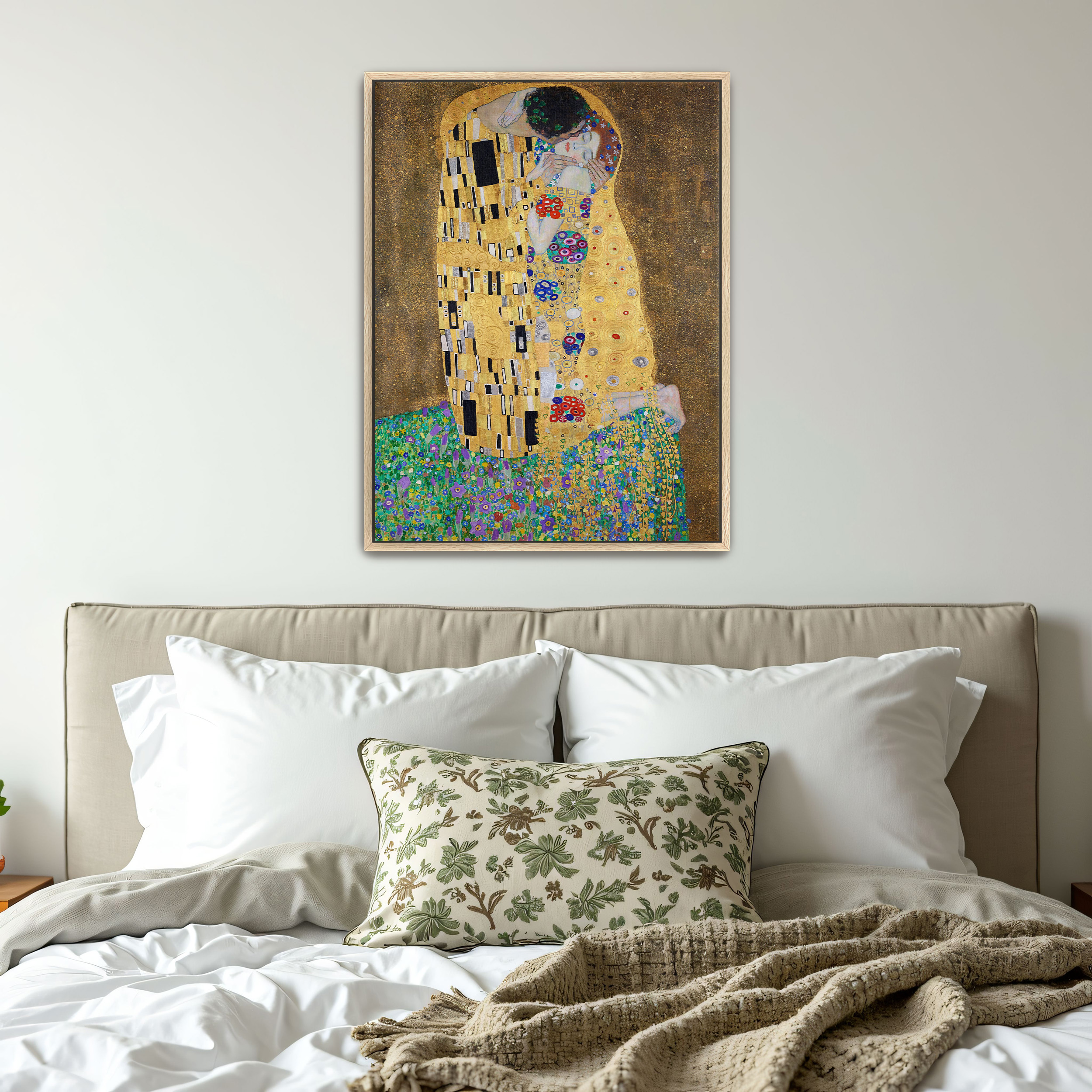
The Kiss as a print, in a room

What the painting shows
The Kiss by Klimt presents two lovers locked in an intimate embrace on a patch of wildflowers. Gustav Klimt painted the work between 1907 and 1908 using oil paint, gold leaf, silver, and platinum on a large square canvas. The couple kneels together at the center of the image, their bodies wrapped in heavy ornamental fabric that joins them into a single silhouette.
You can see the man standing or kneeling over the woman, bending his head downward to kiss her cheek. His hands frame her face with gentle pressure, his fingers resting along her jawline and cheek. A crown of green vines sits in his dark hair. His neck is thick and muscular, and his face remains turned away so you can see only his profile as he presses his lips against her skin.
The woman kneels with her head tilted upward at a sharp angle to receive his kiss. Her eyes are closed, giving her face an expression of quiet surrender. One of her arms reaches over the man’s shoulder to rest behind his neck, while her other hand rests lightly across his fingers. In her auburn hair, she wears a delicate circlet of colorful flowers. Her exposed feet curl at the bottom of her robe, resting right at the precipice of the grassy ledge.
Klimt established a clear contrast between the figures through the patterns decorating their clothing. The man wears a robe patterned with upright black, white, gray, and gold rectangles alongside subtle spirals. The woman wears a flowing dress adorned with concentric circles, floral shapes, and colorful spots of red, blue, and lilac. These opposing motifs visually separate masculine geometry from soft feminine curves.
Beneath the couple, a bank of green grass slopes downward toward the lower edge of the frame. Small wildflowers in shades of violet, blue, yellow, and white carpet this patch of earth. Golden vines and tendrils cascade down from the hem of the woman’s gown, hanging past the edge of the cliff.
Behind the figures, Klimt painted a flat background of mottled gold paint and bronze dust. There is no horizon, sky, or architectural setting behind the couple. The man’s dark hair reaches almost to the top edge of the canvas. This composition reflects the influence of Japanese woodblock prints, which eliminated deep perspective in favor of bold silhouettes.
The story behind it
Klimt created this painting during the height of his gold period, a phase defined by heavy layers of gold leaf, decorative patterning, and metallic paint. English records date the canvas to 1907 and 1908, while German museum records state he began work in 1908 and finished in 1909. The original title recorded in 1908 was Das Liebespaar, meaning The Lovers. The title Der Kuß appeared a year later in an exhibition catalogue supplement.
This artistic direction followed a period of intense public controversy for the artist. Critics had attacked Klimt’s earlier Vienna Ceiling paintings as pornographic and perverted excess. Klimt responded by turning toward private easel works and symbolic subjects. The motif of embracing lovers had already appeared in his Beethoven Frieze and Stoclet Frieze, exploring human relationships through decorative allegories.
Klimt had deep family roots in decorative metalwork because his father was an artisan specializing in gold engravings. Klimt’s own use of gold leaf expanded following an inspiring trip to Italy in 1903. While visiting San Vitale in Ravenna, he observed how the flat surfaces of Byzantine mosaics enhanced their golden brilliance. He adapted this effect on canvas, combining oil paint with gold leaf, silver, and platinum.
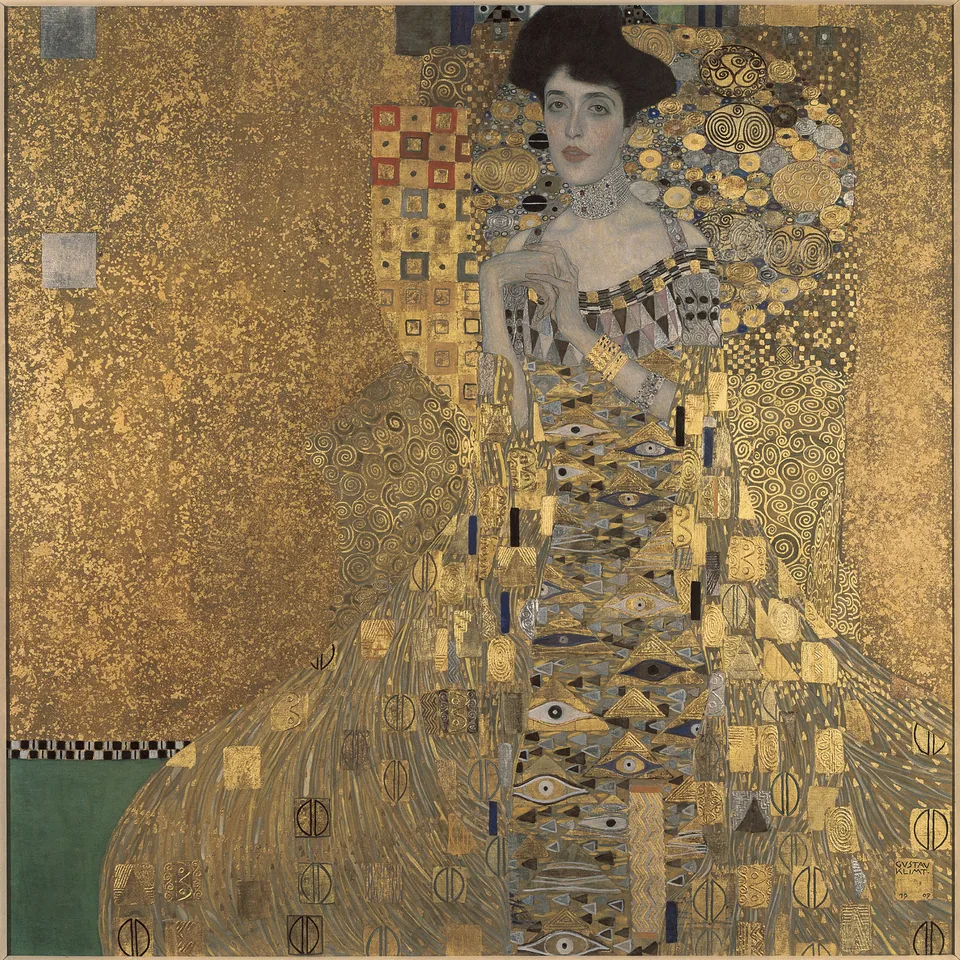
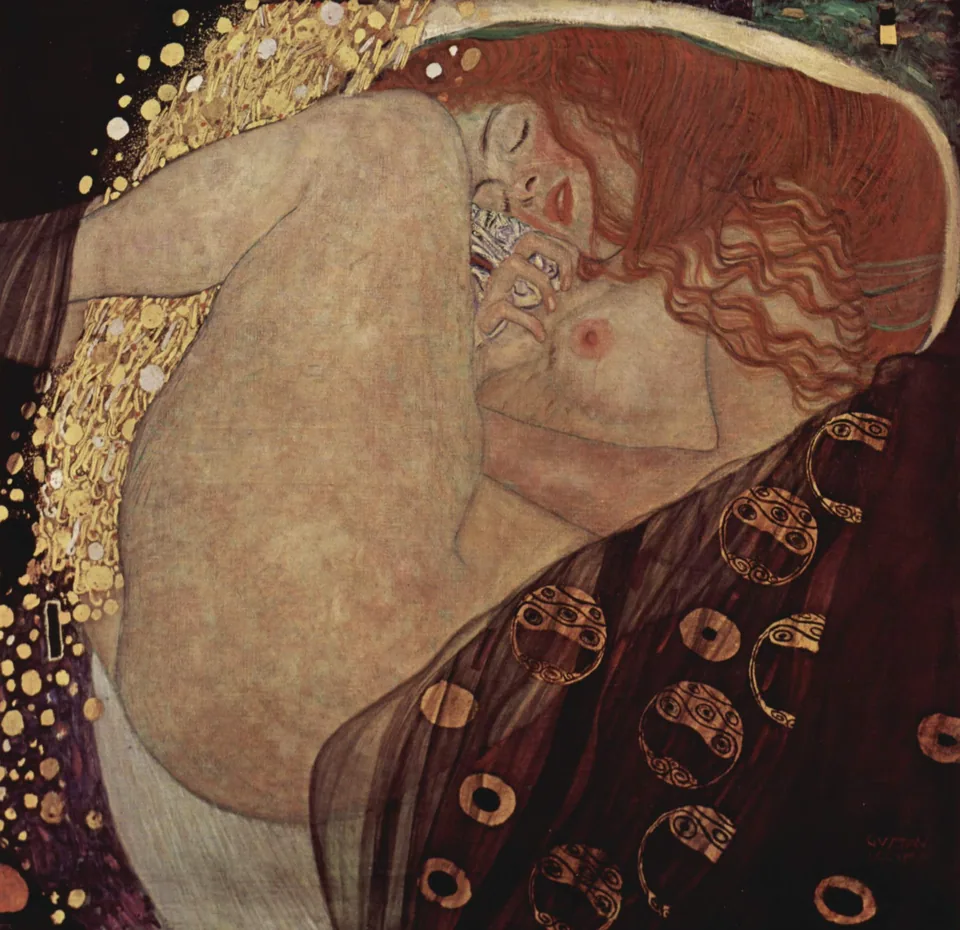
Art historians still debate who modeled for the figures. Many people believe the lovers represent Gustav Klimt and Emilie Flöge, an idea popularized by Elizabeth Hickey’s novel The Painted Kiss. Other writers have suggested composer Alma Mahler or the red-haired model known as Red Hilda, who posed for works like Danaë. No documentary evidence proves who the sitters were.
Scholars have suggested several interpretations for the scene. Some argue Klimt depicted Apollo kissing Daphne from Ovid’s Metamorphoses, while others see Orpheus turning to embrace Eurydice as her translucent body slips away. Cultural scholar Jost Hermand argued the golden aura unites the figures in a cosmogonic experience severed from the outside world. Art historian Werner Hofmann noted that Klimt encoded instinct into the contrasting rectangular and circular patterns of the robes. You can study these interpretations in our guide to The Kiss.
The painting premiered publicly at the 1908 Kunstschau exhibition in Vienna, organized to celebrate the sixtieth anniversary of Emperor Francis Joseph I’s reign. The exhibition building was designed collaboratively by Klimt, Josef Hoffmann, Otto Prutscher, and Koloman Moser. Visitors received the canvas with great enthusiasm, cementing its reputation during the Vienna Secession movement.
The image has inspired many modern adaptations and cultural tributes. Syrian artist Tammam Azzam superimposed the painting onto a bombed building in Damascus in 2013 for his work Freedom Graffiti. The painting also formed the central theme of the 2013 Austrian television movie Alles Schwindel. Later adaptations include digital NFT releases by the Belvedere museum and a 4,000-piece Lego building set.
Where to see it
You can see the original painting in Vienna at the Österreichische Galerie Belvedere. The canvas hangs in the Upper Belvedere Palace, which originally served as Prince Eugene of Savoy’s summer residence. Visiting the museum lets you examine the genuine metallic sheen and thick brushwork in person.
The Austrian government purchased the painting directly from the 1908 Kunstschau exhibition while it was still unfinished. Minister Gustav Marchet acquired the work for the Imperial-Royal Ministry of Religion and Education. The state transferred the canvas to the Moderne Galerie, established in 1903. It has remained in the Belvedere collection ever since.
Choosing a print
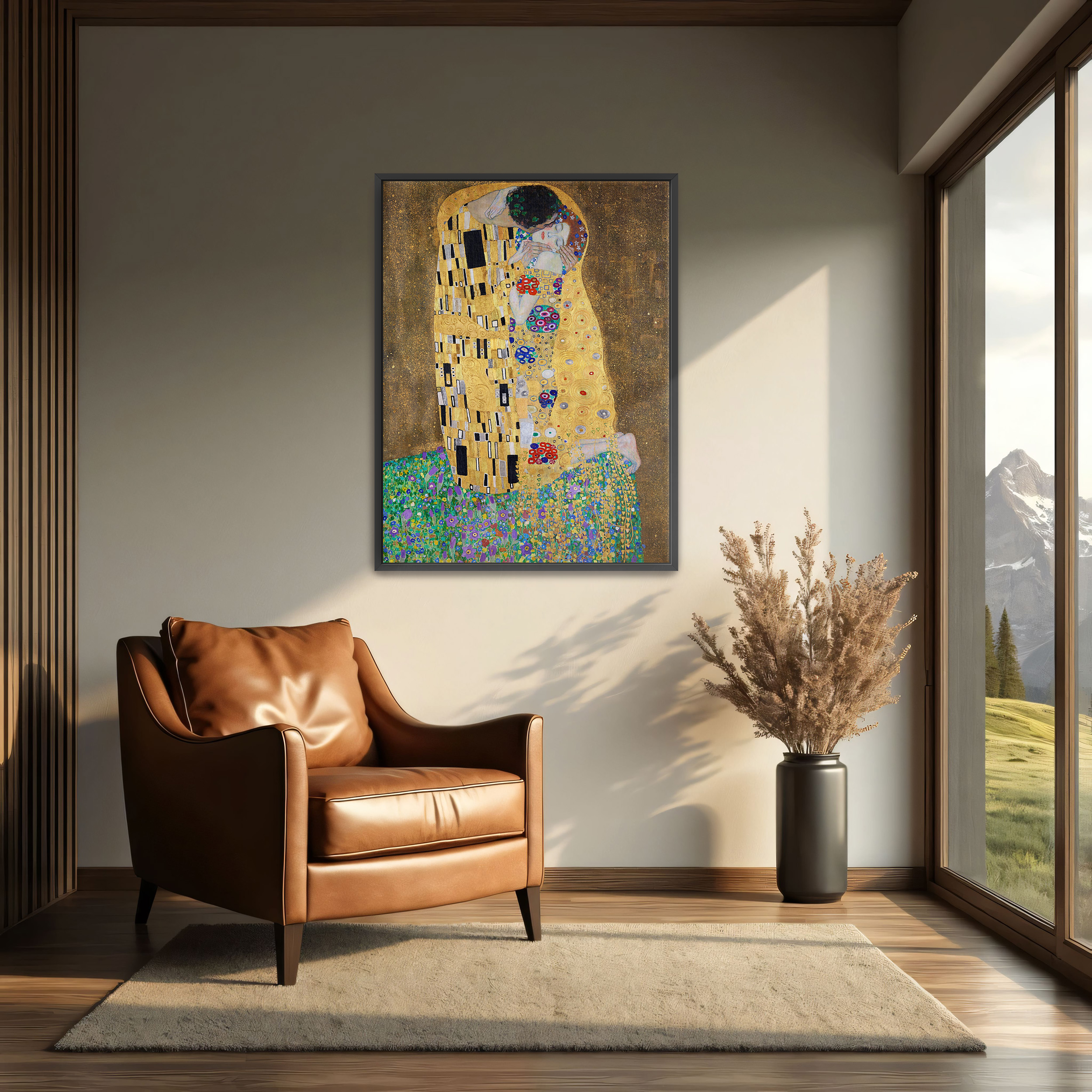
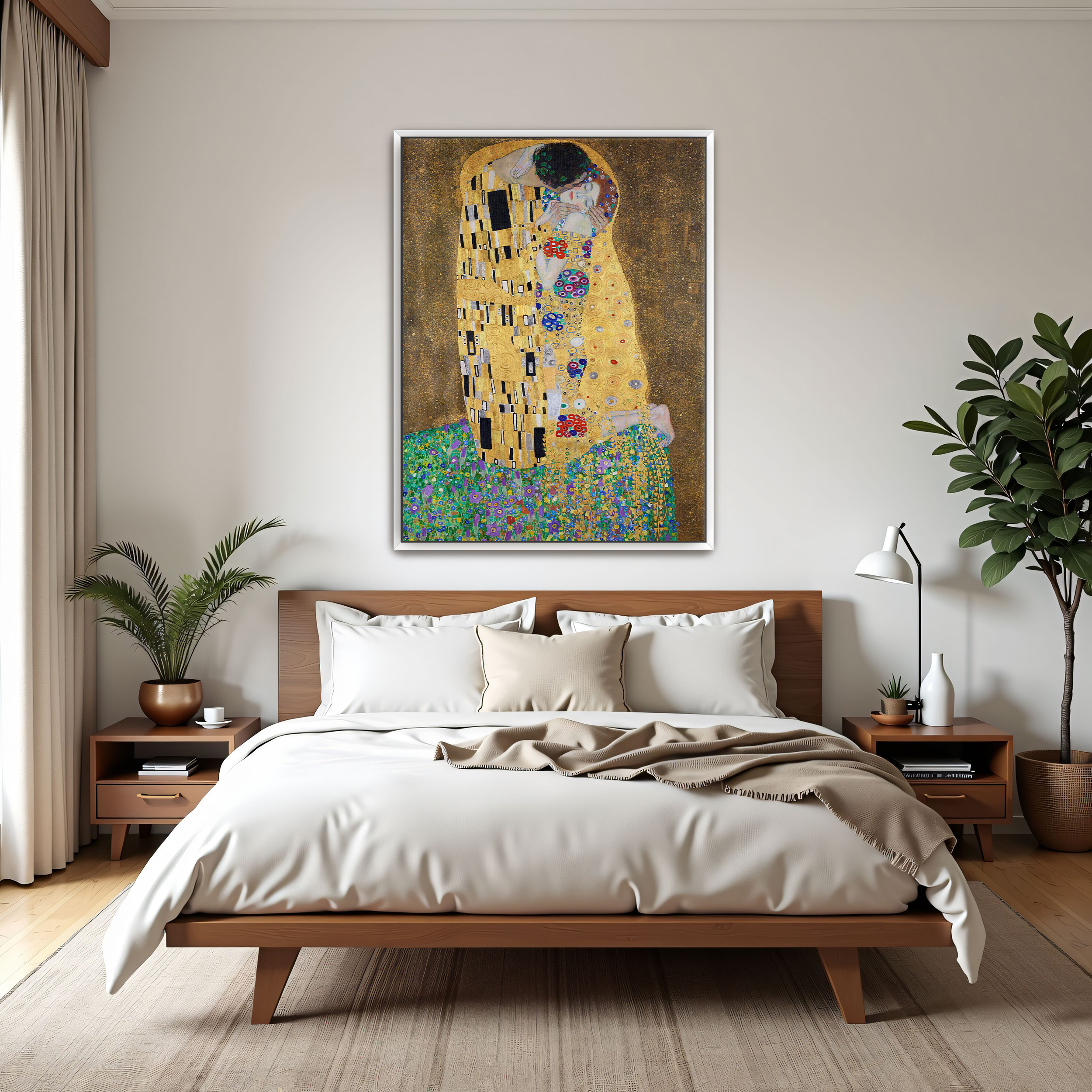
If you want to hang this image in your home, you can choose prints of The Kiss printed and shipped by ArtsyWall. The print is offered in three formats: Premium Canvas, Framed Canvas, and Archival Paper.
Premium Canvas offers a clean gallery wrap with no frame. The canvas texture highlights the rich geometry of the robes and the floral meadow beneath the lovers.
Framed Canvas places the canvas in a wood floating frame available in black, white, gold, silver, walnut, or oak. The floating border cleanly separates the luminous background from your wall.
Archival Paper renders the crisp details of the faces, floral crowns, and spiral patterns on a smooth cotton surface. Its matte finish avoids reflections under glass, making it a fine option for custom framing.
Details of The Kiss
Questions about The Kiss
What does The Kiss by Klimt show?
The Kiss by Klimt shows an embracing couple kneeling on the edge of a flowery meadow against a flat gold background. The man leans down to kiss the woman on her cheek while cradling her face in his hands. Both figures wear decorative robes patterned with geometric shapes, subtle swirls, and flowers, uniting them inside an ornamental golden silhouette.
When did Klimt paint The Kiss?
Gustav Klimt painted The Kiss during his Golden Period, with sources dating the work between 1907 and 1908. Some records indicate Klimt began the canvas in the first half of 1908 and completed it in 1909. The painting was first shown to the public in unfinished form at the 1908 Kunstschau exhibition in Vienna.
Where is The Kiss by Klimt?
The Kiss by Klimt hangs in the Österreichische Galerie Belvedere museum in the Upper Belvedere Palace in Vienna, Austria. The Austrian government acquired the painting directly from the 1908 Kunstschau exhibition before it was finished. It was transferred to the Moderne Galerie at Prince Eugene's summer residence, which later became the Belvedere collection.
How big is The Kiss by Klimt?
The Kiss by Klimt is a large square painting measuring 180 by 180 centimeters, or about six feet tall and six feet wide. Gustav Klimt chose a square format for the composition, positioning the couple close to the upper edge so their golden robes fill the center of the canvas above a flowery slope.
What is The Kiss by Klimt made of?
The Kiss by Klimt is an oil-on-canvas painting made with oil paint, added gold leaf, silver, and platinum. Gustav Klimt applied gold paint and gold bronze across the robes and background to build an intense metallic surface, inspired by the Byzantine mosaics he studied at the Church of San Vitale in Ravenna.