The Kiss by Gustav Klimt: Meaning, History and Where It Hangs
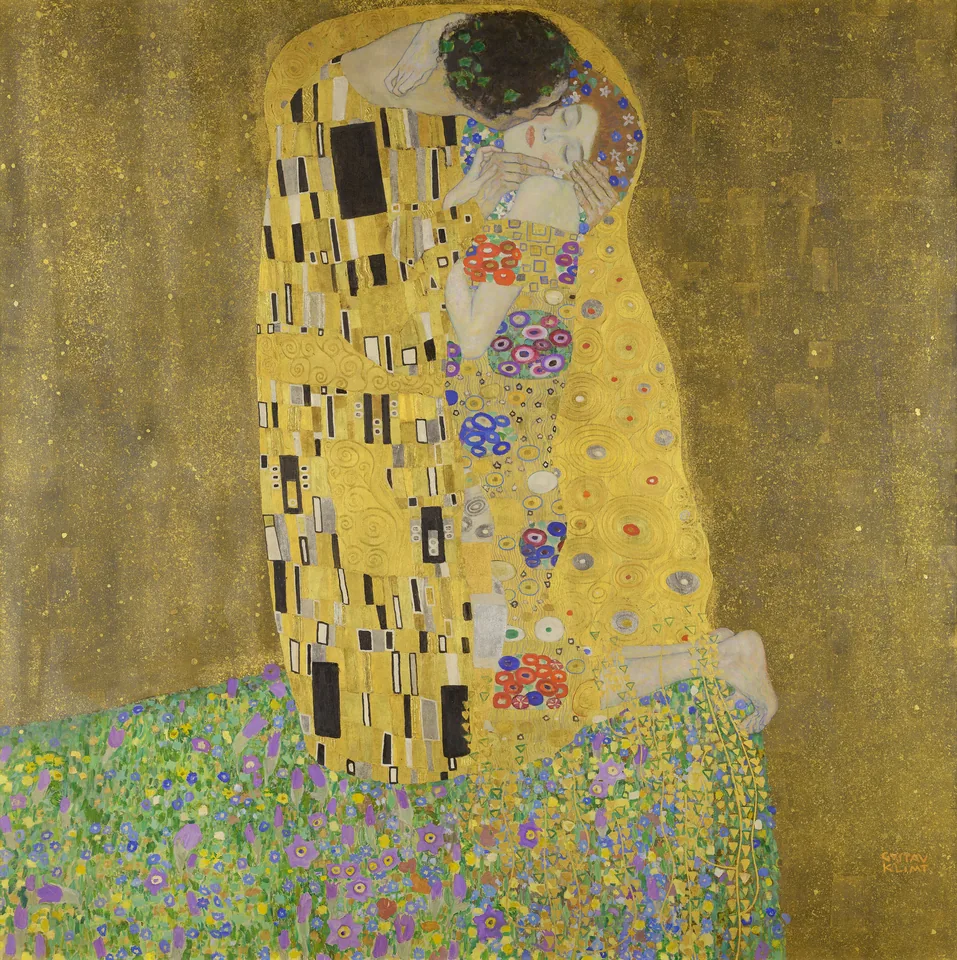
The Kiss painting by Gustav Klimt is an oil and gold leaf artwork created in 1907–1908 that depicts two lovers embracing on a flowery cliff. Klimt's work hangs in Vienna at the Österreichische Galerie Belvedere.
What The Kiss shows
The Kiss is an oil and gold leaf painting by Gustav Klimt, created between 1907 and 1908, and it hangs in the Belvedere in Vienna. The painting shows a couple locked in an intimate embrace against a flat gold background. You see them kneeling together on the edge of a flowery meadow that ends under the woman’s exposed feet.
The man leans forward and turns his face downward to kiss the woman’s right cheek. His strong hands cradle her head, holding her close as he presses toward her. He wears a dark crown of ivy vines around his hair. His head rests close to the upper border of the canvas, which creates an intense, tight framing.
The woman kneels with her eyes closed, receiving his touch with an upturned face. One of her arms reaches over his neck, while her other hand rests against his fingers. She wears a crown of delicate flowers in her hair. Her exposed toes curl gently against the grassy edge, right where the earth drops off.
Their garments display contrasting decorative motifs. The man wears a loose robe covered in sharp, geometric patterns of black, gray, and white rectangles alongside subtle spirals. The woman wears a flowing, tight-fitting dress decorated with circular floral patterns and warm patches of color. The spiral designs in their garments recall Bronze Age art and ancient Western decorative tendrils.
Beneath them, the ground is covered in a carpet of colorful wildflowers. Klimt paints the green grass with dots and clusters of blossoms that contrast with the abstract background. Beyond the edge of the meadow, the landscape disappears completely into a flat field of shimmering gold bronze and metallic leaf.
When and how Klimt painted it
Klimt painted the work during his celebrated Golden Period. Sources offer slightly different timelines for its completion: English historical records state that Klimt worked on the canvas during 1907 and 1908, while German museum records state he painted it in the first half of 1908 and completed it in 1909. Wikidata lists the inception date of the canvas as 1907.
The painting belongs to the most famous chapter of the artist’s career, covered in our guide to Gustav Klimt. During this period, Klimt applied gold leaf, silver, and platinum directly onto canvas. He united fine art painting with decorative craft, producing a sequence of monumental portraits and allegories.
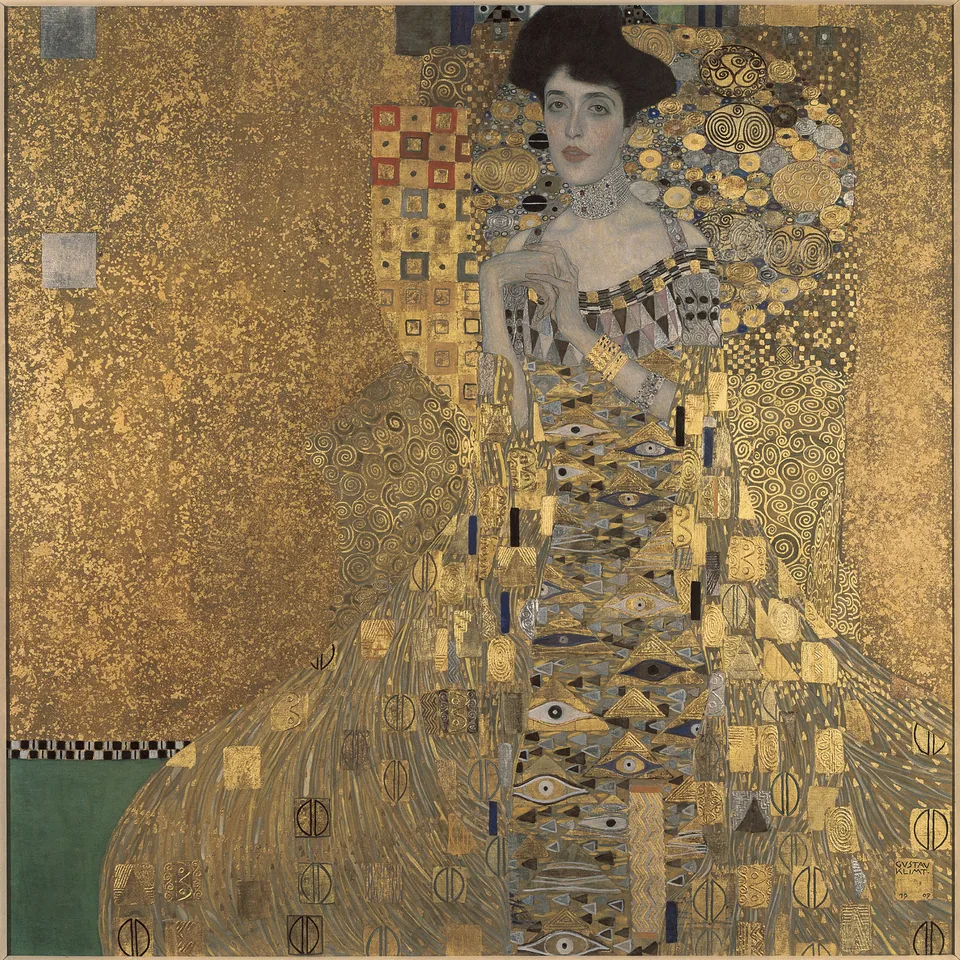
Klimt’s interest in precious metals began with his family upbringing. His father, Ernst Klimt the Elder, was a traveling artisan and gold engraver from Bohemia, and Klimt was initially expected to follow his father into the trade. His younger brother Georg Klimt became an engraver and metalworker who later created metal frames for Gustav’s paintings, including Pallas Athene and Judith I.
A trip to Ravenna in 1903 gave Klimt direct visual inspiration for his gold technique. While visiting the Church of San Vitale, he studied Byzantine wall mosaics made of glittering glass and gold leaf. The glowing backgrounds and flattened figures of those ancient church walls shaped the way he handled light, surface, and religious reverence in modern portraits.
You can also see strong Japanese influences in the way Klimt planned the composition. The flat gold field recalls the decorative style of 17th-century Japanese painter Ogata Kōrin, whose work influenced Viennese artists through Japonism. Placing the man’s head near the upper edge and reducing the background to flat, decorative space also reflects the composition of Japanese woodblock prints.
To create the surface, Klimt worked on a square canvas measuring 180 by 180 centimeters. He applied oil paint alongside genuine gold leaf, silver, and platinum. He also used gold bronze and gold paint to vary the shine, giving the large surface different levels of sheen as light moves across it. You can learn more about this creative era in our guide to Klimt’s golden phase.
What The Kiss means
Klimt never wrote down a detailed guide to what the painting represents. Because the artist left the meaning open, art historians have analyzed the painting through several perspectives, looking at universal human emotion, gender dynamics, and classical mythology.
One central reading focuses on the cosmic union of lovers. Art historian Jost Hermand wrote that the gold aura unites the two figures in a holistic, cosmogonic experience severed from the outside world. The shimmering metallic enclosure cuts the lovers off from everyday life, turning their embrace into a sacred world where time and physical surroundings fall away.
Other scholars examine how Klimt separated male and female energies through ornament. Art historian Werner Hofmann observed that Klimt encoded instinct and desire into contrasting rectangular and rounded robe ornaments rather than the bodies. The man’s garment features rigid, vertical black and gray rectangles, while the woman’s dress carries soft, circular floral shapes.
Art historian Gottfried Fliedl offered a different perspective on the power dynamic between the figures. Fliedl observed that the kneeling woman is subordinated to the masculine principle, inscribed directly into the phallic gloriole that surrounds the couple. In this reading, the man dominates the scene as he stands above the woman while she yields to his embrace.
Classical mythology provides another layer of interpretation. Some scholars argue that Klimt represented Apollo kissing Daphne, capturing the scene from Ovid’s Metamorphoses. Other art historians have suggested that Klimt depicts the moment Orpheus turns to caress Eurydice, pointing out that the woman’s figure appears slightly translucent, as if she is about to vanish back into the underworld.
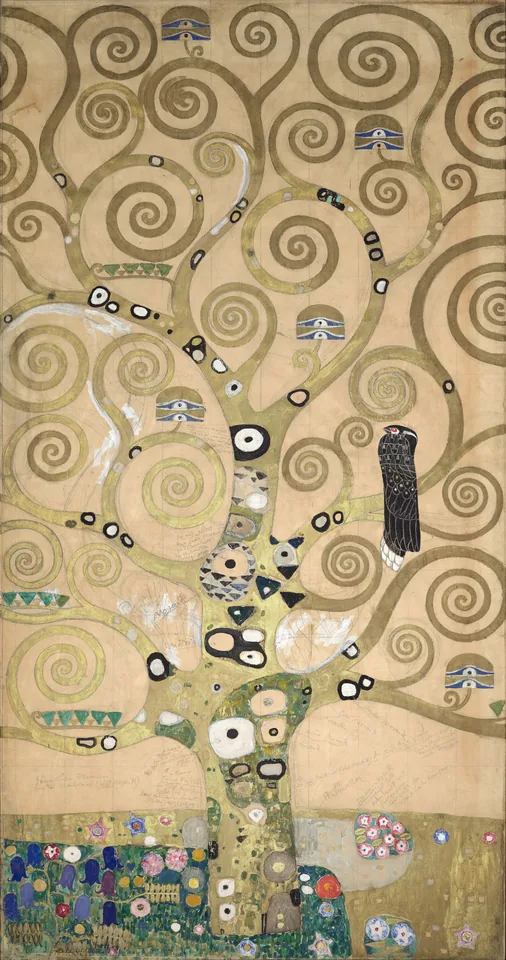
The theme of embracing figures appeared repeatedly across Klimt’s career. He explored similar compositions in his Beethoven Frieze, completed in 1902 for the Vienna Secession building, and in his designs for the Stoclet Frieze in Brussels. The motif of lovers enclosed in decorative ornament served as an ongoing study of intimacy throughout his middle period.
Where The Kiss hangs today
The Kiss hangs today in the Österreichische Galerie Belvedere in Vienna, Austria. You can see the canvas on public display inside the Upper Belvedere Palace, a grand Baroque residence originally built for Prince Eugene of Savoy. Our guide on where to see Klimt paintings explains how the Belvedere built its world-renowned collection.
The painting entered the Austrian state collection before Klimt even applied his final brushstrokes. The Imperial-Royal Ministry of Cultus and Education, led by Minister Gustav Marchet, bought the unfinished painting at the 1908 Kunstschau exhibition in Vienna. The exhibition ran from 1 June to 16 November 1908 to celebrate the 60th anniversary of Emperor Francis Joseph I’s reign.
The Kunstschau was a landmark collaborative event held in a temporary pavilion designed by Josef Hoffmann, Gustav Klimt, Otto Prutscher, Koloman Moser, and other members of the Secession circle. When Klimt showed the painting there, it was listed under the title Liebespaar, or Das Liebespaar, meaning the lovers. The title Der Kuß appeared in print for the first time in an exhibition catalogue supplement in 1909.
After its acquisition at the Kunstschau, the painting moved to the Moderne Galerie, which had been founded in 1903 at Prince Eugene’s summer palace. That institution later evolved into the Österreichische Galerie Belvedere. The canvas has remained in the Belvedere ever since and stands as the centerpiece of its 20th-century Austrian art galleries.
Why The Kiss became so famous
The Kiss became widely regarded as Klimt’s most important and famous painting, as well as a defining achievement of the Vienna Secession. Its immediate purchase by the Austrian government in 1908 gave it national prominence from its very first public appearance. Over the decades, its bold blend of human intimacy and decorative abstraction made it a universal symbol of romance.
Much of the fascination surrounding the painting stems from speculation about who modeled for the couple. Many art historians believe the painting portrays Klimt himself alongside his lifelong companion, fashion designer Emilie Louise Flöge. Elizabeth Hickey’s novel The Painted Kiss popularized this belief among modern readers.
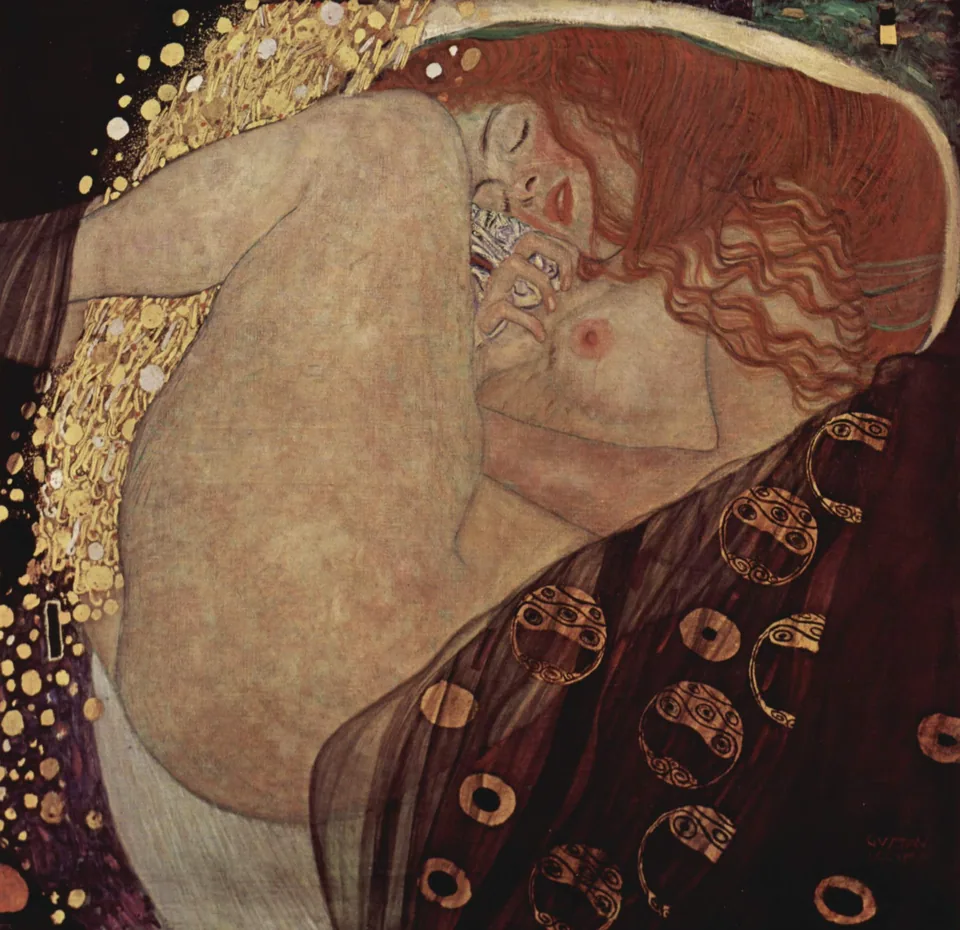
Other candidates for the figures have also been proposed over the years. Some contemporaries speculated that the woman was Alma Mahler, though historical records provide no evidence for that claim. Another theory suggests the female model was ‘Red Hilda’, a model who sat for Klimt’s paintings Danaë, Goldfish, and Woman with Hat and Feather Boa.
The visual power of the painting has inspired artists and media across the world. In February 2013, Syrian artist Tammam Azzam superimposed The Kiss onto a bombed apartment building in Damascus in his digital artwork Freedom Graffiti. The painting also served as the central narrative device in the 2013 Austrian television movie Alles Schwindel, directed by Wolfgang Murnberger.
Major institutions and brands continue to highlight the painting in contemporary culture. In February 2022, the Belvedere museum launched an official digital project that divided high-resolution scans of The Kiss into 10,000 NFT fragments. In 2026, toy manufacturer Lego scheduled release of set 31221, a 4,000-piece building set of Gustav Klimt: The Kiss.
Details to look for
When you stand before the painting or examine a high-quality reproduction, several specific elements reward close attention. The first detail is the combination of metals across the surface. Klimt layered genuine gold leaf, silver, and platinum alongside gold paint and gold bronze, creating subtle shifts in reflectivity that change depending on your viewing angle.
Look next at the faces and hands of the two figures. While their bodies are enclosed in flat, highly decorative robes, their skin is painted with soft, naturalistic modeling. Notice the man’s tender grip as his large hands cup the woman’s cheek, and observe the fine shading on her closed eyelids and parted lips.
The contrasting patterns on the two robes deserve careful study. The man’s garment is dominated by masculine, rigid geometry, featuring black, gray, and white rectangles that stand upright against the gold. In contrast, the woman’s dress is covered in soft, concentric rings, delicate circles, and bright floral sprigs that follow the gentle curve of her body.
Do not overlook the small crowns resting on their heads. The man wears a crown of dark green ivy leaves that wraps around his brow like a classical wreath. The woman wears a softer crown of tiny wildflowers that match the blossoms growing beneath her feet on the grassy slope.
Finally, look down at the bottom edge of the figures where the flowery meadow ends. The woman’s bare feet rest directly on the verge of an abrupt drop, her toes curling into the turf. If you are comparing print reproductions for your home, our comparison of The Kiss print vs IKEA explains what distinguishes an art-grade reproduction from a mass-market poster.
The Kiss as a print for your home
You can bring this famous composition into your living space with our collection of prints of The Kiss. Every reproduction is printed and shipped by ArtsyWall in three formats: Premium Canvas, Framed Canvas, and Archival Paper.
Choosing the right format depends on your room and personal style. Premium Canvas offers a clean, frameless presentation with rich color depth. Framed Canvas provides a polished, gallery-ready look that suits formal dining rooms or living areas. Archival Paper delivers crisp line detail and matte texture, making it an excellent choice for custom framing behind glass.
Questions and answers
Where is the original Gustav Klimt The Kiss painting?
The original Gustav Klimt painting The Kiss hangs in the Österreichische Galerie Belvedere in Vienna, Austria. You can view the artwork in the Upper Belvedere Palace, which houses the permanent collection. The Austrian government acquired the canvas in 1908 directly from its initial public exhibition at the Kunstschau, and the museum has preserved and displayed the painting there ever since.
What is the meaning of The Kiss by Klimt?
The Kiss by Gustav Klimt portrays an intimate embrace that art historians interpret as a celebration of romantic love and human desire. Klimt used contrasting geometric patterns on the man's robe and rounded floral motifs on the woman's dress to express differing male and female principles. Scholars also suggest the painting may reference classical myths such as Apollo and Daphne or Orpheus and Eurydice.
When was The Kiss painted?
Gustav Klimt painted The Kiss between 1907 and 1908 during his famous Golden Period. Some German exhibition records indicate that Klimt continued working on the canvas through the first half of 1908 and completed final revisions in 1909. The painting was publicly shown while still unfinished at the 1908 Kunstschau exhibition in Vienna under its original title, Das Liebespaar.
How much is The Kiss worth?
The Kiss is owned by the Österreichische Galerie Belvedere and is not for sale, so it has no commercial market valuation. The Austrian state purchased the canvas from Gustav Klimt in 1908, and it remains a permanent national cultural treasure. Because the Belvedere will never sell the artwork, any monetary figure placed on the painting is entirely theoretical.
How big is The Kiss painting?
The Kiss by Gustav Klimt is an oil and gold leaf painting on a square canvas measuring 180 centimeters by 180 centimeters. Both its height and its width are recorded at 180 centimeters in museum records. Gustav Klimt chose a large square format so the kneeling couple and the glowing gold leaf background could fill the viewer's entire field of vision.