Klimt's University Paintings: Philosophy, Medicine and Jurisprudence
Gustav Klimt's university paintings were three monumental ceiling panels titled Philosophy, Medicine, and Jurisprudence, commissioned in 1894 for the University of Vienna. These provocative allegories caused fierce controversy, were rejected by faculty members, and were ultimately lost to fire in 1945.
What the University Paintings were
Gustav Klimt’s university paintings were three large ceiling canvases commissioned in 1894 to decorate the Great Hall of the University of Vienna. The Austrian government tasked Gustav Klimt and fellow painter Franz Matsch with depicting the four academic faculties. Matsch accepted the subject of Theology, while Klimt took on Philosophy, Medicine, and Jurisprudence.
You can get a sense of their commanding presence from their physical dimensions. According to Wikidata, each panel measured 430 centimeters in height and 300 centimeters in width. Inception dates are recorded as 1899 and 1900, with Klimt working on the cycle between 1900 and 1907. You can explore how these fit into his wider career in our guide to Gustav Klimt.
None of Klimt’s three panels ever went on display at the University of Vienna. While Matsch’s painting Theology remains in the Catholic Theology faculty meeting room, Klimt’s compositions broke completely with academic tradition. Instead of celebrating human intellect, his panels presented a dark, fatalistic vision of human existence. In our catalog of paintings, these lost works represent his boldest public statements.
Philosophy
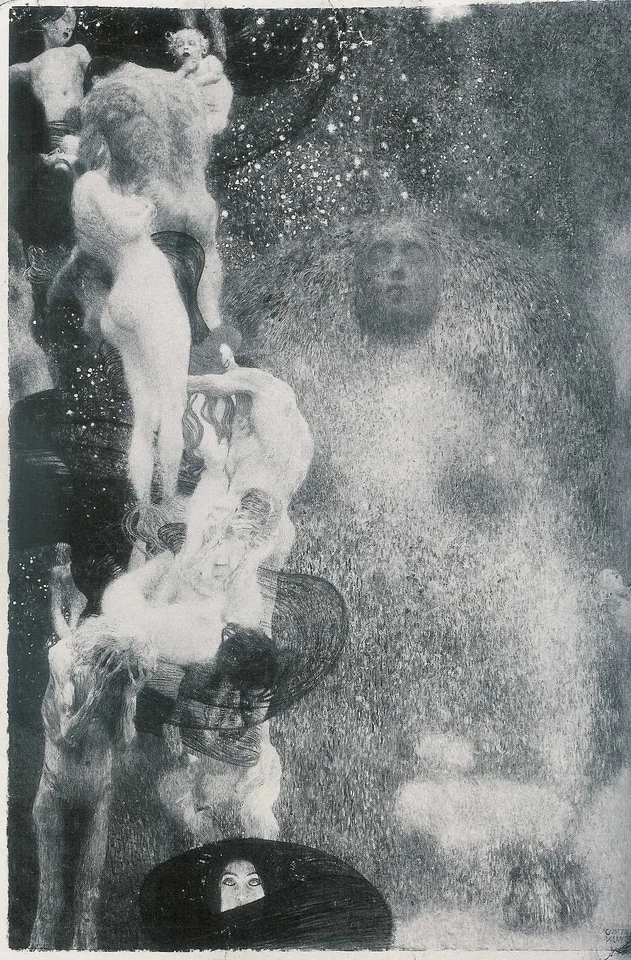
Philosophy was the first panel Klimt completed, presenting it to the Austrian government in March 1900 at the seventh exhibition of the Vienna Secession. The original proposal for the ceiling called for the theme of “The Victory of Light over Darkness.” Klimt abandoned that triumphant narrative to create a haunting composition.
On the left side of the panel, Klimt arranged a drifting column of bodies showing the cycle of human existence: the beginning of life, fruition, and decay. Across from them on the right side, the mystery of the globe hovered in darkness, while knowledge emerged below as an illuminated female figure. Klimt offered a deeply pessimistic view of science as an eternal struggle rather than a triumphant force, depicting humanity drifting helplessly in a viscous void.
The panel received contrasting reactions at home and abroad. When shown at the 1900 World Exhibition in Paris, Philosophy was awarded a gold medal. In Austria, however, local art critics attacked the canvas, finding its somber imagery unsettling and unfitting for a university hall.
Medicine
Medicine was presented second, appearing in March 1901 at the tenth Vienna Secession exhibition. Like Philosophy, it ignored conventional academic allegory in favor of biological vulnerability and mortality. You can compare this approach to Klimt’s other symbolic compositions in our collection of allegories.
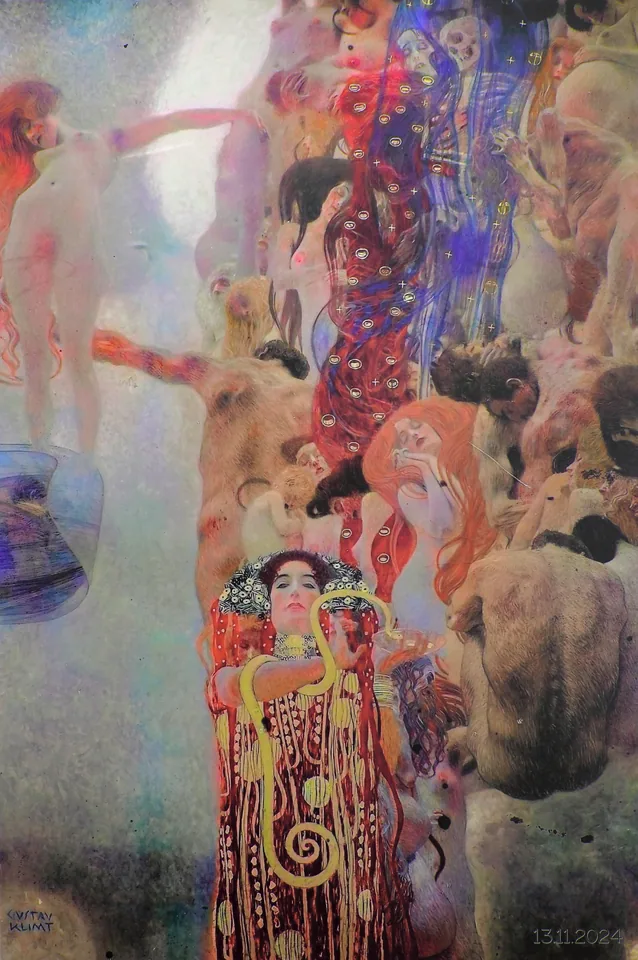
Along the right side of the canvas, Klimt painted a tall, floating column of semi-nude figures representing the river of life. Skeletal death stood intertwined with the living human forms. On the left side, a floating young nude female and a newborn infant represented life itself, connected to the drifting column of bodies only by two touching arms.
At the bottom of the canvas, standing centered in front of humanity, Klimt placed Hygieia. She held the Aesculapian snake coiled around her right arm and carried the cup of Lethe in her hand. Instead of ministering to the sick, she turned her back entirely on the human figures behind her. This cold detachment outraged the medical profession. An editorial in the Medizinische Wochenschrift complained that Klimt’s Medicine ignored the two primary achievements of doctors: prevention and cure.
Jurisprudence
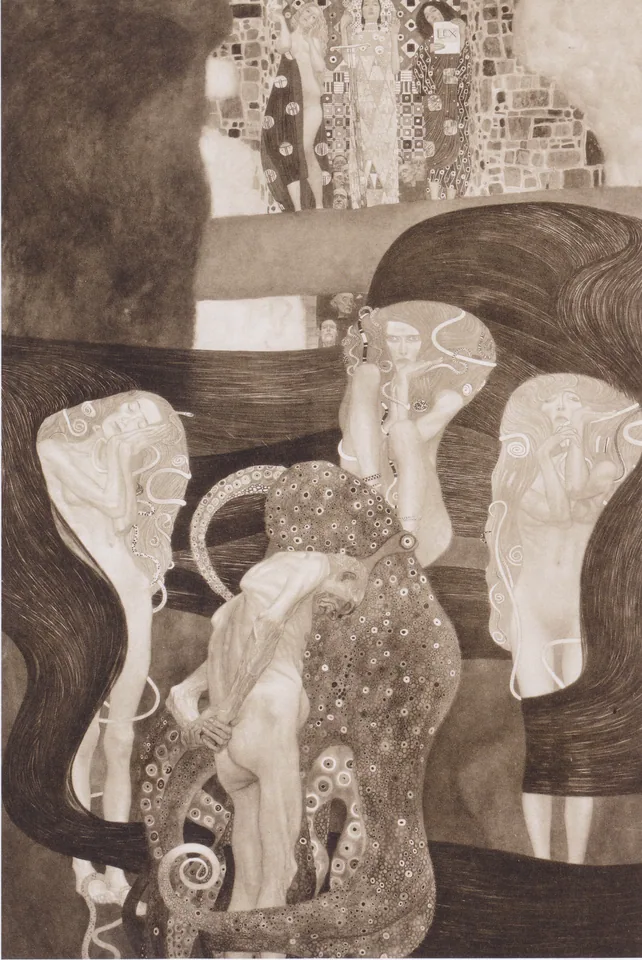
Jurisprudence, the final canvas in the series, departed radically from Klimt’s initial 1898 draft. The finished panel presented an aggressive, uncompromising composition that art historians interpret as Klimt’s direct response to public attacks on his earlier panels.
At the center of the painting, Klimt showed a condemned, emaciated old man trapped in the tentacles of an octopus. Three Eumenides, the Greek furies, surrounded the suffering prisoner to ensure his punishment. In the center, the judges appeared as small, distant figures, removed from the torment taking place beneath them.
At the top of the canvas, the personifications of Truth, Justice, and Law looked down on the scene. Justice gripped a sword, Law held a book inscribed with the word Lex, and Truth appeared half-naked. Critics strongly objected to the work. They argued that Jurisprudence functioned as a bottom-to-top wall mural rather than a proper ceiling painting, and they charged that Klimt had reduced legal philosophy to mere crime and punishment.
The scandal
The public reception of the panels was marked by intense hostility and political controversy. Eighty-seven faculty members of the University of Vienna formally protested against Klimt’s murals. In 1901, a public prosecutor was summoned, and the controversy over the panels prompted the first cultural debate ever raised in the Austrian Parliament.
Across the Austrian government, only the education minister defended Klimt. When Klimt was elected professor at the Academy of Fine Arts in 1901, the state government refused to ratify his appointment. Klimt fought back creatively and politically. Between 1901 and 1902, he painted Goldfish (to my critics) as a direct response to opponents who attacked the university panels as pornography and perverted excess. Author Hermann Bahr entered the debate in 1903, publishing the book Gegen Klimt to compile the hostile reviews and show the absurdity of the attacks.
The state grew increasingly anxious about displaying the controversial panels. In 1904, the education ministry declined a request to send the paintings to the Louisiana Purchase Exposition in St. Louis. In November 1903, a ministerial commission proposed displaying them in the Österreichische Galerie rather than installing them in the university Great Hall.
Klimt resolved never again to accept public commissions, stating that he had had enough of censorship and rejected all state support. On 3 April 1905, he wrote to the education ministry resigning his commission and asking to retain his works. When state removal staff arrived to take the panels, Klimt held them off by threatening them with a shotgun. With financial assistance from his patron August Lederer, Klimt bought back his paintings by repaying his 30,000-crown state advance in 1905.
Lost in 1945
After leaving state control, the paintings entered private collections. Patron August Lederer received Philosophy in exchange for financing Klimt’s repayment, and German records note that Lederer later acquired Jurisprudence as well. English records state that artist Koloman Moser purchased Medicine and Jurisprudence in 1911. Accounts also differ on Medicine: German sources state it entered the Österreichische Galerie, while English sources record that it came into the possession of a Jewish family before Nazi Germany seized it in 1938.
In 1939, Nazi authorities confiscated Philosophy and Jurisprudence from the Jewish Lederer family through aryanization. Baldur von Schirach then purchased both paintings for the University of Vienna using ministry funds, an acquisition initiated by Eduard Pernkopf and Richard Meister.
The three panels were exhibited together on a few occasions during these years. They were shown at Galerie Miethke in Vienna and Galerie Keller & Reiner in Berlin in 1907. In 1928, they hung together at the Klimt memorial exhibition marking ten years since his death. Their final public showing took place at a Klimt retrospective organized by Baldur von Schirach at the Vienna Secession.
In 1943, the paintings were moved to Schloss Immendorf in Lower Austria for safe storage. Between 1942 and 1945, the Institut für Denkmalpflege used the castle to store seized art collections, including the confiscated Lederer collection. On 8 May 1945, Schloss Immendorf caught fire and burned out completely with the art stored inside. Retreating German SS forces are widely believed to have set the fire to keep the art from enemy hands, though sources also note the fire was presumably started by the retreating Feldherrnhalle tank corps of the German army. While the building was gutted, art historian Tina Marie Storkovich established that no definitive proof exists that the paintings were destroyed.
What survives
Because the canvases were lost in the 1945 fire, visual records of the cycle remain limited. What survives includes preliminary sketches, black-and-white photographs of the originals, and one color photograph showing a detail of Medicine. Only one photograph survives showing the complete painting of Medicine, taken shortly before its presumed destruction.
Preparatory drawings give direct insight into Klimt’s working methods. Many of these preparatory sketches are preserved in the collections of the Albertina in Vienna. Photographs of the paintings, once held by the Welz Gallery in Salzburg, now belong to the Austrian National Library.
Modern projects have tried to recreate the visual power of the lost canvases. In 2005, the Leopold Museum mounted black-and-white copies of the paintings on the ceiling of the Great Hall at the University of Vienna. By late 2021, Google and the Leopold Museum used deep learning and expert retouching to reconstruct the possible colors of all three panels. On 13 November 2024, a twelve-by-eight-meter AI color reconstruction of Medicine was unveiled on an exterior wall at the Medical University of Vienna campus.
Questions and answers
What happened to Klimt's university paintings?
Klimt's university paintings burned in a fire at Schloss Immendorf on 8 May 1945 during the closing days of World War II. Nazi authorities had moved the confiscated canvases to the Austrian castle for storage. Retreating German forces reportedly burned the building, leaving the panels presumed destroyed, though art historian Tina Marie Storkovich noted that absolute proof of their destruction is missing.
Why were Klimt's Faculty Paintings controversial?
Klimt's Faculty Paintings provoked outrage because they broke with traditional allegories that glorified science, justice, and human reason. Instead of depicting heroic victories, Gustav Klimt showed humanity subject to aging, suffering, and death. Eighty-seven faculty members signed a formal protest against the works, medical critics condemned Medicine for omitting clinical cures, and politicians denounced the ceiling panels in the Austrian Parliament.
Who is Hygieia in Klimt's Medicine?
In Klimt's Medicine, Hygieia is the Greek goddess of health, positioned at the bottom center of the canvas. She wears a serpent around her arm and holds the cup of Lethe while turning her back on the suffering river of humanity behind her. Her detached stance angered contemporary physicians, who felt the painting ignored the healing powers of modern medical science.
Do any photos of Klimt's Faculty Paintings survive?
Black-and-white photographs of all three Faculty Paintings survive, along with one original color photograph of a detail from Medicine. A single photograph documents the complete Medicine canvas shortly before 1945. These historical negatives, once kept in Salzburg, now belong to the Austrian National Library and have allowed researchers to develop modern digital reconstructions of the lost murals.