Select the painting to see it full screen and zoom in.
What the painting shows
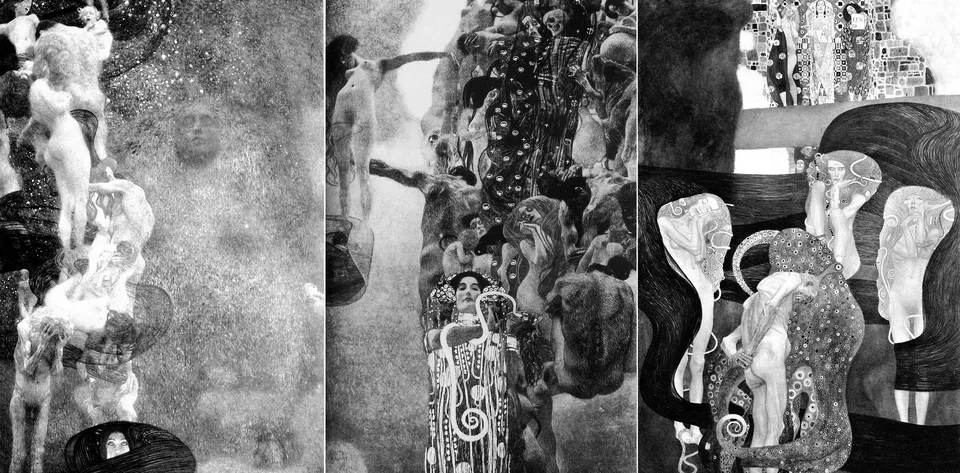
Philosophy by Klimt was one of three monumental ceiling panels designed for the University of Vienna, painted in oil on canvas between 1899 and 1907 before its loss in 1945. When you look at the surviving black and white photograph of the work, you see a tall vertical composition dominated by floating figures and shimmering atmospheric textures. The composition rejects classical order, presenting what Klimt called a dreamlike mass of humanity drifting through a viscous void.
On the left side of the canvas, a column of nude human figures drifts upward through darkness. Klimt described this group as representing the beginning of life, fruition, and decay. At the top of this drifting column, you see an infant held aloft, followed by intertwined bodies of lovers, mature figures, and bowed, gaunt forms near the lower edge. These men and women appear suspended in an aimless trance, carried by unseen currents rather than standing on solid ground.
To the right, a colossal, shadowy face emerges from a dense cloud of sparkling stars and stippled mist. Klimt described this monumental presence as the globe conceived as mystery. Its eyes look outward into space with a remote, veiled gaze, obscured by a dense aura of texture.
At the bottom of the canvas, a glowing female face with dark hair and bright, luminous eyes rises from the shadows. Klimt identified this radiant figure emerging below as knowledge. Her direct gaze confronts you from beneath the drifting stream of humanity, providing the painting’s sharpest focal point against the surrounding dark expanse. As one of Klimt’s most ambitious allegories, the canvas replaced traditional scholarly symbols with an unsettling vision of human existence.
The story behind it
The Austrian Ministry of Education commissioned Klimt in 1894 to create three works known as the University Paintings for the ceiling of the university’s Great Hall. The original theme proposed by the authorities for this canvas was “The Victory of Light over Darkness.” Officials expected a conventional, celebratory tribute to rational thought and academic inquiry. Klimt took the assignment in a different direction between 1900 and 1907, turning away from rationalism and academic optimism.
Klimt first presented Philosophy to the Austrian government at the seventh Vienna Secession exhibition in March 1900. While the painting won a gold medal at the World Exhibition in Paris that same year, the reaction in Vienna was hostile. Eighty-seven faculty members signed a formal protest against the mural, disturbed by the depiction of aimless, naked bodies. Critics attacked the work for what they called pornography and perverted excess.
The scandal quickly escalated into a national crisis. In 1901, a public prosecutor stepped in, and debates over the murals erupted on the floor of the Austrian Parliament. The government retaliated by refusing to ratify Klimt’s 1901 election as a professor at the Academy of Fine Arts. Author Hermann Bahr defended the works in his 1903 book Gegen Klimt, calling the public and official attacks absurd. The Austrian ministry continued its opposition, even blocking a request to display the ceiling panels at the 1904 Louisiana Purchase Exposition in St. Louis.
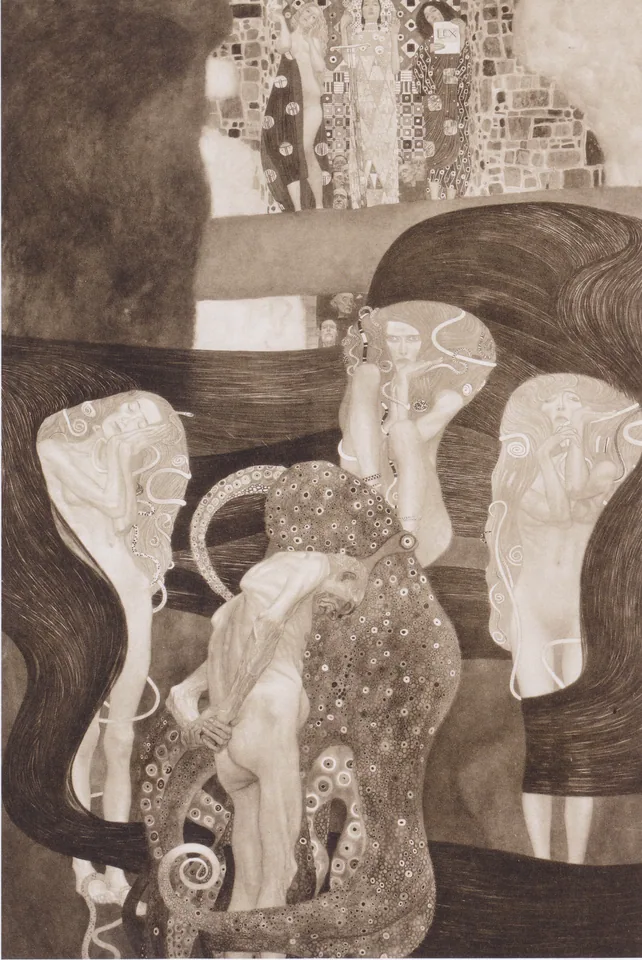
Deeply frustrated by the censorship, Klimt resolved never again to take state commissions or accept government funding. None of the murals ever hung in the University of Vienna. On 3 April 1905, Klimt resigned his commission after rejecting a proposal to hang the panels in the Österreichische Galerie. When ministry officials insisted the canvases were state property, Klimt kept possession of them by threatening removal workers with a shotgun. Backed by his patron August Lederer, Klimt repaid his 30,000-crown advance and transferred Philosophy to Lederer’s collection. You can explore how this work fits into Klimt’s career among every Klimt painting in our catalog.
What happened to it
Philosophy remained in private hands until the Second World War. In 1943, following a final exhibition, officials moved the painting along with Medicine and Jurisprudence to Schloss Immendorf in Lower Austria to protect them from air raids.
The artwork did not survive the end of the war. In May 1945, retreating SS forces set fire to Schloss Immendorf, gutting the castle. Philosophy is widely believed to have burned in the blaze. While art historian Tina Marie Storkovich noted that there is no conclusive proof the canvases were inside when the building burned, no trace of the original canvas has ever surfaced.
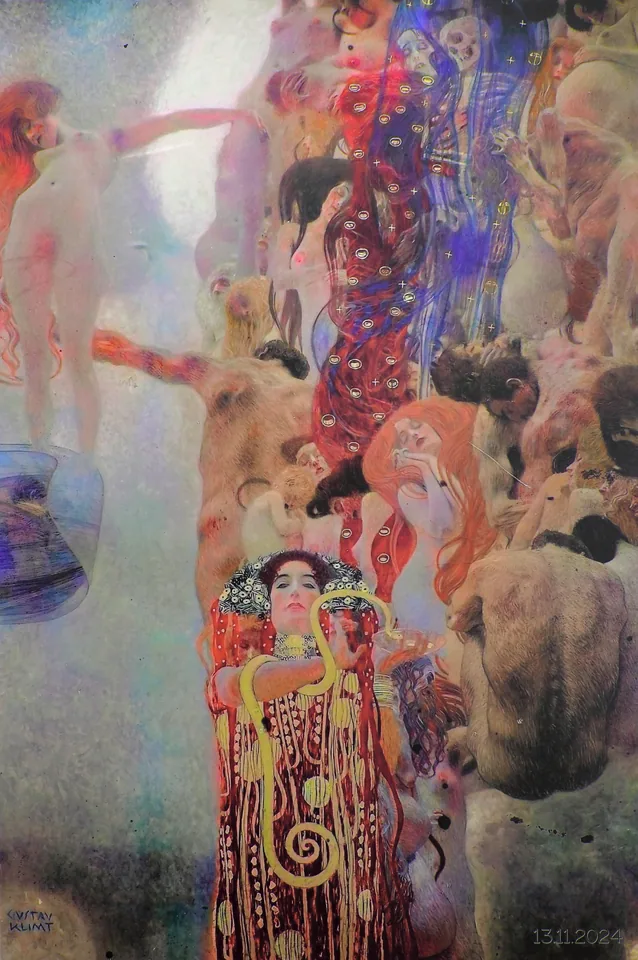
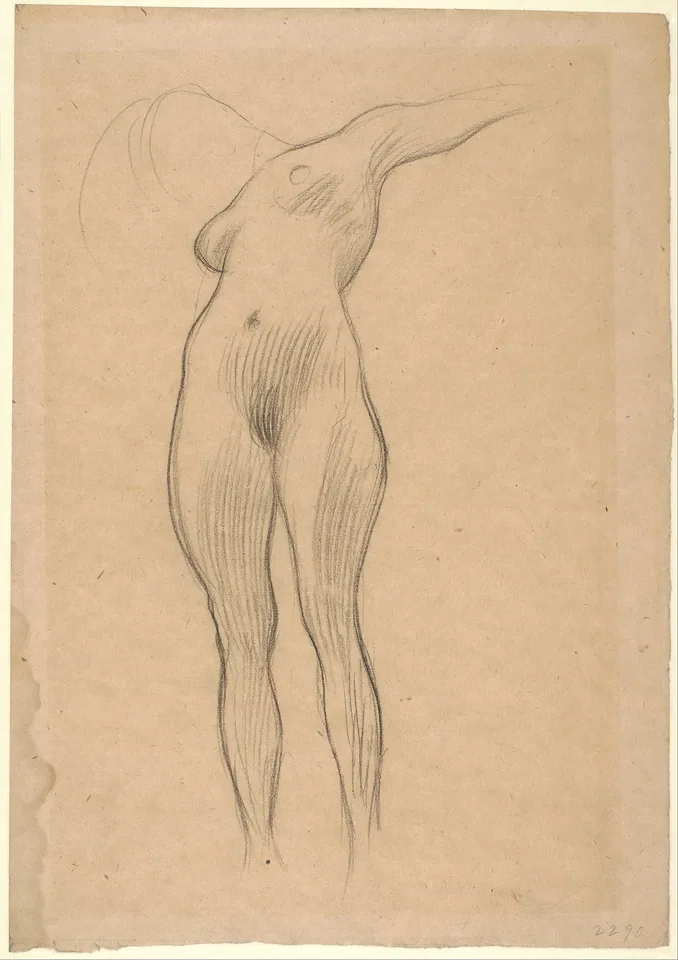
Today, all that survives of Philosophy are preparatory sketches and black and white photographs. In 2021, the Leopold Museum and Google applied deep learning technology and expert retouching to these photographs to reconstruct the colors Klimt may have used on the lost canvas.
Details of Philosophy
Questions about Philosophy
What happened to Philosophy by Klimt?
Philosophy by Gustav Klimt was destroyed in May 1945 during the final days of World War II. After being stored for safekeeping at Schloss Immendorf in Lower Austria, the artwork was lost when retreating SS forces set fire to the castle. Although art historian Tina Marie Storkovich found no conclusive proof of its destruction, the building was gutted, leaving only preparatory sketches and monochrome photographs of the work.
What does Philosophy by Klimt show?
Philosophy by Gustav Klimt shows a symbolic vision of human life rather than a conventional tribute to reason. On the left, an upward stream of human figures depicts life from infancy to old age and decay. On the right, a massive face emerges as a symbol of the mysterious cosmos. Below these figures, a radiant female head looks outward, representing knowledge emerging from the dark, viscous void.
Which series does Philosophy belong to?
Philosophy belongs to Gustav Klimt's University of Vienna Ceiling Paintings, widely known as the Faculty Paintings. Commissioned in 1894 for the ceiling of the university's Great Hall, the three-part decorative cycle also included Medicine and Jurisprudence. Following intense public controversy over their provocative imagery, Klimt withdrew the entire series from the state in 1905, ensuring that none of the three canvases ever hung inside the university.