Select the painting to see it full screen and zoom in.
What the painting shows
Jurisprudence by Klimt is an oil on canvas work created between 1903 and 1907. The composition presents a condemned man subjected to severe physical and psychological judgment. When you look at the canvas, the scene centers on vulnerability, punishment, and dread rather than rational justice.
In the lower foreground, an elderly, gaunt man stands naked with his back bowed and hands clasped behind him. A large sea monster wraps its spotted tentacles around his body and limbs, trapping him in a deadly embrace. Around him stand three female furies, depicted as the Eumenides, with snakes coiled through their flowing hair. Their cold, unblinking expressions look directly out at you while heavy dark locks flow down the canvas.
High above this scene of physical punishment, an upper register displays the remote figures of Truth, Justice, and Law. They wear patterned robes and hold their traditional symbols, standing before intricate geometric panels. Art historians describe the composition as laden with anxiety, reading the central struggle as a psycho-sexual conflict. The painting belongs to Klimt’s symbolic allegories, where human forms embody complex internal states.
The story behind it
In 1894, the Austrian Ministry of Education commissioned Gustav Klimt to paint ceiling panels for the University of Vienna Great Hall. Klimt executed these works between 1900 and 1907 as part of the University of Vienna ceiling paintings, also known as the Faculty Paintings. The completed series comprised three ceiling works: Philosophy, Medicine, and Jurisprudence. None of these three Faculty Paintings were ever put on display at the university.
When Klimt presented his panels, critics attacked them for alleged pornography and perverted excess. Gilles Néret noted that the murals contradicted the era’s trend to sublimate reality and present only its favorable aspects. Eighty-seven faculty members signed an official protest, and a public prosecutor intervened as the controversy reached the Austrian Parliament. The debate marked the first cultural discussion raised in parliament, though politicians took no formal action, and only the education minister defended Klimt.
Following the scandal, the Austrian government refused to ratify Klimt’s 1901 election as a professor at the Academy of Fine Arts. Klimt was never offered another teaching post and resolved never again to accept state commissions or state support. In 1903, writer Hermann Bahr published the book Gegen Klimt, arguing that the public hostility toward the works was absurd. The ministry also declined a request to show the paintings at the 1904 Louisiana Purchase Exposition in St. Louis due to nervousness over public reactions.
In November 1903, the ministry’s artistic commission examined the panels and proposed hanging them in the Österreichische Galerie instead of the Great Hall. Klimt rejected the proposal, resigned his commission on 3 April 1905, and kept his panels after threatening removal staff with a shotgun. With financial support from his patron August Lederer, Klimt repaid his advance to the state. His friend and fellow artist Koloman Moser purchased Jurisprudence and Medicine in 1911.
What happened to it
In 1943, after a final exhibition, the paintings were moved to Schloss Immendorf in Lower Austria for protection. In May 1945, retreating German SS forces set fire to Schloss Immendorf to prevent it from falling into enemy hands.
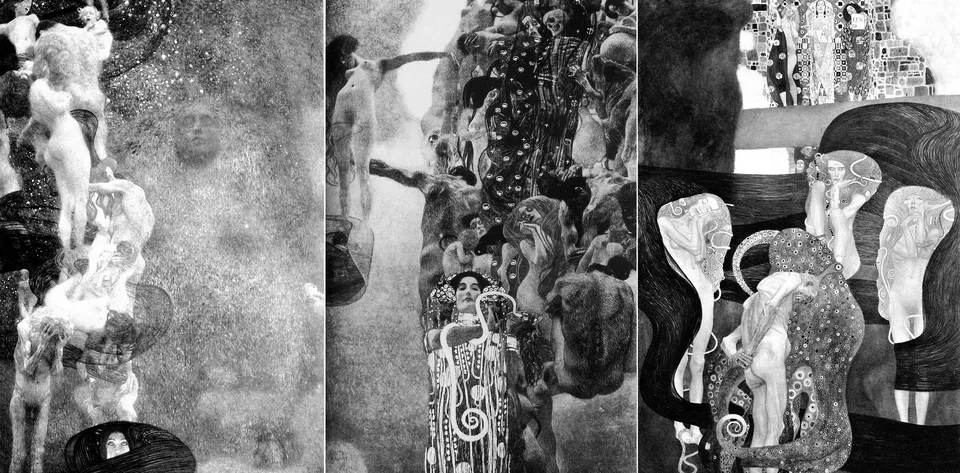
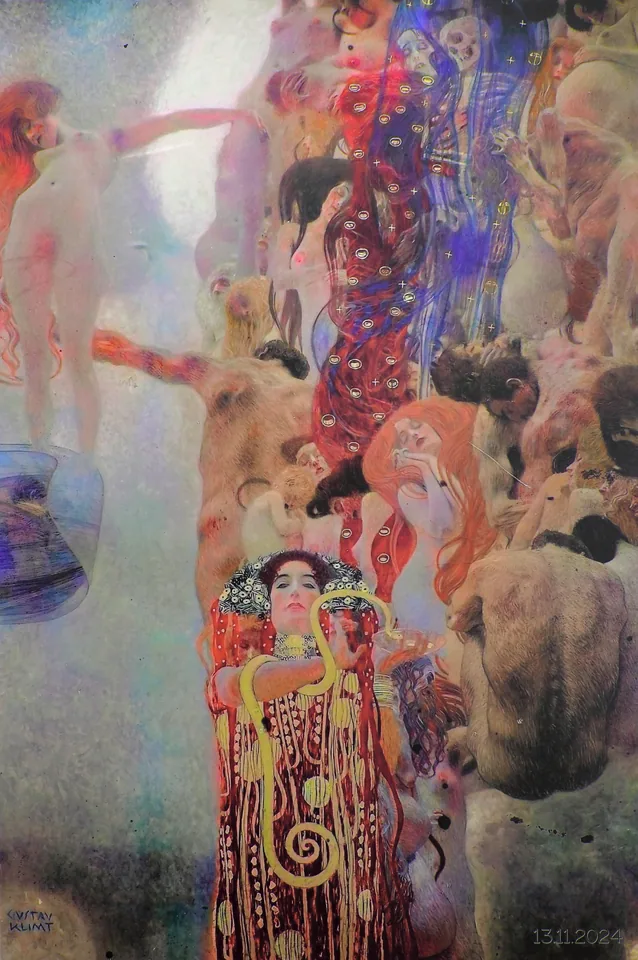
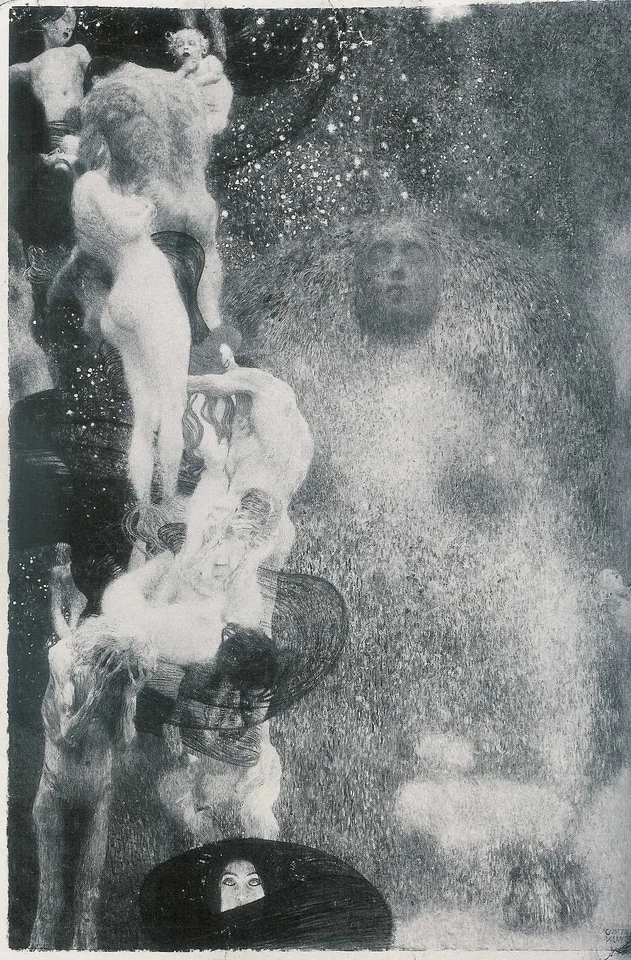
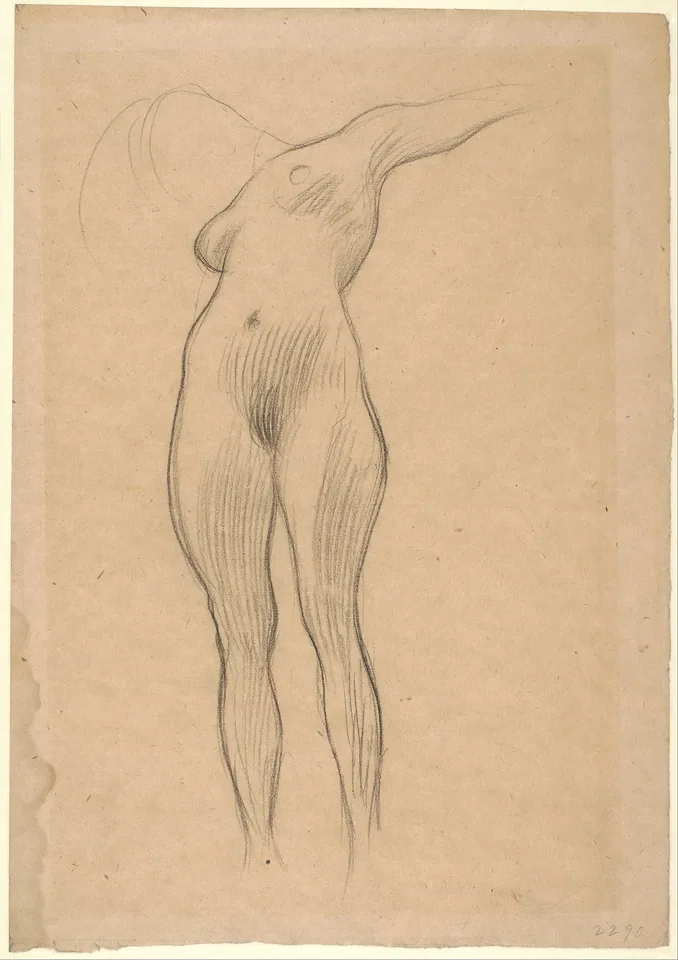
It is widely believed that Jurisprudence and the companion panels were destroyed in the fire at Schloss Immendorf. Art historian Tina Marie Storkovich found, however, that while the castle was gutted, no conclusive proof of the paintings’ destruction exists. As far as is known, only preparatory sketches and a few photographs survive today. When you explore every Klimt painting, digital color reconstructions completed in late 2021 by Google and the Leopold Museum offer a glimpse into how the original palette may have appeared.
Details of Jurisprudence
Questions about Jurisprudence
What happened to Jurisprudence by Klimt?
Jurisprudence by Klimt is widely believed to have been destroyed by fire in May 1945. Retreating German SS troops burned Schloss Immendorf in Lower Austria, where the canvas had been stored for protection during the war. Although the castle was gutted, art historian Tina Marie Storkovich noted that no conclusive proof of the painting's destruction exists. Today, only preparatory sketches, historical photographs, and modern digital color reconstructions remain.
What does Jurisprudence by Klimt show?
Jurisprudence by Klimt portrays an elderly condemned man trapped inside the coils of an octopus-like sea monster. Three female furies, identified as the Eumenides, stand around him with intertwined snakes in their hair to execute his punishment. Above this punishing scene, the three remote figures of Truth, Justice, and Law look on from an elevated background register. The scene captures deep anxiety and a severe psycho-sexual conflict.
When did Klimt paint Jurisprudence?
Gustav Klimt painted Jurisprudence between 1903 and 1907 as the final piece of his ceiling panels for the University of Vienna. The Austrian state initially commissioned the work in 1894, but severe public controversy delayed its completion. Klimt eventually resigned the official commission in 1905, repaid the state advance with financial help from August Lederer, and completed the canvas privately before selling it to Koloman Moser in 1911.