Select the painting to see it full screen and zoom in.
What the painting shows
The Faculty Paintings by Klimt were three monumental oil paintings titled Philosophy, Medicine, and Jurisprudence. As complex allegories, the panels rejected traditional academic symbols in favor of raw human bodies, existential cycles, and psychological dread.
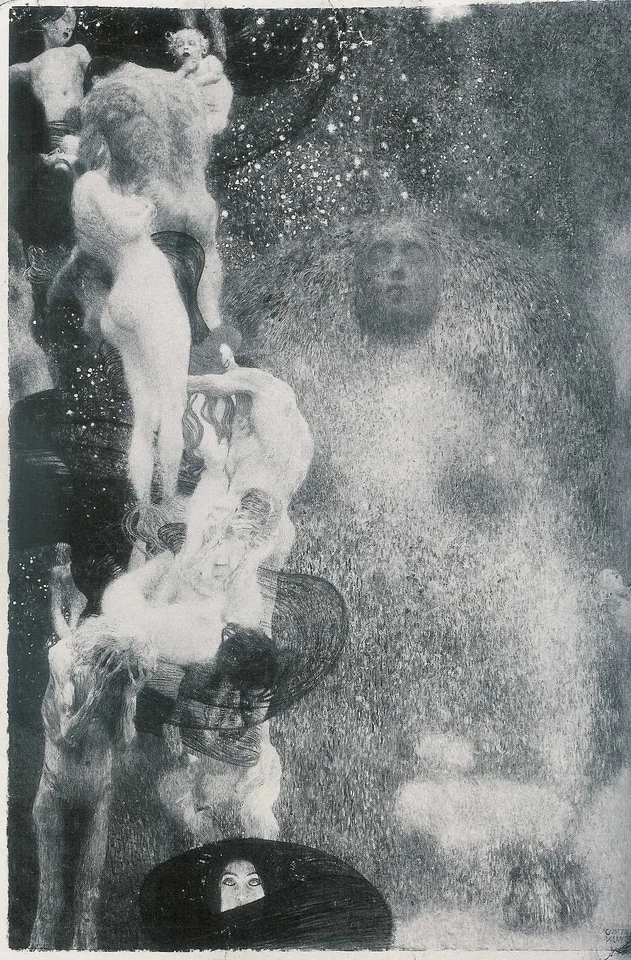
In Philosophy, seen on the left panel of the photographic record, a dense column of drifting bodies rises along the left side. Klimt explained that these figures represent the journey of life, from birth through fruition to physical decay. To their right, a hazy cosmic shape evokes the mystery of the universe, while a glowing head emerges from below to represent knowledge. Instead of showing the triumph of human reason, Klimt pictured humanity as a dreaming crowd drifting through empty space.
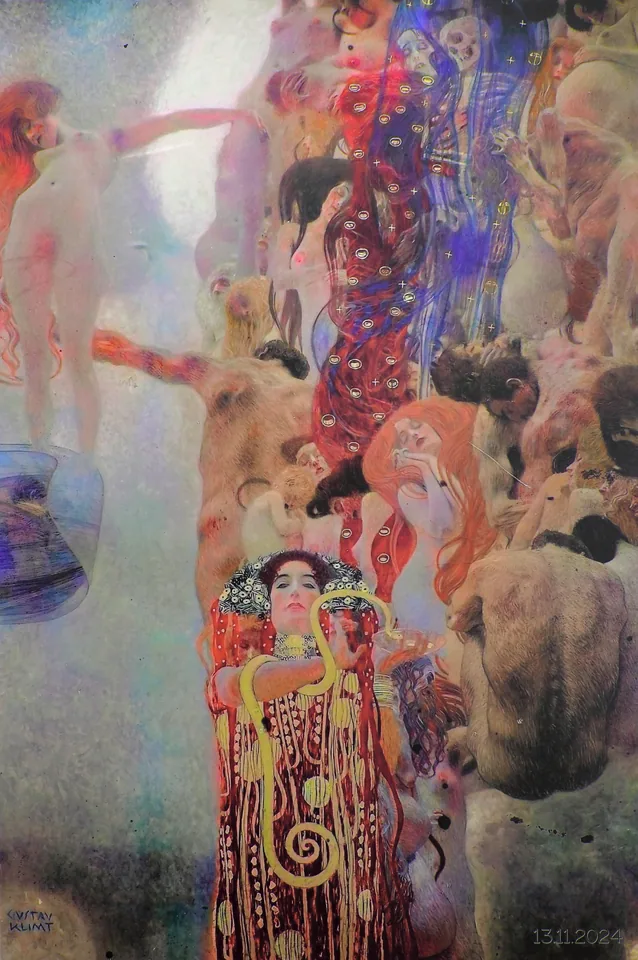
Medicine, shown in the center panel, presents a tall pillar of naked and semi-nude figures along the right edge, forming a continuous river of life. A skeleton stands among the living bodies to personify death. Toward the left, a naked female figure floats in space with an infant at her feet. She connects to the main column solely through two outstretched arms, hers and a man’s viewed from the back. At the bottom foreground, Hygieia, the goddess of health, stands apart from mankind. She holds the cup of Lethe with the Aesculapian snake coiled around her wrist.
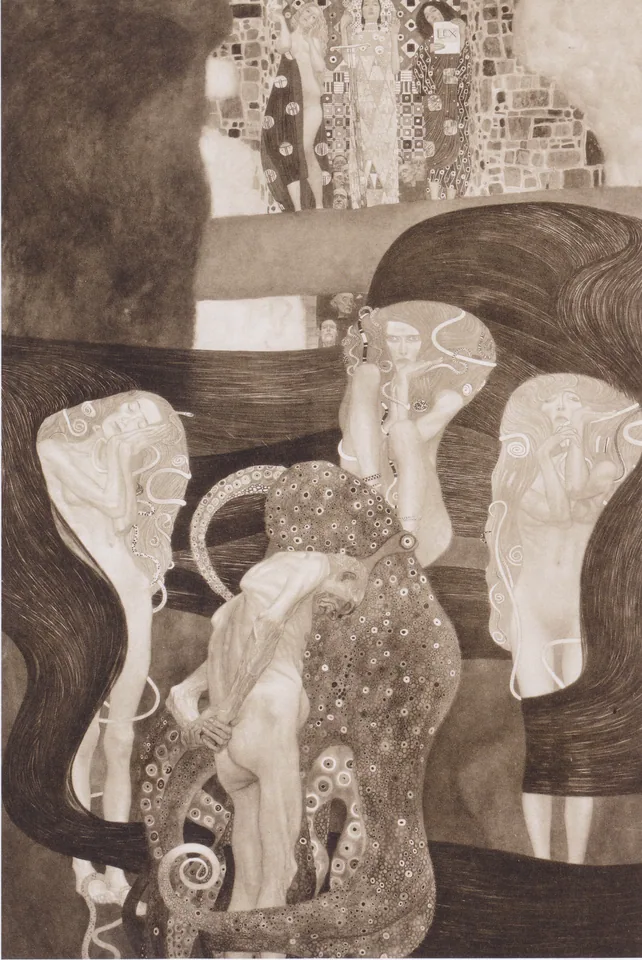
Jurisprudence occupies the third panel on the right. An elderly, naked prisoner stands hunched forward, wrapped in the coils of a monstrous octopus. Three snake-haired furies, representing the Eumenides, surround him to inflict punishment. Far above in the upper background, the small figures of Truth, Justice, and Law look down from a flat, decorative register, detached from the physical torment below.
The story behind it
The Ministry of Education commissioned Gustav Klimt in 1894 to paint ceiling panels for the Great Hall of the University of Vienna. Klimt spent years preparing the compositions, departing from the historical style seen in other entries across his paintings.
When Klimt presented Philosophy at the Vienna Secession in March 1900, the response in Vienna was hostile. Austrian critics denounced the painting as vague and depressive, even as it won a gold medal at the World Exhibition in Paris that same year. Eighty-seven faculty members signed an official petition rejecting the work.
Medicine caused an even harsher public reaction when shown in 1901. Critics accused Klimt of pornography and complained that he ignored medical advances such as prevention and cure. The controversy sparked a debate in the Austrian Parliament, marking the first time the assembly debated visual art. The state refused to confirm Klimt’s appointment as professor at the Academy of Fine Arts, ending his chances for academic employment.
Klimt responded by abandoning state patronage. In 1905, he withdrew from the commission, repaid his 30,000-crown advance with money provided by collector August Lederer, and secured the return of the canvases after threatening removal workers with a shotgun. To read more about the commission, visit the guide to the University (Faculty) Paintings.
What happened to it
None of the three Faculty Paintings were ever installed at the University of Vienna. After Klimt reclaimed them, August Lederer took ownership of Philosophy as repayment for funding the advance. In 1911, artist Koloman Moser bought Medicine and Jurisprudence. Medicine later joined another private Jewish collection in Vienna, from which Nazi authorities seized the canvas in 1938.
In 1943, officials transferred all three paintings to Schloss Immendorf in Lower Austria to protect them from wartime air raids. In May 1945, retreating German SS units set fire to the castle. It is widely accepted that the three canvases burned in the ruins. While historian Tina Marie Storkovich noted that absolute physical proof of their destruction is missing, no fragments have ever resurfaced.
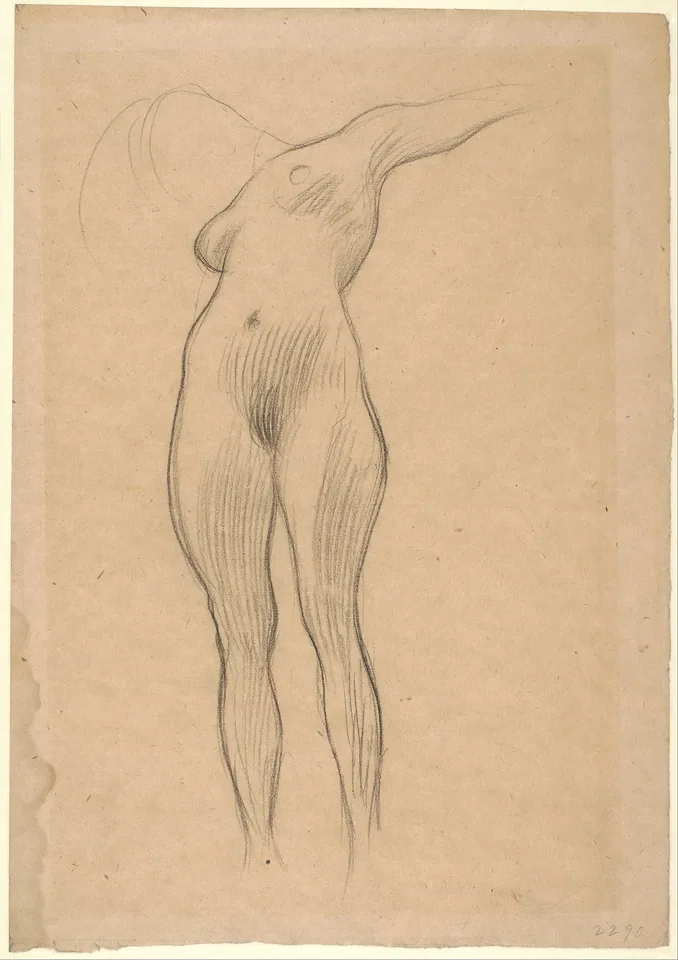
Black-and-white photographs and preparatory sketches are the primary surviving visual records. In 2021, the Leopold Museum and Google used deep learning algorithms and historical records to reconstruct the possible original colors of the lost paintings, with manual adjustments by Klimt specialists.
Details of The Faculty Paintings
Questions about The Faculty Paintings
What happened to The Faculty Paintings by Klimt?
The Faculty Paintings by Klimt were moved in 1943 to Schloss Immendorf in Lower Austria for safekeeping. In May 1945, retreating German SS forces set fire to the castle to keep contents from enemy hands. The three canvases are widely believed to have burned in the fire, though art historian Tina Marie Storkovich noted no definitive physical proof survives. Today, only sketches and several photographs remain.
What does The Faculty Paintings by Klimt show?
The Faculty Paintings by Klimt present three distinct panels titled Philosophy, Medicine, and Jurisprudence. Philosophy displays a floating mass of human figures next to a glowing sphere and an apparition of light. Medicine shows a column of bodies intertwined with a skeleton, guarded below by the goddess Hygieia with an Aesculapian snake. Jurisprudence features an emaciated prisoner trapped by an octopus and three Eumenides, watched by distant judges.
When did Klimt paint The Faculty Paintings?
Gustav Klimt was commissioned to create the ceiling panels in 1894 and worked on them between 1899 and 1907. He exhibited Philosophy at the Vienna Secession in 1900 and Medicine in 1901. He completed work on Jurisprudence by 1907 after resigning from the state commission in 1905 and refunding the government advance with the support of private collector August Lederer.