Select the painting to see it full screen and zoom in.
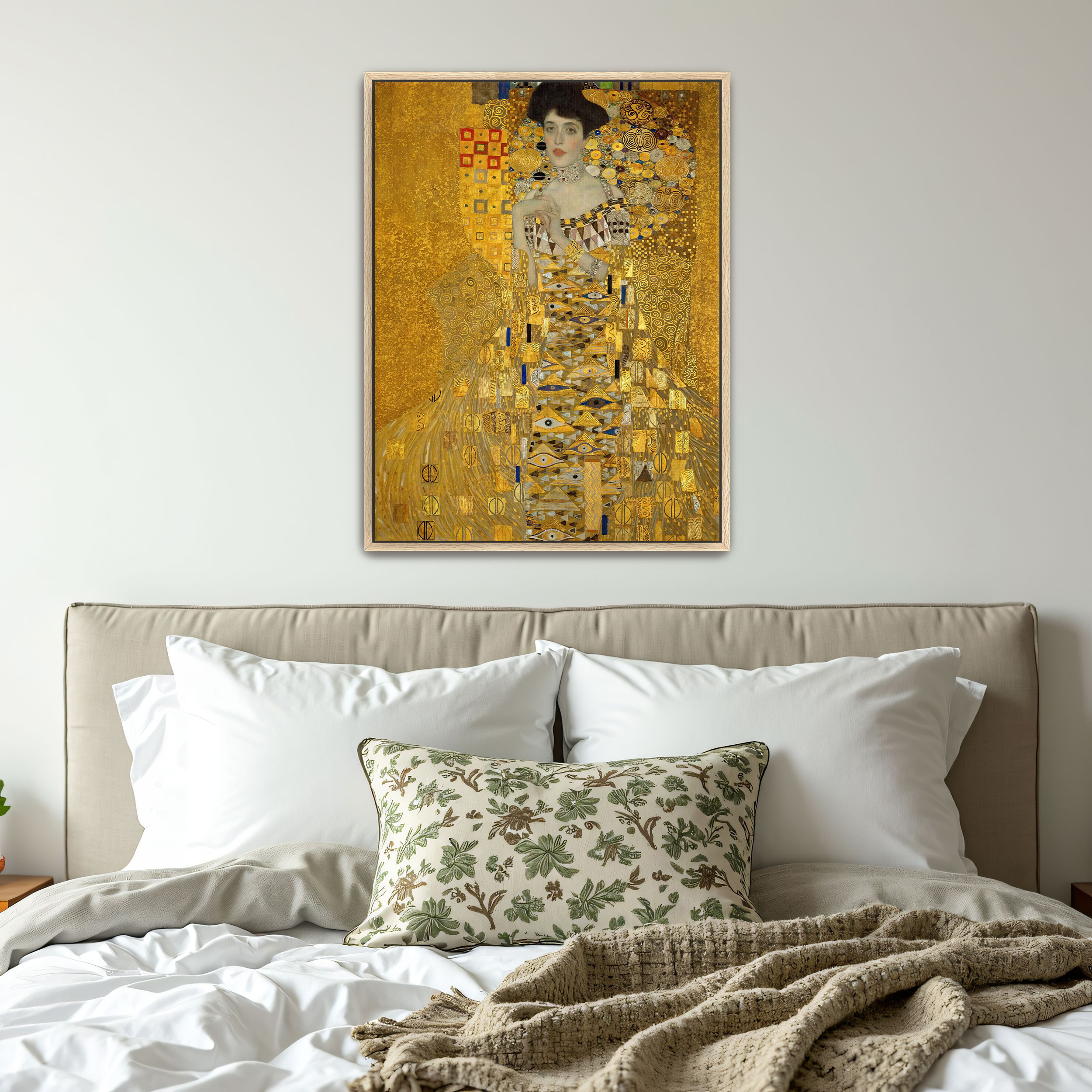
Portrait of Adele Bloch-Bauer I as a print, in a room



What the painting shows
Portrait of Adele Bloch-Bauer I by Gustav Klimt, often called the Woman in Gold, presents a seated figure surrounded by shimmering metal leaf and intricate ornamentation. Klimt completed the painting between 1903 and 1907, creating what is widely considered the final and most representative work of his gold period. The canvas is a square measuring 138 by 138 centimeters.
Adele sits in the right half of the composition, turned slightly toward you. Her face, styled dark hair, bare shoulders, and delicate clasped hands are rendered realistically with soft modeling and pale flesh tones. These naturalistic passages occupy less than one-twelfth of the entire picture surface. Her dark eyes gaze straight forward beneath heavy brows, framed by red lips and a faint flush on her cheeks. Around her neck rests a wide, diamond-encrusted choker.
The rest of the surface dissolves into a two-dimensional expanse of gold and silver leaf. Adele wears a tight golden gown that cascades across the lower half of the composition. The fabric displays horizontal registers of repeating motifs, including double rows of slender triangles, black rectangular accents, and staring eye shapes enclosed within larger triangles. Klimt also incorporated subtle monogram designs based on the letters A and B, referencing Adele Bloch-Bauer’s initials.
Behind her head, a circular golden halo or headrest spreads out, decorated with dark running spirals, silver circular medallions, and clustered speckles. Adele’s golden armchair bulges out to either side, covered with tight coils and running spiral ornaments that blend directly into the background. To the right, a textured wall of hammered gold leaf and small square mosaic tiles fills the space from top to bottom.
On the left side of the canvas, the setting remains ambiguous. Klimt painted a mottled, shimmering golden wall interrupted near the top and left edge by small silver and dark geometric squares. Two vertical bands of alternating red and gold checkerboard patterns run down behind the chair. Across the bottom left, the golden field ends at a crisp horizontal border of black-and-white checkers, giving way to a solid band of muted olive green at the floor level.
To build this surface, Klimt applied gold and silver leaf over layers of gesso, a gypsum or chalk paste that produced delicate bas-relief textures under the metallic foil. He drew inspiration directly from the sixth-century Byzantine mosaics of Emperor Justinian and Empress Theodora at the Basilica of San Vitale in Ravenna, which he visited in December 1903. Art historians also note traces of Minoan, Mycenaean, Egyptian, and medieval Italian art, along with Japanese ukiyo-e woodblock prints. Art historians such as Elana Shapira read erotic symbolism into the triangles, eggs, and almond shapes on her gown, while scholar Frank Whitford noted that the surrounding gold turns the sitter into an apparition akin to a sacred icon.
Who the sitter was
Adele Bauer was born in Vienna on August 9, 1881, into a prominent Jewish family. Her father, Moritz Bauer, directed the Wiener Bankverein and served as general director of the Oriental Railway. In December 1899, at age eighteen, she married Ferdinand Bloch, a thirty-five-year-old sugar industrialist and banker. Following the wedding, both partners changed their surname to Bloch-Bauer. The couple had no children.
Adele became an intellectual presence in Viennese society, holding regular cultural salons at the couple’s home. Her gatherings attracted politicians such as Karl Renner and Julius Tandler, as well as writers and composers like Gustav Mahler and Richard Strauss. Her niece, Maria Altmann, later described Adele as elegant and intellectualized, but delicate and often suffering from severe headaches while smoking heavily.
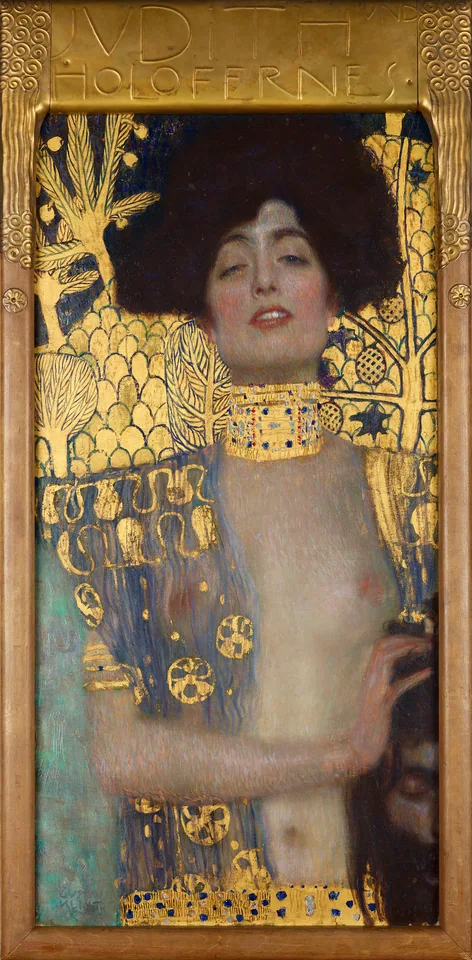
Klimt established a close artistic relationship with Adele across several years. In 1901, she modeled for his painting Judith I, wearing the exact same jeweled choker that appears in her 1907 portrait. Writer Catherine Dean suggested that Adele was Klimt’s mistress, though biographers Melissa Müller and Monica Tatzkow found no evidence that their connection went beyond close friendship. In mid-1903, Ferdinand Bloch-Bauer commissioned Klimt to paint Adele as an anniversary present for her parents. Klimt spent four years preparing the canvas, producing over one hundred drawings, the most extensive preparatory work he ever made for a single commission. In 1912, Ferdinand commissioned Klimt to paint her again in Portrait of Adele Bloch-Bauer II, making Adele the only person Klimt ever painted twice in full length across his commissioned portraits.
Adele died of meningitis on January 24, 1925, at the age of forty-three. In her 1923 will, she had asked Ferdinand to consider leaving her Klimt paintings to the Austrian State Gallery upon his death. Ferdinand kept the artworks in Adele’s bedroom as a memorial shrine.
Following Nazi Germany’s annexation of Austria in March 1938, Ferdinand fled Vienna, eventually finding refuge in Switzerland. The Nazi regime seized his estate under false allegations of tax evasion, and attorney Erich Führer (recorded in some sources as Friedrich Führer) took control of the collection. Adele’s famous choker was taken by Hermann Göring for his wife Emmy, and in 1941, Führer transferred the portrait to the Galerie Belvedere in Vienna. The museum renamed it Dame in Gold to conceal Adele’s Jewish heritage.
Ferdinand Bloch-Bauer died in Zurich in November 1945, leaving his entire estate to his nieces and nephew. Postwar Austrian authorities refused to grant export licenses for other family assets unless the heirs surrendered the Klimt canvases. In 1998, investigative journalist Hubertus Czernin exposed records proving the Austrian state did not legally own the paintings. Maria Altmann, Adele’s niece, hired attorney E. Randol Schoenberg and initiated legal proceedings that reached the United States Supreme Court in Republic of Austria v. Altmann. In January 2006, an Austrian arbitration panel determined that the paintings had been looted and belonged to the Bloch-Bauer heirs.
Where to see it
Portrait of Adele Bloch-Bauer I hangs in the Neue Galerie in New York City, located on Museum Mile at Fifth Avenue and 86th Street. The museum, co-founded by Ronald Lauder, has displayed the painting permanently since July 12, 2006.
Lauder purchased the painting from Maria Altmann and the family heirs in June 2006 for a world-record price, securing its permanent home in a public institution. While private collectors can occasionally read about opportunities to buy an original Klimt through specialized auctions, this singular golden portrait remains accessible to everyone who visits the Neue Galerie’s galleries of Austrian and German art.
Choosing a print
Prints are printed and shipped by ArtsyWall in three formats, each highlighting different qualities of Klimt’s shimmering original.
- Framed Canvas suits this portrait exceptionally well. The canvas weave carries the deep gold, ochre, and green fields, while the floating wood frame matches the architectural enclosure Klimt originally planned with Josef Hoffmann.
- Premium Canvas offers a clean presentation. The gallery-wrapped edges let the swirling mosaic patterns and gold leaf textures extend continuously around the sides of the stretcher bars.
- Archival Paper captures the precision of Klimt’s decorative details. The textured 100% cotton rag surface brings out the fine lines of Adele’s face, the intricate eye motifs on her gown, and the geometric squares of the background.
Details of Portrait of Adele Bloch-Bauer I
Questions about Portrait of Adele Bloch-Bauer I
What does Portrait of Adele Bloch-Bauer I by Klimt show?
Portrait of Adele Bloch-Bauer I shows Adele seated in a golden chair enveloped by shimmering gold patterns. Her realistic face, dark hair, jeweled collar, and clasped hands appear in the upper center, while her gown flows outward into geometric shapes, eye symbols, and gold leaf that fill most of the canvas.
Who was Adele Bloch-Bauer?
Adele Bloch-Bauer was a Viennese cultural figure from a prominent Jewish banking family who married industrialist Ferdinand Bloch-Bauer. She hosted salons that gathered politicians, writers, and composers in Vienna. Adele modeled for Klimt's 1901 Judith I and sat for two full-length portraits before dying of meningitis in 1925 at age forty-three.
When did Klimt paint Portrait of Adele Bloch-Bauer I?
Gustav Klimt worked on Portrait of Adele Bloch-Bauer I between 1903 and 1907. Ferdinand Bloch-Bauer commissioned the portrait in mid-1903 as an anniversary gift for Adele's parents. Klimt drew more than one hundred preparatory sketches and studied early Christian mosaics in Ravenna before completing the gold-leaf canvas in 1907.
Where is Portrait of Adele Bloch-Bauer I by Klimt?
Portrait of Adele Bloch-Bauer I hangs on permanent public display at the Neue Galerie in New York City. The painting entered the museum in 2006 after businessman Ronald Lauder acquired it from Maria Altmann, following the Austrian arbitration ruling that restored the looted canvas to the Bloch-Bauer family.
What is Portrait of Adele Bloch-Bauer I by Klimt made of?
Gustav Klimt painted Portrait of Adele Bloch-Bauer I on canvas using oil paint, gold leaf, and silver leaf. To create the raised decorative relief beneath the leaf, he used gesso, a traditional mixture of chalk or gypsum. Architect Josef Hoffmann designed the original gold-leaf wood frame.