Select the painting to see it full screen and zoom in.
What the painting shows
Hope II by Klimt depicts a standing pregnant woman who occupies the central third of a square canvas. She tilts her head downward with her eyes closed, looking toward her exposed breasts and rounded stomach. Her long brown hair falls around her pale face, and her hands are raised gently near her chest. The central figure depicts Herma, who was one of Klimt’s favourite models. Because she wears a decorative gown, the figure is less provocative than the completely naked woman in Klimt’s earlier painting, Hope I.
A bold, patterned cloak wraps around her body. The fabric displays concentric circles, discs, and geometric shapes in bright red, orange, yellow, and green. Klimt decorated the clothing with gold leaf, creating a flat appearance reminiscent of Byzantine artwork and Orthodox icons. Down the left side of the gown runs a cascading strip filled with swirls, blue accents, purple bands, and stylized circular motifs. This flattened decorative surface contrasts with the soft modeling of Herma’s bare skin and contoured features.
A small human skull appears tucked directly into the folds of the patterned garment above the woman’s belly. Art historians read this skull as a symbol of death, perhaps signifying the physical dangers of childbirth or serving as a traditional memento mori. At the bottom edge of the painting, three more women bow their heads, appearing to pray or mourn. Their faces and hands emerge from patterned clothing beneath the swelling curve of the cloak. Behind the figures, the background remains quiet and flat, painted in dark tones flecked with gold.
The story behind it
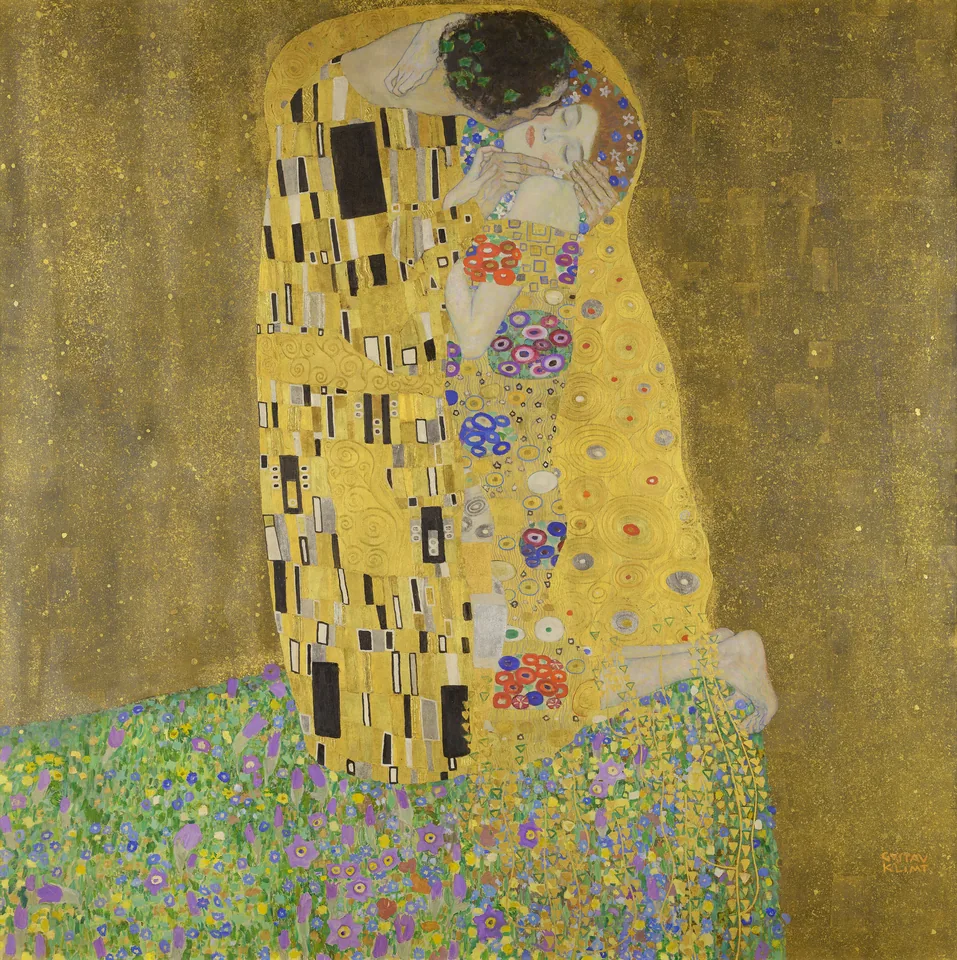
Klimt created this painting during his celebrated gold period between 1907 and 1908. He worked on it at the same time as The Kiss, and both pieces share a similar vertical grouping and rich, decorative palette. Depicting pregnancy was considered taboo in fine art at the start of the twentieth century, yet Klimt repeatedly returned to the subject in his personal exploration of life cycles.
Klimt originally called the painting Vision. It only later took the title Hope II, connecting it directly to his earlier canvas Hope. It stands out among Klimt’s allegories for its balance between life and mortality. Between 1909 and 1914, Klimt returned to the canvas to make changes: he painted over a halo that originally sat above the woman’s head and added the skull resting over her belly. If you explore every Klimt painting from this era, you can see how frequently he refined finished compositions before letting them leave his studio.
The public first saw the work at the 1908 Kunstschau exhibition in Vienna, where it hung alongside The Kiss and Danaë. A year later, it appeared under the title Vision at the 1909 International Art Exhibition in Vienna.
Eugenie Primavesi acquired the canvas before December 1914. Decades later, in the late 1930s, the painting was sold through Otto Kallir’s Neue Galerie or Kallir’s successor, Vita Künstler. It stayed in private collections for several decades until Hans Barnas sold it in 1978.
Where to see it
You can see Hope II at the Museum of Modern Art in New York City. The museum acquired the painting in 1978, bringing one of Klimt’s major square-format compositions into its permanent collection. The work measures 110.5 by 110.5 centimetres and hangs on display among other twentieth-century European modern works.
Details of Hope II
Questions about Hope II
What does Hope II by Klimt show?
Hope II by Klimt shows a pregnant woman with closed eyes bowing her head toward her bare breasts and abdomen. A human skull peers out from beneath her patterned cloak, symbolizing death. At the bottom of the canvas, three additional women bow their heads as if praying or mourning against a dark, gold-flecked background.
When did Klimt paint Hope II?
Gustav Klimt painted Hope II between 1907 and 1908. He worked on the canvas during the same period he created The Kiss. Between 1909 and 1914, Klimt revised the painting by painting over a halo above the woman's head and adding the human skull above her swollen belly.
Where is Hope II by Klimt?
Hope II by Gustav Klimt is in the permanent collection of the Museum of Modern Art in New York City. The museum acquired the painting in 1978 from art collector Hans Barnas. It remains on view there today as one of the key works from Klimt's golden period.