Klimt's Golden Phase: The Gold Paintings Explained
Klimt's golden phase was a creative period from about 1899 to 1910 defined by gold leaf, flat ornament, and Byzantine imagery. It produced works such as The Kiss and the Portrait of Adele Bloch-Bauer I.
What the golden phase was
Klimt’s golden phase was a creative period running from about 1899 to 1910 when Gustav Klimt incorporated gold leaf, metallic elements, and flat ornamental patterns into his oil paintings. The start of this era coincided with the early years of the Vienna Secession, an avant-garde artist group Klimt helped establish. The period continued until about 1909 or 1910, bringing Klimt sustained financial success and positive critical reaction from international collectors.
From 1900 onward, Klimt applied Art Nouveau principles of flat decoration, stylized motifs, and real gold leaf to approximately one large-format female portrait per year. These canvases merged realistic rendering of faces and hands with two-dimensional gilded fields. Instead of painting traditional atmospheric backgrounds, Klimt filled negative space with shimmering sheets of metal leaf, swirling spirals, and geometric tessellations.
Today, you recognize this phase as the signature aesthetic of Klimt’s career. The combination of rich gold surfaces and figurative painting transformed Viennese modernism. Exploring prints from the gold period shows you how these compositions use reflective tones to structure human emotion, myth, and modern portraiture on a single canvas.
Why gold
Klimt’s attraction to gold was both familial and historical. His father, Ernst Klimt the Elder, was a professional gold engraver from Bohemia. As a young man, Gustav Klimt was initially expected to follow family tradition and learn his father’s engraving trade. His younger brother Georg Klimt chose that path, becoming a trained engraver and metalworker who later cast and chased custom metal frames for Gustav’s paintings.
Travel also shaped Klimt’s artistic direction. Trips to Venice and Ravenna in Italy exposed him to early Christian and Byzantine wall mosaics. The shimmering, light-filled apses of Ravenna demonstrated how gold tesserae could lift a religious figure out of ordinary time and space. Klimt translated this Byzantine approach into modern secular painting, replacing mosaic glass with fragile sheets of gold leaf pressed into oil paint.
Historical influences from East Asia played an equal role in Klimt’s visual vocabulary. The gold backgrounds Klimt began using in the mid-1890s recalled Japonism, particularly the screens and scrolls of the seventeenth-century Japanese painter Ogata Korin. By combining Japanese flatness, Byzantine sacred gilding, and his family metalworking heritage, Klimt developed an ornamental style that set him apart from traditional academic painters in Vienna.
How Klimt used gold leaf
Applying gold leaf required precise workshop techniques. Klimt laid delicate sheets of leaf onto prepared oil paint and sizing, smoothing the thin metal across broad areas of the composition. He did not treat gold simply as a flat wash. He worked the gilded surface by layering contrasting textures, scoring the surface, and painting delicate patterns of squares, circles, and curves over the top.
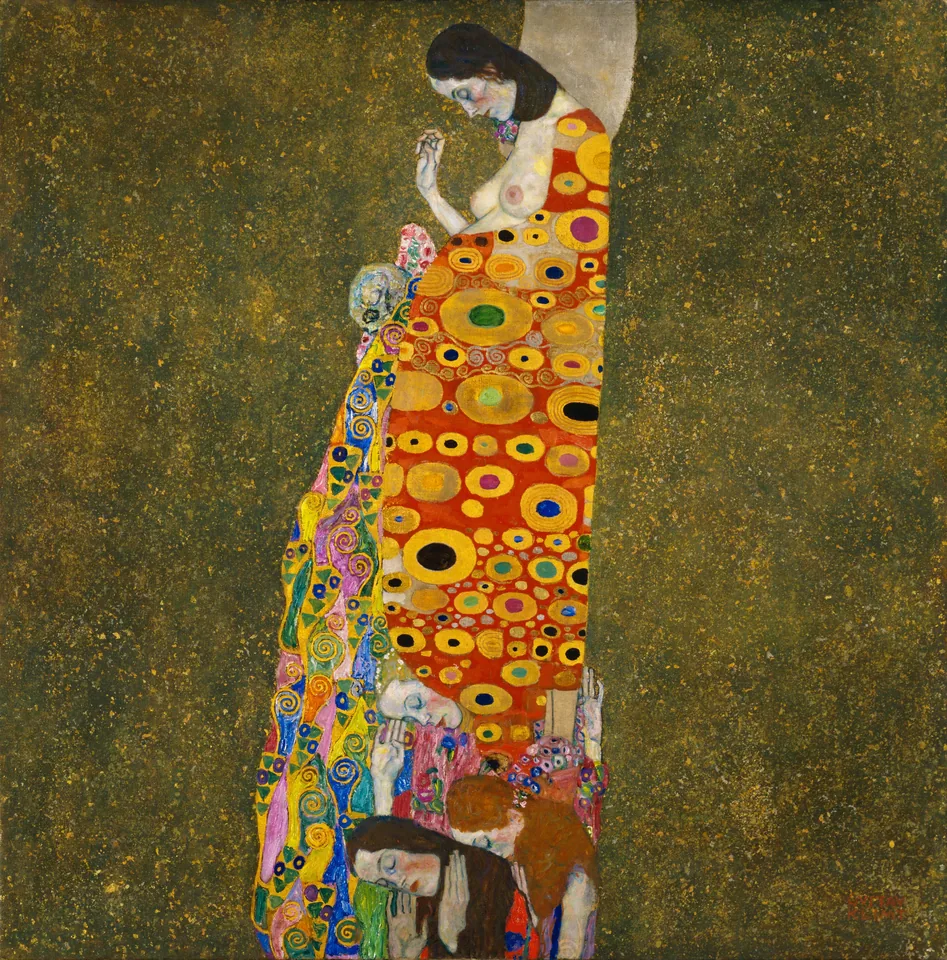
In some paintings, Klimt combined multiple precious metals to produce subtle shifts in luster. In Hope II, he executed the composition using both gold and platinum alongside his oil pigments. The cooler silver tone of platinum sat against the warm yellow of the gold leaf, adding physical depth to the fabric of the subject’s clothing without breaking the decorative flatness of the picture plane.
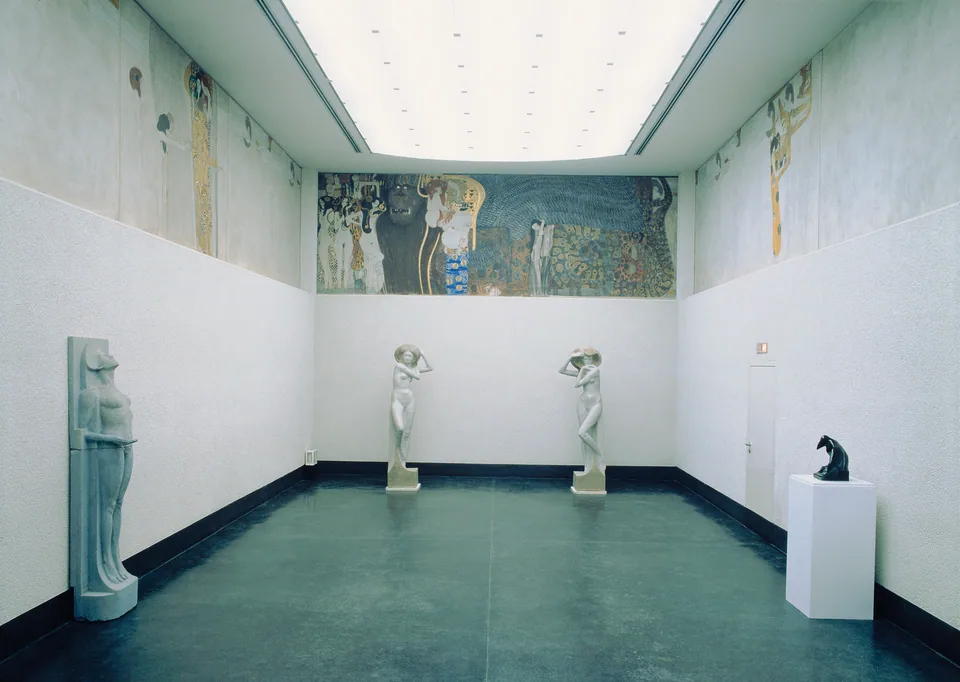
Klimt also used gold across architectural settings and temporary exhibition spaces. For the Beethoven Frieze, completed in 1902 inside the Vienna Secession building, he applied light materials and gold directly onto the plastered masonry. The gold created a reflective backdrop that responded to natural gallery light, guiding viewers through the sequential narrative along three continuous walls.
The main gold paintings
Klimt produced several famous works during this decade. Each piece handled the balance between natural human skin and flat gold leaf in a distinct way.
Pallas Athena (1898)
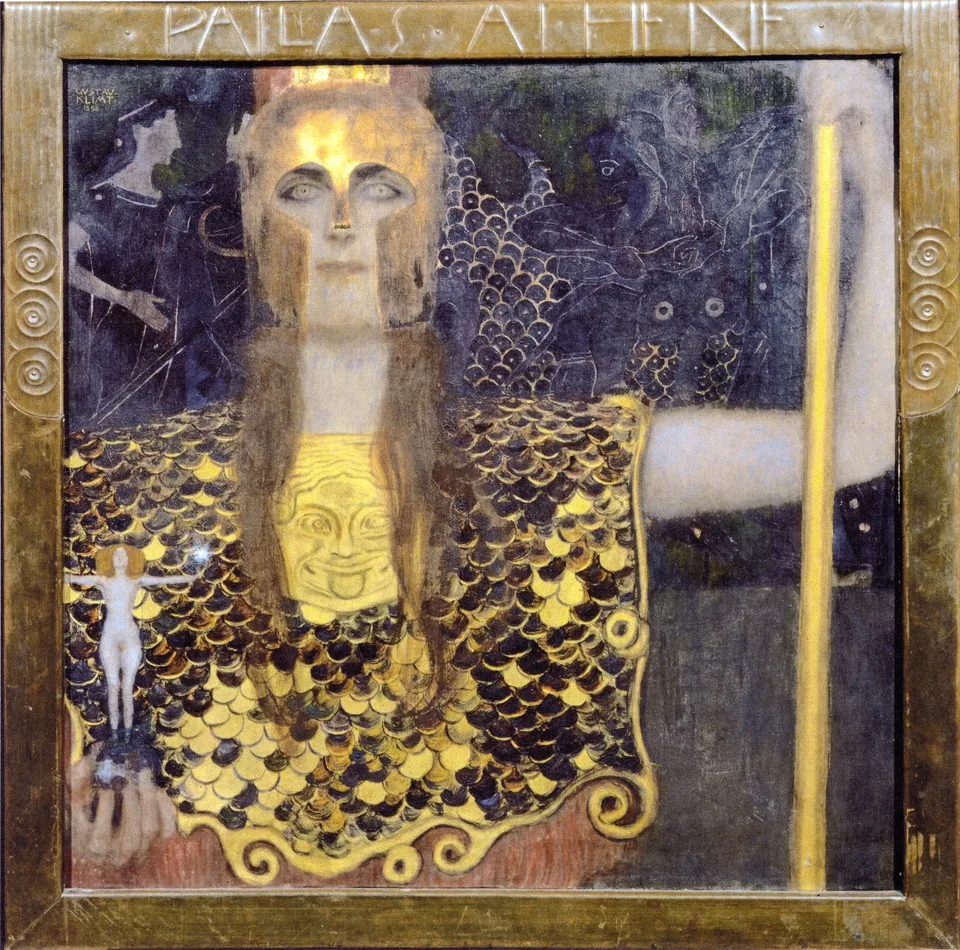
Klimt painted Pallas Athena in 1898 using oil on canvas, though Wikidata lists its inception date as 1899. The canvas measures 75 by 75 cm and hangs today in the Vienna Museum on Karlsplatz. Art historians often consider it the earliest piece from Klimt’s golden phase. First exhibited at the second Vienna Secession exhibition in November 1898, the composition depicts the Greek goddess of wisdom wearing a golden helmet and breastplate. In her hand, she holds a spear and a small, standing nude figure of Nuda Veritas. Georg Klimt created the original metal frame after a design provided by Gustav.
Judith I (1901)
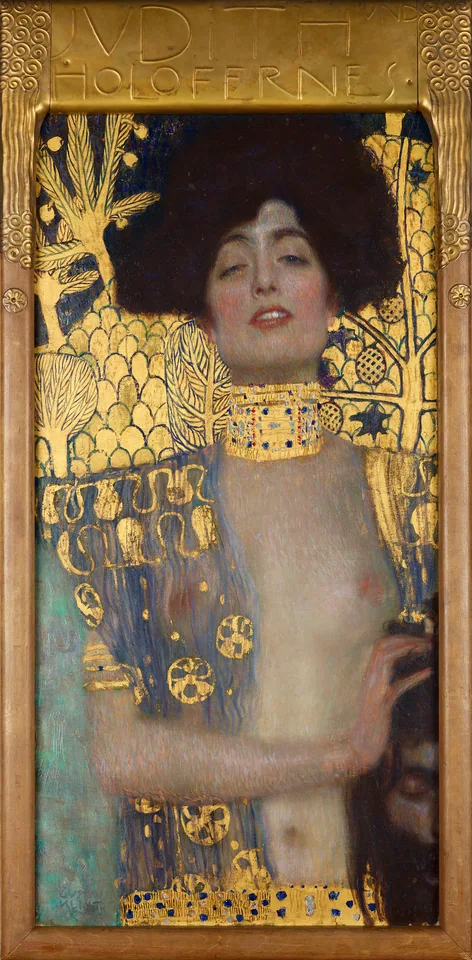
Measuring 84 by 42 cm, Judith I incorporates oil paint, canvas, and gold leaf. The painting hangs in the Belvedere in Vienna. The composition presents the biblical figure Judith holding the severed head of Holofernes, set against an expanse of golden luminosity that contrasts with the model’s dark hair. Viennese socialite Adele Bloch-Bauer served as the model for the figure. To prevent critics from confusing the biblical heroine with Salome, Klimt asked his brother Georg to construct a metal frame engraved directly with the title Judith und Holofernes.
Beethoven Frieze (1902)
Klimt created the Beethoven Frieze in 1902 for the Fourteenth Vienna Secessionist Exhibition, an event organized to honor the composer Ludwig van Beethoven. Klimt painted the monumental frieze using light materials applied directly onto the walls of the left side hall of the Vienna Secession building. Although intended solely for the duration of the temporary exhibition, the frieze was preserved afterward and restored for public display in 1986.
The Stoclet Frieze (1905–1911)
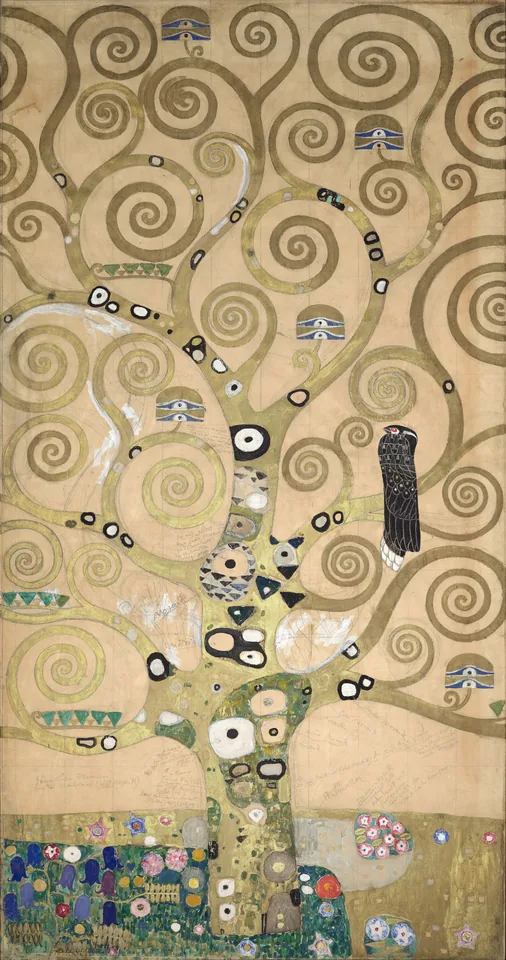
In 1904, Fritz Warndorfer of the Wiener Werkstatte commissioned Klimt to design a mosaic frieze for the dining room of Adolphe Stoclet’s palace in Brussels. Klimt began working drawings in 1905 and revised them in 1908. Leopold Forstner’s workshop executed the mosaics, which were mounted on the walls of Palais Stoclet in 1911. Klimt described his dining room designs for the building as probably the ultimate stage of his development of ornament. You can see the full preparatory working drawings, including the standing couple and the Stoclet Frieze cartoon titled The Tree of Life, preserved in the Museum of Applied Arts (MAK) in Vienna.
Portrait of Adele Bloch-Bauer I (1907)
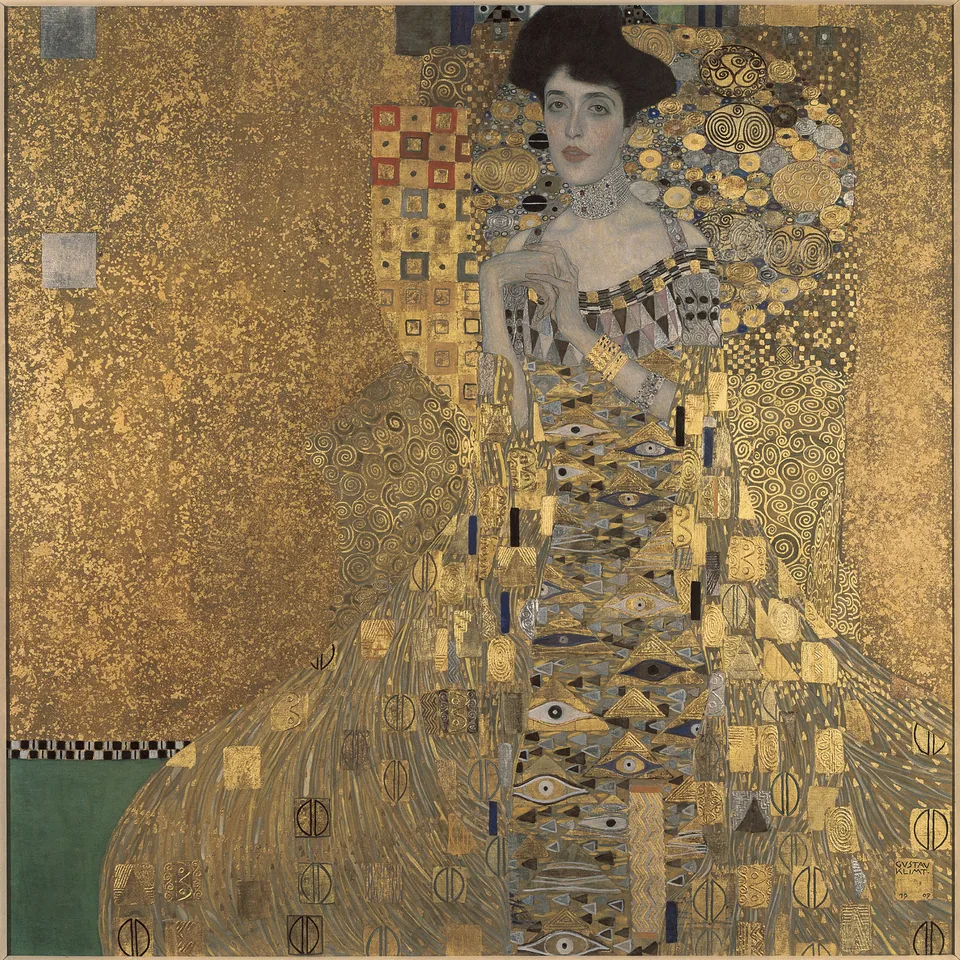
Completed in 1907, the Portrait of Adele Bloch-Bauer I represents the high point of Klimt’s gilded portrait commissions. The canvas measures 138 by 138 cm and hangs in the Neue Galerie New York. Klimt painted Bloch-Bauer seated on a gilded chair, wrapped in an elaborate dress filled with golden eyes, triangles, and flowing bands. Only her face, neck, and hands are rendered in soft, naturalistic tones, while the rest of the canvas dissolves into flat, patterned metal leaf. In 2006, collector Ronald S. Lauder purchased the painting for the Neue Galerie in a private sale that set the reported record for the highest price ever paid for a painting.
The Kiss (1907–1908)
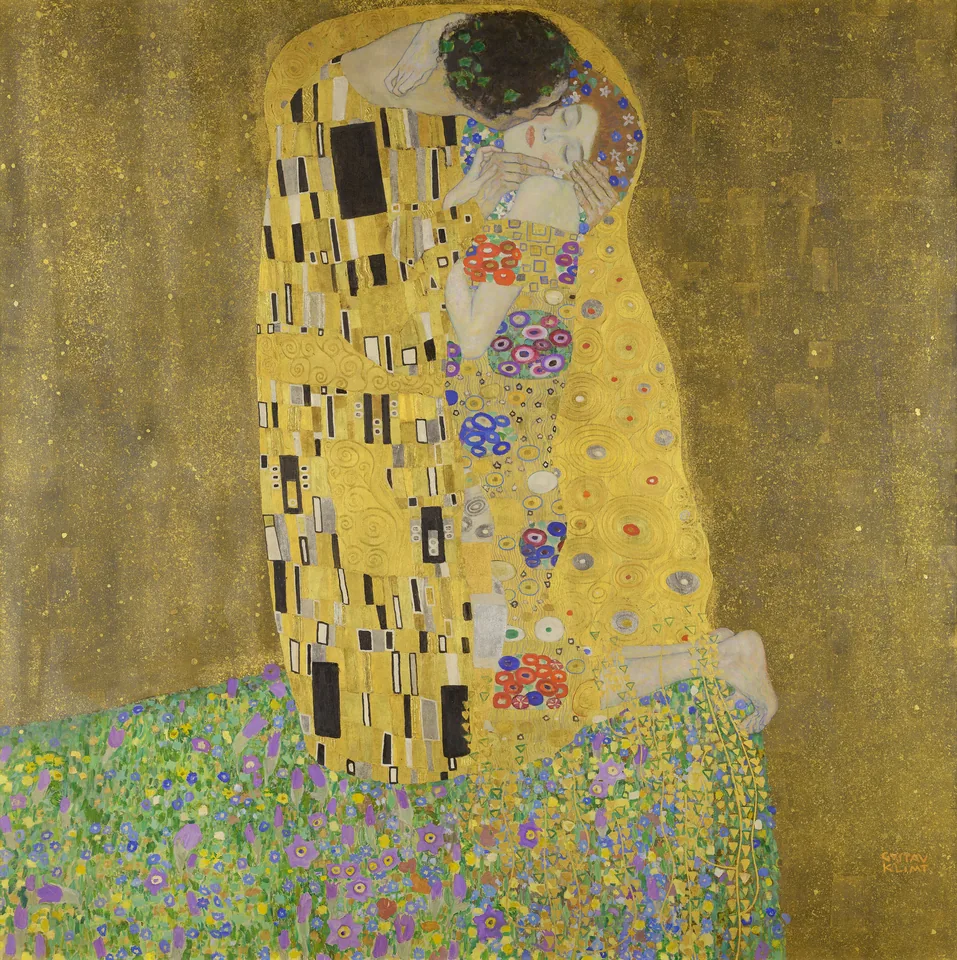
Known originally as Der Kuss, The Kiss is Klimt’s most famous canvas. Measuring 180 by 180 cm, the painting is preserved in the Belvedere in Vienna. Klimt completed the work between 1907 and 1908, showing a man and a woman embracing on a flower-strewn meadow at the edge of a cliff. The man wears a cloak covered in sharp black, white, and gray rectangles, while the woman’s dress features bright, circular floral motifs. The lovers are enclosed within a golden shroud against a background speckled with bronze and gold dust. The painting was exhibited at the Kunstschau Wien 1908 and purchased immediately from the exhibition by the Imperial-Royal Ministry of Cultus and Education. Many scholars consider the couple to depict Klimt and his lifelong companion Emilie Louise Floge as lovers.
Danae (1907)
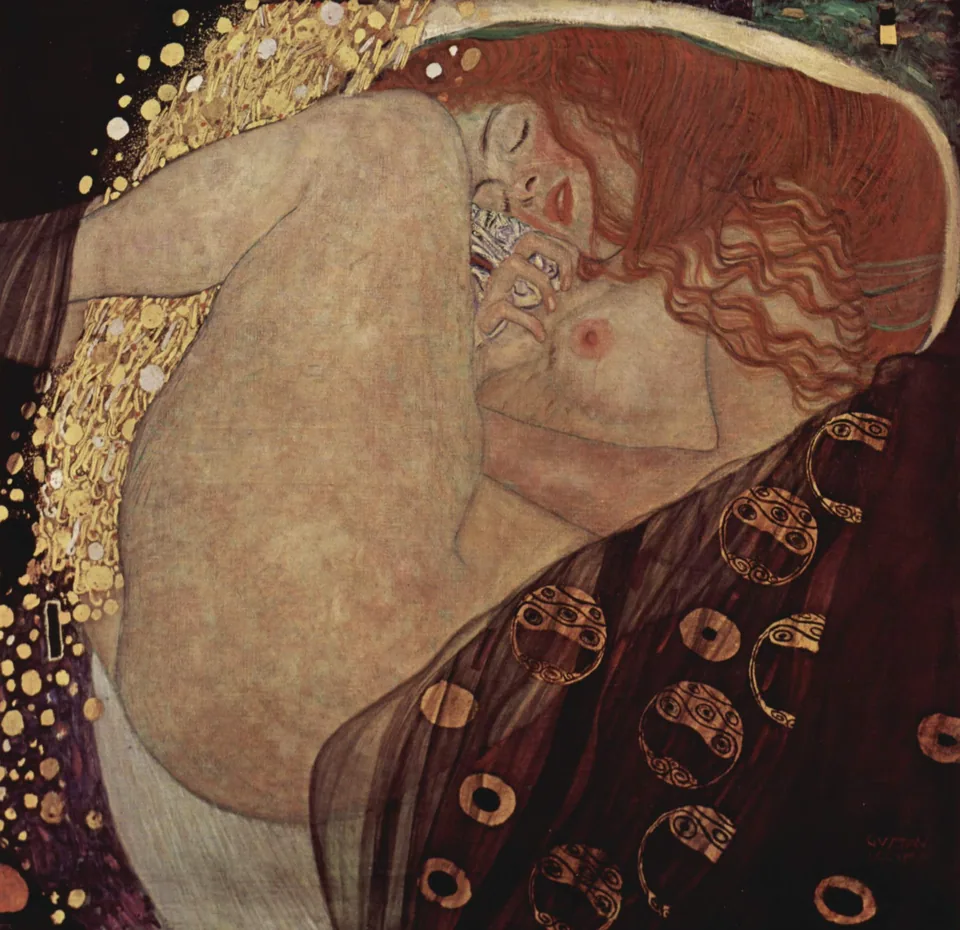
Danae is an oil on canvas painted in 1907, measuring 77 by 83 cm. The composition depicts the Greek mythological figure sleeping while Zeus visits her in the form of a golden stream flowing between her legs. Klimt arranged the figure in a close crop, surrounding her pale skin with dark purple fabric and heavy beads of gold. The canvas was kept in Vienna’s Galerie Wurthle until 1995, entered the Hans Dichand collection, and is owned by Dichand’s three children, with Wikidata also listing the Leopold Museum as the collection and location for the work.
Hope II (1907–1908)
Hope II measures 110.5 by 110.5 cm and was painted with oil, gold, and platinum on canvas. Dewiki lists the painting as created in 1907 and held by the Metropolitan Museum of Art in New York, while Wikidata and English sources record its acquisition by the Museum of Modern Art (MoMA) in New York City in 1978. The work depicts Klimt’s favourite model Herma draped in a flat, gold-leaf-decorated garment that art historians describe as resembling Byzantine art and Orthodox icons. A human skull appears tucked into the folds of her patterned shawl above three bowed female figures. The painting was exhibited under the original title Vision at the 1908 Kunstschau and at the 1909 International Art Exhibition in Vienna.
How the golden phase ended
Klimt’s golden phase came to an end around 1909 and 1910. The installation of the Stoclet Frieze mosaics in Brussels in 1911 marked the culmination of Klimt’s decorative ornamental development. Having pushed gold leaf, mosaic tiles, and flat geometry to their absolute limits, Klimt began seeking a fresh visual direction for his studio work.
His shift away from gold is clear in the history of Death and Life. Klimt completed an initial version of this large canvas between 1910 and 1911. In 1915, he reworked the painting extensively, painting out its original gold background and replacing it with a muted blue ground. During his final decade, Klimt turned to vibrant floral palettes, expressive brushwork, and patterns derived from folk textiles and East Asian robes, leaving metal leaf behind.
Choosing a gold Klimt for your wall
When you select a print from Gustav Klimt’s golden phase, remember that modern prints reproduce gold areas using ink colors, not real metallic leaf. You will see rich ochres, yellows, and warm honey tones that recreate the patterns and tones of the original canvas. Before ordering, read our Klimt print buying guide to compare how each format displays these warm colors in your room.
Prints are printed and shipped by ArtsyWall in three formats: Premium Canvas, Framed Canvas, and Archival Paper. Premium Canvas gives you an unglazed, textured look that echoes the surface of an oil painting. Framed Canvas provides a finished edge, while Archival Paper offers crisp detail for intricate ornamental patterns.
Questions and answers
What is Klimt's golden phase?
Klimt's golden phase was a distinct decade in Gustav Klimt's career, running from about 1899 to 1910. During this period, Klimt applied gold leaf, metallic surfaces, and flat decorative patterns directly onto his canvases and wall murals. This phase brought Klimt positive critical reaction and financial success, producing famous works like The Kiss and the Portrait of Adele Bloch-Bauer I.
Why did Klimt use gold leaf?
Gustav Klimt used gold leaf because of his family roots, travels, and artistic interests. His father was a gold engraver from Bohemia, and his brother Georg was a metalworker who made frames for his paintings. Trips to Venice and Ravenna introduced Klimt to church mosaics, while Japanese painter Ogata Korin inspired his use of flat gold backgrounds starting in the mid-1890s.
When was Klimt's golden period?
Gustav Klimt's golden period began around 1898 or 1899 with the painting Pallas Athene and continued through 1909 or 1910. The period reached its decorative culmination with the completion of designs for the Palais Stoclet in Brussels. By 1911, the mosaic installation was mounted, and Klimt moved away from metallic leaf toward colorful oil backgrounds.
Is there real gold in Klimt's paintings?
Original paintings from Gustav Klimt's golden period contain genuine gold leaf applied to the canvas or plaster. In works like Judith I and The Kiss, Klimt pressed gold leaf onto the painted surface alongside oil pigments. In Hope II, he combined oil paint with both gold and platinum leaf to build textured, reflective patterns across the composition.