Select the painting to see it full screen and zoom in.
What the painting shows
The Beethoven Frieze by Klimt is a monumental three-wall mural cycle executed in 1901–1902 that translates Ludwig van Beethoven’s Ninth Symphony into visual allegories of human struggle, yearning, and fulfillment. Created in the Viennese Art Nouveau style, known as Jugendstil, the composition spans 34.14 meters across a U-shaped space, standing 2.15 meters tall and weighing four tons. Gustav Klimt painted directly on raw plaster using casein paint, chalk, graphite, and gold leaf, deliberately incorporating broad zones of bare white wall into the rhythm of the design. Stylistically, the cycle draws on ancient Greek, Byzantine, early medieval, and Japanese art. Klimt positioned two-dimensional, stylized, line-accentuated figures within an ornamentally structured pictorial field, creating one of the most distinctive friezes of his career.
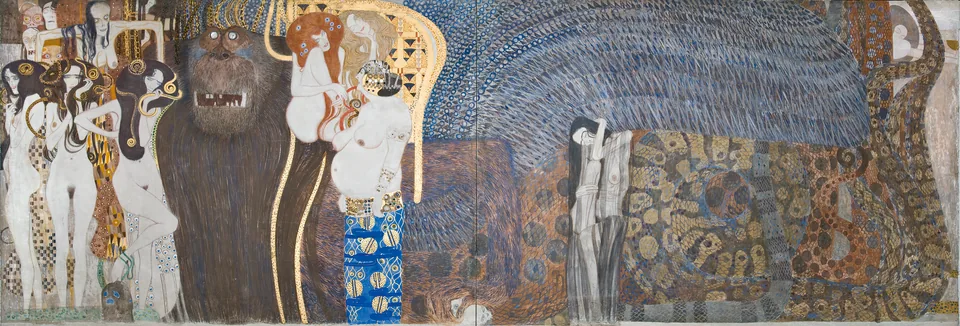
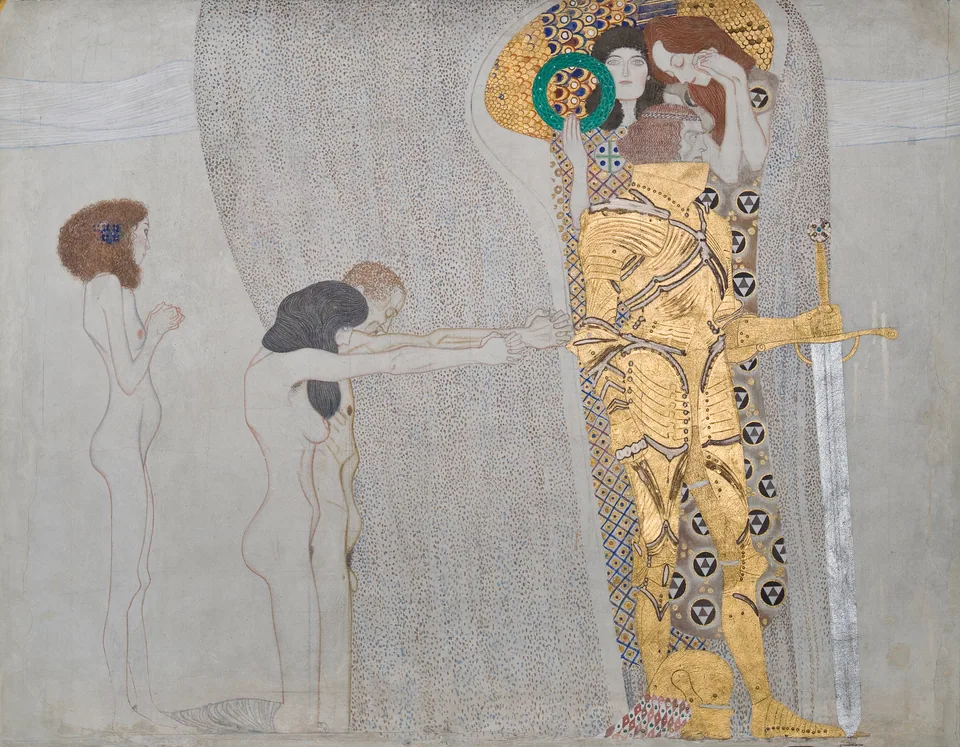
Following the literary interpretation of Beethoven’s symphony by composer Richard Wagner, the narrative unfolds across three connected walls. The left wall illustrates humanity’s longing for happiness. Drifting through the upper zone of the plaster, pale, floating female spirits or genii embody the human search for love and joy. Below them, a standing girl and a kneeling couple stretch out empty hands. These figures represent suffering humanity pleading with a standing golden knight to take up the fight for their redemption. Two standing female figures behind the warrior represent Ambition, holding a laurel victory wreath, and Sympathy, personifying the inner forces that guide him forward. Art historians often interpret the face and stature of this armored knight as an allegorical portrait of conductor and composer Gustav Mahler.
The central wall confronts the viewer with the hostile forces that oppose mankind’s search for peace. At the center sits the colossal, ape-like giant Typhoeus, rendered in dark, somber tones with winged shoulders and blue serpent coils emerging from his body. To his left stand his daughters, the three Gorgons, surrounded by sinister, mask-like heads that personify Sickness, Madness, and Death. To the right of Typhoeus, three stylized women represent Lust, Unchastity, and Intemperance, positioned next to a shriveled, crouching female form personifying Gnawing Grief. The panel directly portrays the destructive threats confronting human individuals, including sexual license and its feared consequence, syphilis. Klimt’s stark, frank treatment of these figures created immense controversy in 1902 and prefigured the harsh expressive forms of modern European painting.
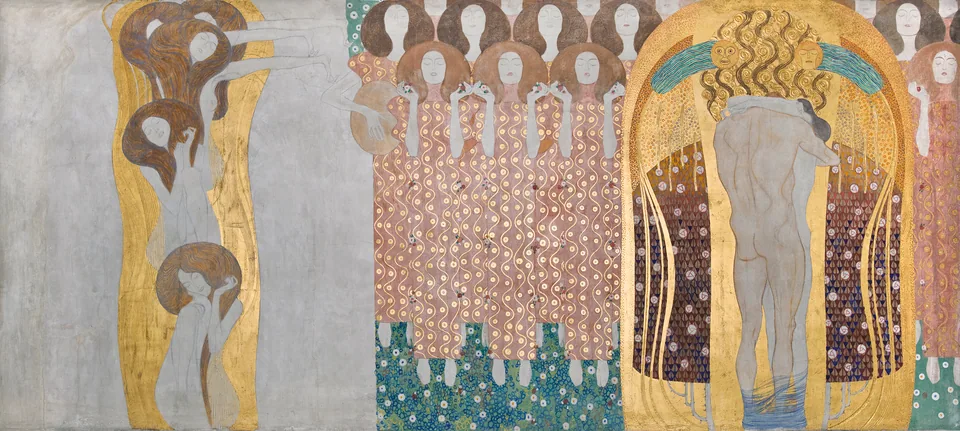
The right wall resolves the narrative through the transformative power of the arts. Floating genii drift past an open space toward a woman playing a stringed lyre, who personifies Poetry. Beyond her stand five women representing the Arts, whose raised hands and open gestures point toward pure joy, divine harmony, and love. The frieze culminates in a dense choir of paradise angels singing against patterned decorative bands. Beneath them, an embracing man and woman kiss inside an ornamental floral halo. This final scene provides an allegorical image for the final chorus of Beethoven’s Ninth Symphony, visualizing the universal kiss sent forth to the entire world. Klimt’s rich use of gilded patterns and symbolic motifs throughout these figures marks an essential milestone in his broader allegories.
The story behind it
The Beethoven Frieze originated as a temporary installation for the Fourteenth Exhibition of the Vienna Secession, held from April to June 1902. The exhibition celebrated the seventy-fifth anniversary of Beethoven’s death. Architect Josef Hoffmann designed the Secession interior as a unified total work of art, or Gesamtkunstwerk, centered on Max Klinger’s polychrome marble statue of the composer. Klimt conceived his painted frieze as an architectural border on the upper walls of a side hall, leaving a visual opening through which visitors could look across toward Klinger’s sculpture. On the eve of the opening, April 14, 1902, Gustav Mahler conducted a special wind ensemble and timpani arrangement of Beethoven’s Ode to Joy inside the building to inaugurate the event.
Because the Secession planned to tear the installation down after the exhibition closed, Klimt applied light, fragile materials directly to the hall’s plaster surfaces. The official exhibition brochure guided visitors through the narrative, explaining the allegorical figures wall by wall. While many artists and progressive viewers praised the installation, conservative critics attacked the frieze for its raw depictions of nudity, sickness, and moral decay. Some commentators described Hoffmann’s entire exhibition concept as a monument to the collective narcissism of the artists. By the time Klimt organized the 1908 Kunstschau exhibition in Vienna, he publicly conceded that the Secession’s original ideal of art transforming everyday society was no longer achievable.
The physical survival of the frieze required extraordinary intervention. To save it from destruction when the Secession exhibition ended, art collector Carl Reininghaus bought the cycle. Sources differ on the date, recording that Reininghaus acquired the work in 1903 or bought it after workers sawed the plaster into seven separate transportable panels in 1907. In gratitude for saving the work, Klimt presented Reininghaus with more than one hundred preparatory drawings. In 1915, Austrian industrialist August Lederer purchased the frieze panels and preparatory drawings at the urging of his wife, Serena Lederer, adding them to one of Vienna’s greatest private collections.
World War II brought severe danger to the Lederer collection. Following the 1938 German annexation of Austria, the Nazi government confiscated the property of the Jewish Lederer family. Serena Lederer fled to Hungary, where she died in exile. The disassembled frieze survived the wartime bombings in storage. Sources differ on its exact wartime shelter: Austrian records state it remained hidden in Schloss Thürnthal, while other historical records state Allied forces retrieved the panels in 1945 from the underground salt mine at Altaussee. Following the defeat of the Nazi regime, Austrian authorities restituted the seven panels to Serena’s surviving son, Erich Lederer.
Erich Lederer lived in Switzerland and sought to export the frieze, but the Austrian Federal Monuments Office repeatedly denied his export permit under Austrian heritage protection laws. In 1973, Lederer agreed to sell the cycle directly to the Republic of Austria, expressing satisfaction with the agreement reached with government ministers Hertha Firnberg and Bruno Kreisky. The fragile plaster panels suffered extensive structural and surface damage from decades of dismantling, transport, and damp storage. Beginning in 1973, restorer Manfred Koller led a meticulous ten-year state restoration project for the Austrian Federal Monuments Office to stabilize the plaster backing, clean the casein paint, and re-adhere loose gold leaf.
Decades later, in 2013, heirs of Erich Lederer submitted a formal restitution claim to the Austrian government. They argued that the 1973 sale had been coerced because Austrian authorities had used the export ban to force Lederer into selling the frieze to the state. In March 2015, the Austrian Art Restitution Advisory Board formally rejected the heirs’ claim, concluding that the 1973 purchase contract was legally sound and that Lederer had negotiated the agreement voluntarily. The detailed design of the armored knight, Ambition, and Sympathy later appeared on a commemorative Austrian collector coin minted in 2004, cementing the work’s enduring place in Austrian cultural heritage.
Where to see it
The Beethoven Frieze is permanently exhibited in Vienna, Austria, inside the Secession Building where it was originally created. The mural belongs to the collection of the Belvedere (Österreichische Galerie Belvedere), which maintains the cycle on long-term loan to the Secession association.
Visitors view the painting in a climate-controlled exhibition hall constructed in the basement of the Secession Building in 1985. Opened to the public in 1986, this permanent room restores the frieze to its original U-shaped three-wall configuration at eye level. This arrangement lets visitors walk along the left wall, stand beneath the central panel of hostile forces, and finish before the celestial choir on the right wall. The architectural relationship has changed since 1902, as Max Klinger’s polychrome Beethoven sculpture now resides in Germany at the Museum der bildenden Künste in Leipzig.
Viewing the restored plaster in person reveals technical choices that photography cannot replicate. Klimt left broad passages of rough, unpainted plaster completely visible, using the matte chalk ground as a structural counterpoint to gleaming bands of real gold leaf. The work stands as a defining foundation of Klimt’s celebrated gold period, demonstrating his shift toward planar geometry and rhythmic surface decoration. To explore the thematic history and visual breakdown of the entire cycle, read our in-depth guide to the Beethoven Frieze. In 2020, to commemorate Beethoven’s 250th birthday, the Secession provided visitors with audio headsets playing the Ninth Symphony, re-establishing the acoustic bond between Beethoven’s music and Klimt’s monumental walls.
Details of Beethoven Frieze
Questions about Beethoven Frieze
What does Beethoven Frieze by Klimt show?
The Beethoven Frieze by Klimt shows an allegorical journey based on Ludwig van Beethoven's Ninth Symphony. Across three walls, floating female genii represent the search for happiness, suffering figures appeal to an armored golden knight, monstrous hostile forces threaten humanity, and poetry leads to an angelic paradise choir where an embracing couple kiss.
When did Klimt paint Beethoven Frieze?
Klimt painted the Beethoven Frieze between 1901 and 1902. German records state Klimt painted the cycle in 1901 before installing it for the Fourteenth Vienna Secession exhibition, while English records date the painting to 1902. The finished frieze opened to the public in April 1902 as part of a temporary tribute to Ludwig van Beethoven.
Where is Beethoven Frieze by Klimt?
The Beethoven Frieze by Klimt is in Vienna, Austria, displayed in a dedicated climate-controlled basement hall inside the Secession Building. The artwork belongs to the permanent collection of the Österreichische Galerie Belvedere, which keeps the restored three-walled mural on long-term loan at the Secession site where visitors can view it today.
How big is Beethoven Frieze by Klimt?
The Beethoven Frieze by Klimt stands 2.15 meters high and spans 34.14 meters in total width across three U-shaped walls. The entire plaster cycle weighs approximately four tons. Its grand physical scale allowed Klimt to incorporate broad zones of raw white plaster alongside detailed, stylized figures and radiant sections of applied gold leaf.
What is Beethoven Frieze by Klimt made of?
The Beethoven Frieze by Klimt was painted directly on wall plaster using casein paint, chalk, graphite, and gold leaf alongside various applied materials. Klimt deliberately integrated large sections of untreated, bare plaster into his compositions because he designed the cycle as a temporary decorative installation for a single exhibition.