Women in Klimt's Paintings: Sitters, Muses and Allegories
A Klimt woman painting captures female presence across society portraits, classical allegories, and intimate drawings. Gustav Klimt focused on women as patrons, professional muses, and modern figures throughout his career.
Why women fill Klimt’s work
A Klimt woman painting stands at the center of the artist’s visual world. Gustav Klimt concentrated on female figures throughout his career, placing women into high-society commissions, allegorical scenes, and life studies. In turn-of-the-century Vienna, wealthy patrons hired him to paint their wives and daughters, while studio models gave form to his independent ideas.
Klimt broke with Austrian convention in his studio work. He painted exposed nude figures showing natural hair and pubic hair without wrapping them in traditional allegorical drapery. His models included women like Herma, whom he valued for her physical poise and demanded to paint even during her pregnancy. These studio sessions gave him figures that defied academic polish and felt direct, grounded, and modern.
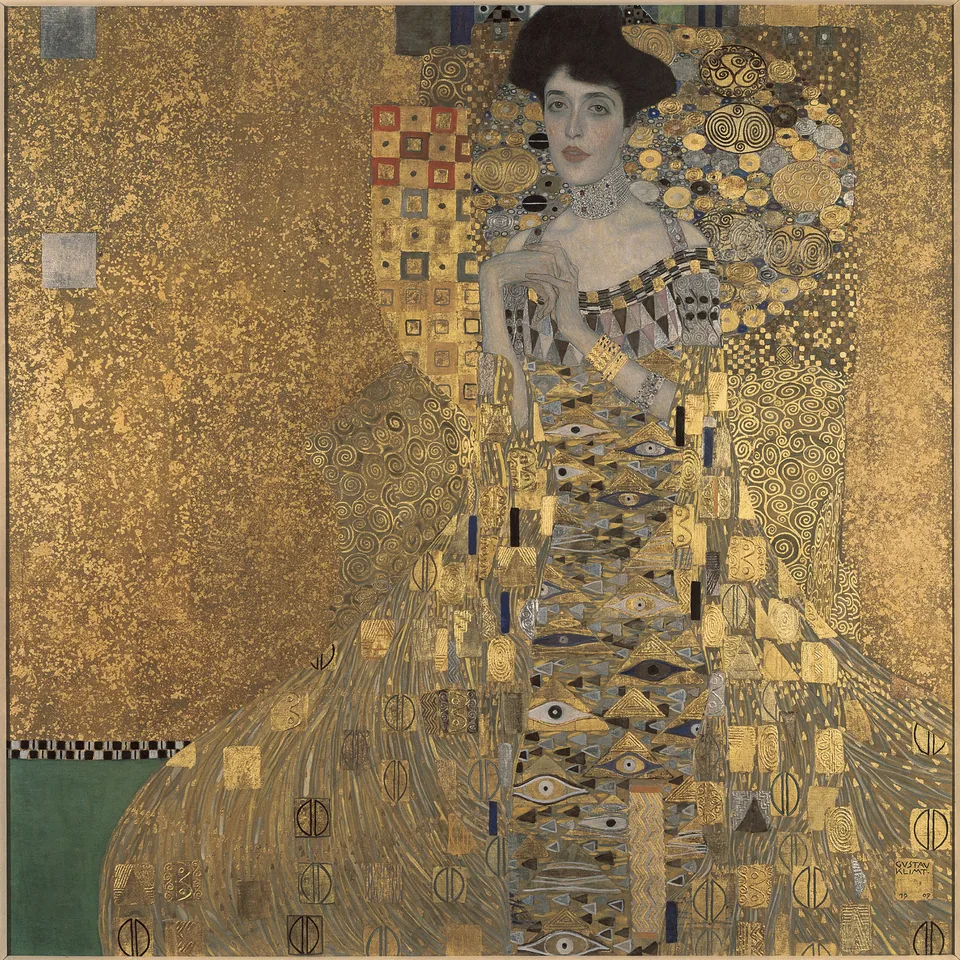
Female patrons also ran the cultural networks that sustained him. Women like Adele Bloch-Bauer hosted salons that brought together artists, composers, and writers. By turning his attention to female presence, Klimt recorded both the public faces of Viennese society and private studio studies. You can explore these subjects today across our portraits selection.
The society portraits
Klimt built his early independent reputation through formal portraits of Vienna’s upper middle class. In 1899, he painted Serena Pulitzer Lederer in a tall oil composition measuring 190.8 by 85.4 cm, now held by the Metropolitan Museum of Art. Serena Lederer stands in a flowing white gown against a soft background, setting a format Klimt refined over the following decade.
In 1904, Klimt completed the portrait of Hermine Gallia, measuring 170.5 by 96.5 cm, which now hangs in the National Gallery in London. He followed this in 1905 with a portrait of Margaret Stonborough-Wittgenstein, sister of philosopher Ludwig Wittgenstein and pianist Paul Wittgenstein. Painted for her wedding, the canvas measures 179.8 by 90.5 cm. Her son sold the work in 1960, and it is now displayed in Munich’s Alte Pinakothek in the Bavarian State Painting Collections.
Klimt painted Fritza Riedler in 1906, a work measuring 153 by 133 cm in the Belvedere collection in Vienna. In this canvas, geometric blocks, checkerboard patterns, and decorative borders frame the sitter’s head and chair. He balanced realistic treatment of the sitter’s face and hands with flattened ornamentation across the furniture and background.
Family commissions also brought younger sitters to his easel. In 1912, he painted nine-year-old Mäda Primavesi, measuring 149.9 by 110.5 cm, now at the Metropolitan Museum of Art. The following year, he painted her mother, Eugenia Primavesi, in a canvas measuring 140 by 85 cm, now in the Toyota Municipal Museum of Art. These paintings combined decorative wallpaper patterns with direct, standing postures.
Adele Bloch-Bauer and Emilie Flöge
Two women held distinct places in Klimt’s life and work: his close companion Emilie Flöge and his patron Adele Bloch-Bauer. Klimt began the portrait of Flöge in 1902 and completed it by the summer of 1908. Flöge was an Austrian fashion designer and model who ran a successful Viennese fashion salon. Klimt depicted her standing tall in a reform dress of her own design, accented with genuine silver and gold leaf. The canvas measures 181 by 84 cm and hangs today in the Vienna Museum. Read our full guide to Emilie Flöge to learn more about their creative partnership.
Adele Bloch-Bauer was a Viennese socialite married to sugar manufacturer Ferdinand Bloch-Bauer. In mid-1903, Ferdinand commissioned Klimt to paint Adele as an anniversary gift for her parents. Klimt worked on the canvas until 1907, creating Portrait of Adele Bloch-Bauer I, also known as the Woman in Gold. Klimt used oil paint along with silver and gold leaf, applying gesso to create raised relief motifs. The gold ornamentation drew inspiration from Byzantine mosaics Klimt saw at the Basilica of San Vitale in Ravenna in 1903. Architect Josef Hoffmann designed the gold-leaf frame.
Adele Bloch-Bauer remains the only verified person Klimt painted twice in full-length format. In 1912, Ferdinand commissioned Portrait of Adele Bloch-Bauer II, measuring 190 by 120 cm. Here, Klimt traded heavy metallic leaf for bright bands of green, blue, and pink, showing Adele in a dark hat and patterned stole. Our guide to the Woman in Gold traces the full history and restitution of these two canvases.
Allegories: Judith, Danae, Hope and the Water Serpents
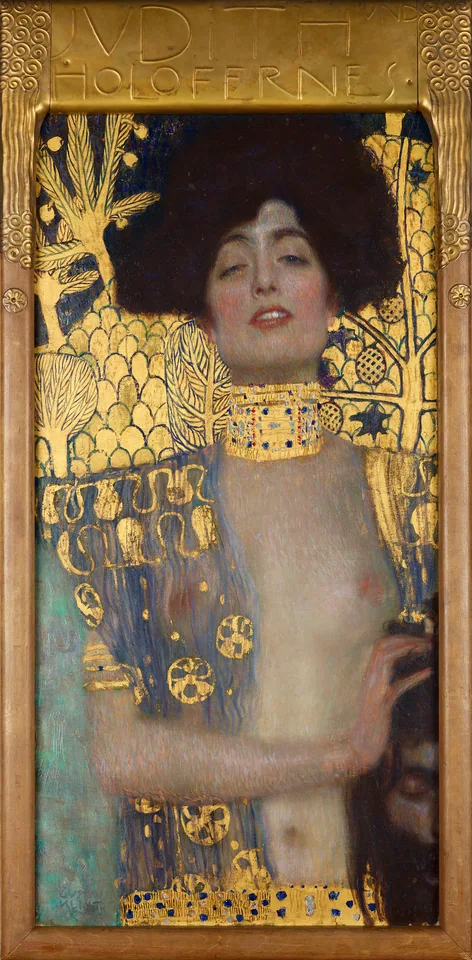
Klimt used mythological and biblical figures to explore modern themes. In 1901, he painted Judith I, an oil on canvas with gold measuring 84 by 42 cm, located at the Belvedere. Adele Bloch-Bauer served as the model. Judith stands holding the severed head of Holofernes, wearing a gold choker. To prevent critics from mislabeling the biblical heroine as Salome, Klimt’s brother Georg crafted a metal frame engraved with the title Judith and Holofernes. In 1909, Klimt returned to the subject with Judith II, measuring 178 by 46 cm, now in the Ca’ Pesaro in Venice. You can find reproductions of these subjects in our allegories gallery.
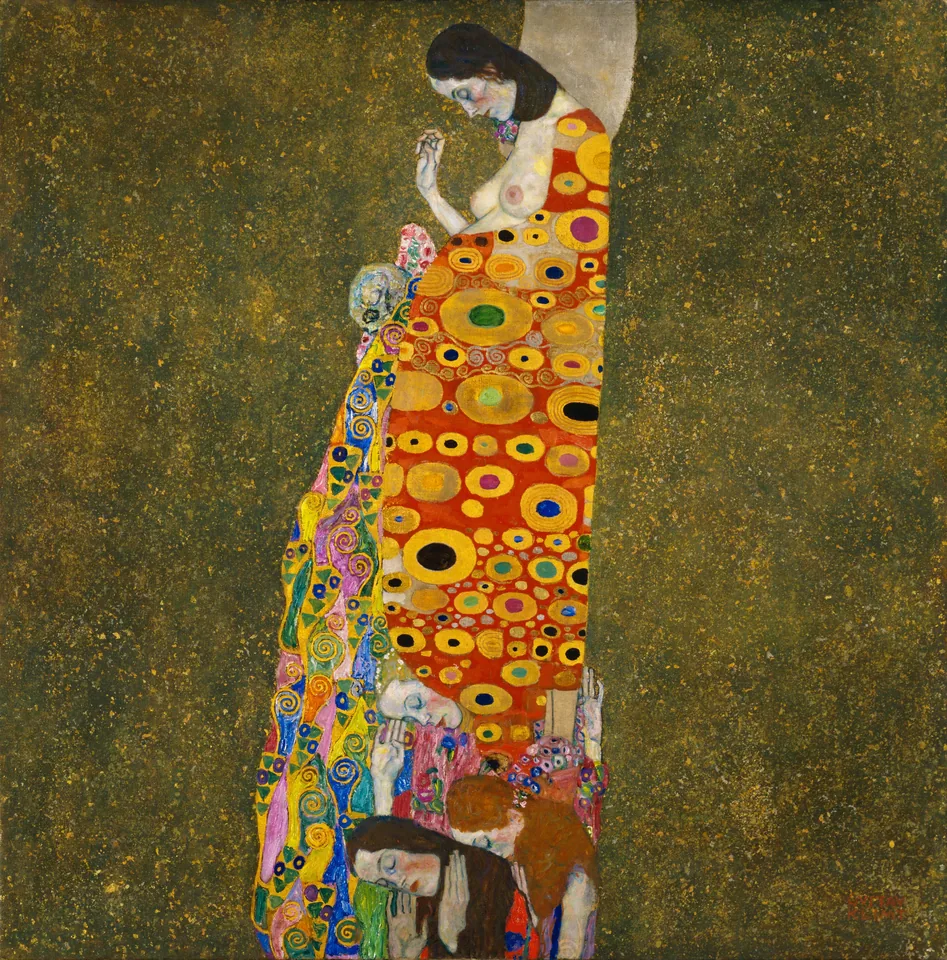
In 1903, Klimt painted Hope I, measuring 189 by 67 cm, which now hangs in the National Gallery of Canada. The painting shows his studio model Herma, pregnant and nude, gazing forward with her hands linked above her stomach. Klimt withdrew the canvas from the 1903 Vienna Secession Exhibition on the advice of the Minister for Culture and Education. In 1907, he completed Hope II, measuring 110.5 by 110.5 cm, now held by the Museum of Modern Art in New York. In this version, the woman wears a patterned gown decorated with colored circles, bowing her head toward a skull resting in her folds.
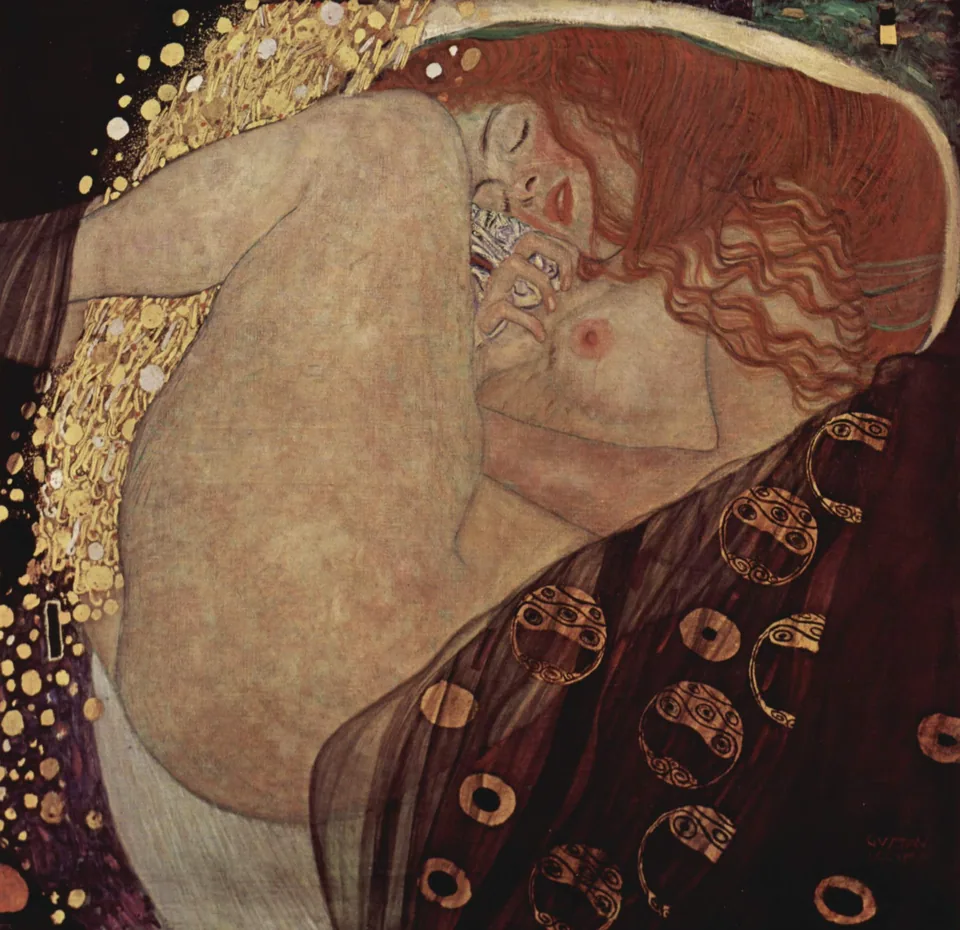
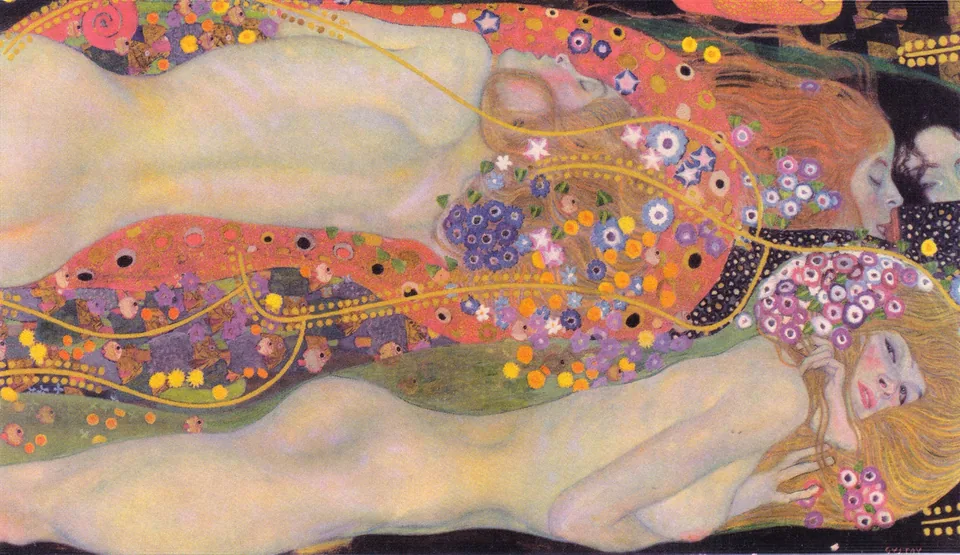
Klimt painted Danaë in 1907, measuring 77 by 83 cm, now in the Leopold Museum collection. The composition curls the sleeping figure into a compact square canvas while a stream of gold coins flows across the frame. Around the same time, Klimt finished Water Serpents II, an oil on canvas measuring 80 by 145 cm, originally owned by Jenny Steiner. The painting depicts four water nymphs, with two fully nude figures in the foreground. Art historians interpret Water Serpents II as a disguised depiction of a lesbian relationship.
The Three Ages of Woman
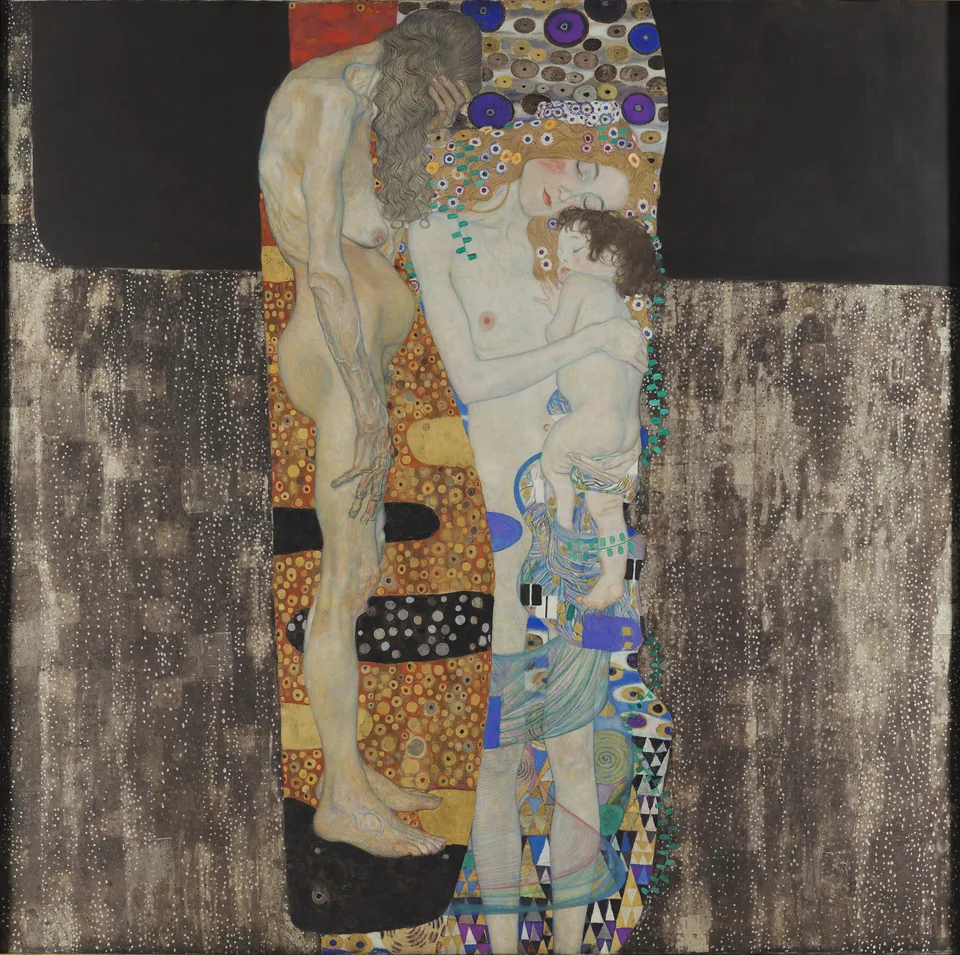
Klimt painted The Three Ages of Woman in 1905 on a square canvas measuring 180 by 180 cm. The work is located in Rome at the Galleria Nazionale d’Arte Moderna e Contemporanea. It addresses the passage of human life through three female figures set against a dark background.
At the center, a young mother holds a sleeping infant. A cool blue aura encircles both figures, accented with soft pastel flowers and ornamental specks. The child rests its head against the mother’s chest while the mother inclines her head downward in peaceful rest. To their left stands an elderly woman, her head turned aside and bowed downward, shielding her face with her hand. Her profile, graying hair, and aged skin appear in warm, earthy tones, establishing a stark contrast between youth and old age.
Late portraits
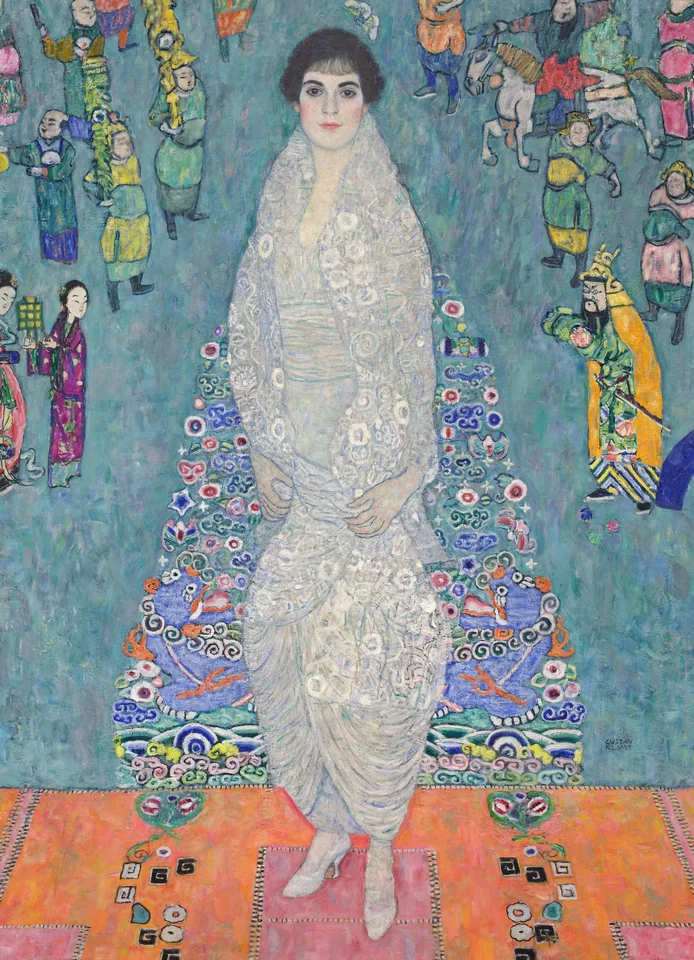
Klimt’s late portraits moved away from metallic leaf and embraced bright color planes and Asian decorative motifs. Between 1914 and 1916, he painted the Portrait of Elisabeth Lederer, measuring 180.4 by 130.5 cm. Elisabeth was the twenty-year-old daughter of August and Serena Lederer. Klimt showed her in a white chiffon floral shawl, close-fitting top, skirt, and white silk shoes. Serena Lederer took the canvas from Klimt’s studio in 1916, believing it complete despite Klimt insisting otherwise. When sold at auction in New York in 2025, it set one of the highest prices ever paid for a painting at auction.
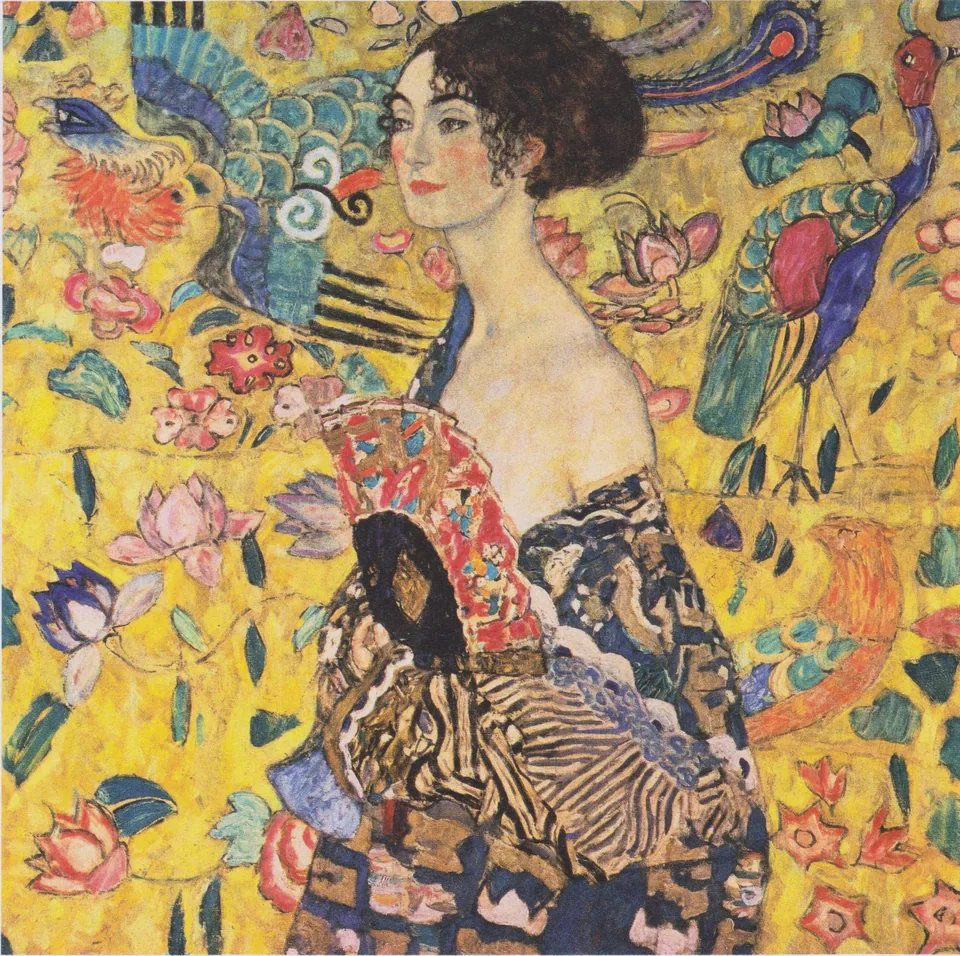
Lady with a Fan stands as Klimt’s final portrait. Painted in 1917, the square work measures 100.2 by 100.2 cm and stood on an easel in his studio when he died in 1918. The sitter holds a decorated fan over her chest, wearing an open robe against a background filled with Asian textile motifs, including flying birds and lotus flowers. The model remains unidentified, with candidates including Johanna Staude, Emilie Flöge, and a ballet dancer. In 2023, the canvas sold at auction in London, ranking among the highest auction prices ever recorded.
Klimt’s drawings of women
Drawing formed the daily foundation of Klimt’s artistic practice. He made hundreds of preliminary studies on paper to resolve postures, drapery folds, and facial angles before touching a canvas. For the Portrait of Elisabeth Lederer alone, Klimt executed numerous preparatory studies in pencil and charcoal. He typically initiated painted portraits by laying down conté or charcoal underdrawings directly onto the canvas.
His paper studies focused on female figures in relaxed poses around his studio. These sheets capture women resting, reclining, and adjusting their hair in quick, continuous lines. After Klimt died in 1918, Emilie Flöge preserved hundreds of these drawings in a locked room in her home. You can view prints of these studies in our collection of Klimt’s drawings. Every print order is printed and shipped by ArtsyWall in Premium Canvas, Framed Canvas, or Archival Paper.
Questions and answers
Why did Klimt paint women?
Gustav Klimt painted women because Viennese society patrons commissioned portraits of wives and daughters, while studio models inspired his allegorical works. He broke with Austrian convention by painting exposed female nudes with natural hair and without traditional drapery. Women served as financial patrons, intellectual salon hosts, and artistic collaborators throughout his career in Vienna.
Who were the women in Klimt's portraits?
The women in Gustav Klimt's portraits were primarily cultured figures from prominent Viennese families alongside personal companions. Sitters included salon host Adele Bloch-Bauer, fashion designer Emilie Flöge, and art patron Serena Lederer. He also painted younger family members, such as twenty-year-old Elisabeth Lederer, child Mäda Primavesi, Margaret Stonborough-Wittgenstein, Hermine Gallia, and Fritza Riedler.
Who was Adele Bloch-Bauer?
Adele Bloch-Bauer was a Viennese socialite and salon host who married sugar manufacturer Ferdinand Bloch-Bauer in 1899. She gathered artists and intellectuals at her home, including Gustav Mahler and Richard Strauss. She is the only verified person whom Gustav Klimt painted twice in full-length portraits, and she modeled for his 1901 work Judith I.
What is Klimt's Lady with a Fan?
Lady with a Fan was Gustav Klimt's final portrait, painted in 1917 and found on his easel after his death in 1918. The square canvas measures 100.2 by 100.2 cm. The sitter remains unidentified, though candidates include Johanna Staude, Emilie Flöge, or a dancer. It ranks among the highest-priced paintings sold at auction.