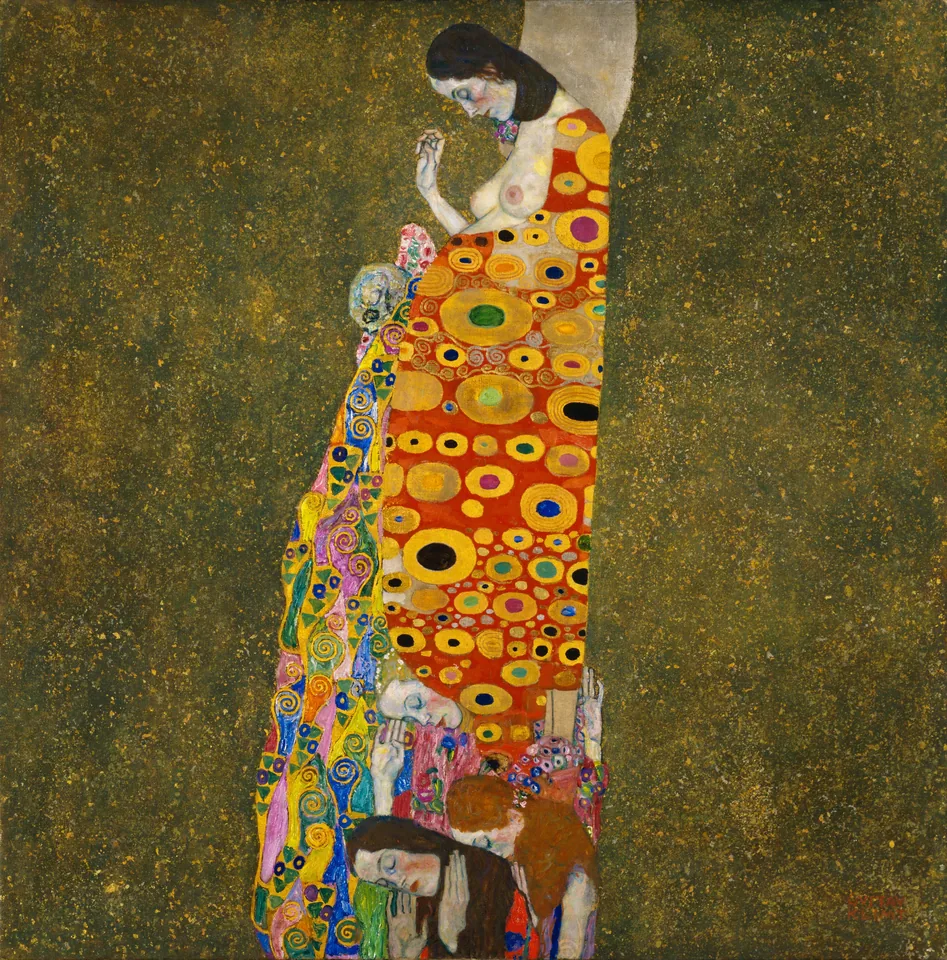
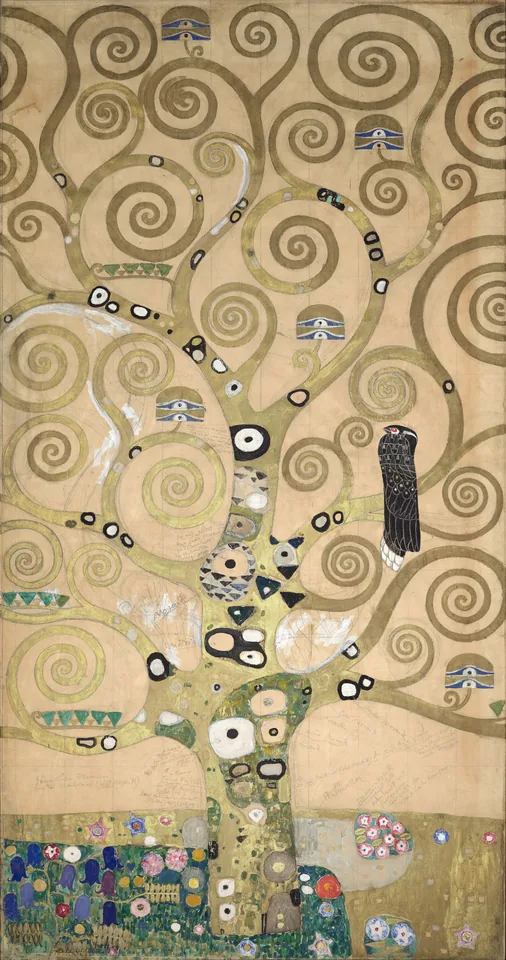
Select the painting to see it full screen and zoom in.
What the painting shows
The Three Ages of Woman by Klimt is an oil painting completed in 1905 that symbolizes the cycle of life. Three female figures representing infancy, youth, and old age stand gathered near the center of the canvas. The figures form the focal point of the composition, arranged vertically on a narrow, patterned shape that resembles an isolated island surrounded by darkness. By setting these figures together, Klimt stages an allegory of human growth, physical vigor, and inevitable physical decline.
On the right side of the central cluster, you see a radiant young woman holding a small child against her chest. The young woman stands upright in profile with her head tilted gently downward toward the baby. Both the mother and child have their eyes closed, sharing a calm, sleeping expression. A cloud of bright, voluminous reddish hair frames the mother’s pale face, adorned with small blue and white blossoms that symbolize spring. Her bare skin appears smooth and firm under the light. Her left arm wraps tightly around the toddler, whose head rests against her shoulder. Sheer blue fabric drapes across the lower limbs of the mother and child, binding them together in a single embrace. They are the only figures in the entire composition who touch one another.
On the left side of the group stands an elderly woman, turned in profile toward the edge of the frame. Her posture presents a stark physical contrast to the youth beside her. Her head bows forward, and she raises a bony, weathered left hand to shield her face, completely concealing her features behind long, tangled gray hair. Klimt does not soften the bodily effects of aging. He paints her with sagging skin, hollow ribs, a bloated belly, and dark, prominent veins that run down her arms and legs. Her long, bony fingers hang at her side. Klimt paints both of her bare feet flat against the ground, ensuring that you can see the unvarnished reality of her aged body from head to toe. Her figure slightly overlaps the young mother behind her, physically linking the end of life with its beginning.
Surrounding these figures are distinct patterned fields, or auras, that separate the women into two visual worlds. The mother and child stand enveloped inside a cool aura composed of fluid, aquatic patterns. Streams of turquoise, pale blue, lavender, and white run downward like a cascading stream of ribbons and bubbles. Geometric shapes, spiral motifs, and speckled patches drift through this cool field. The old woman, by comparison, stands within a dense, static column of warm, earthy tones. Rich oranges, browns, ochres, and deep red patches surround her body, covered with black and gold circular spots. The figures and their decorative zones overlap: the young woman’s leg extends behind the left aura, while the old woman’s head passes directly in front of the right aura.
The background around this central column lacks any sense of traditional perspective. A solid, deep black field covers the entire upper portion of the canvas, hanging over the figures like a heavy ceiling. This stark black void makes the central group look fragile, as if darkness threatens the small island where the three women stand. Below the black zone, the sides of the canvas fill with a textured, metallic field painted in soft bronze, gray, and brown tones dusted with white speckles. This neutral background creates a quiet, restful field that pushes the colorful patterns and pale bodies forward.
The story behind it
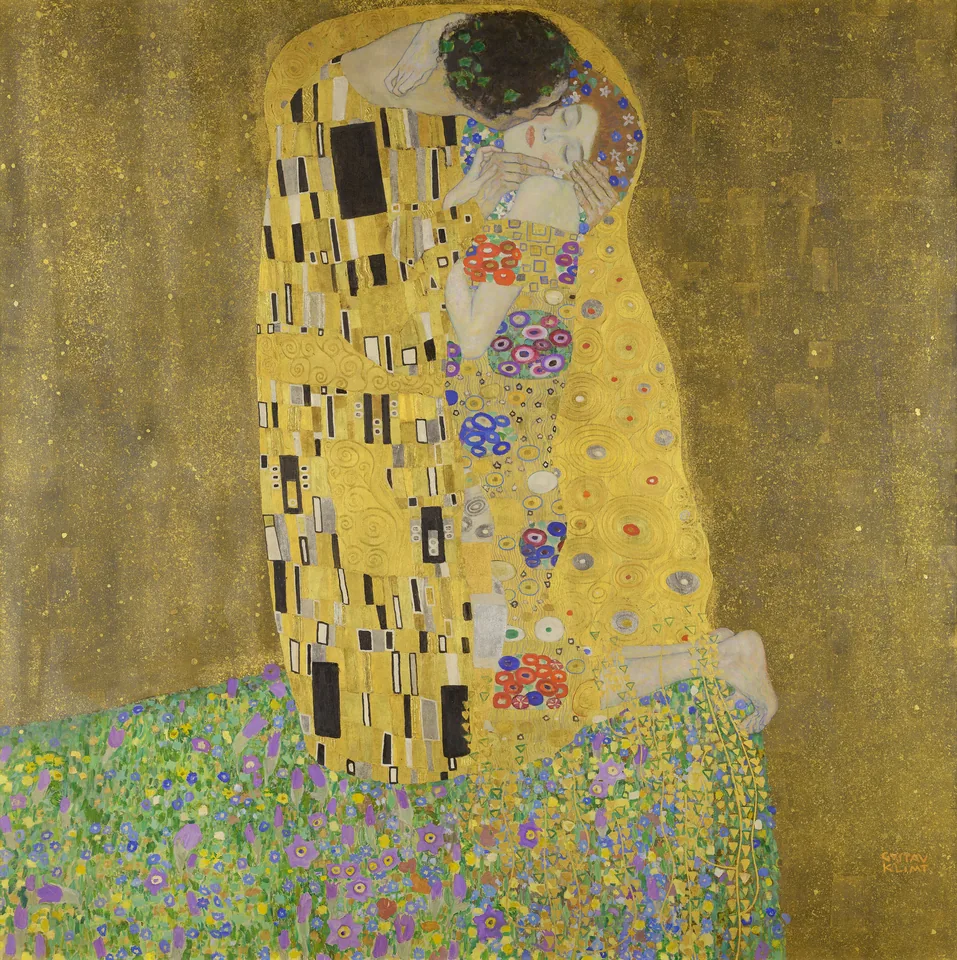
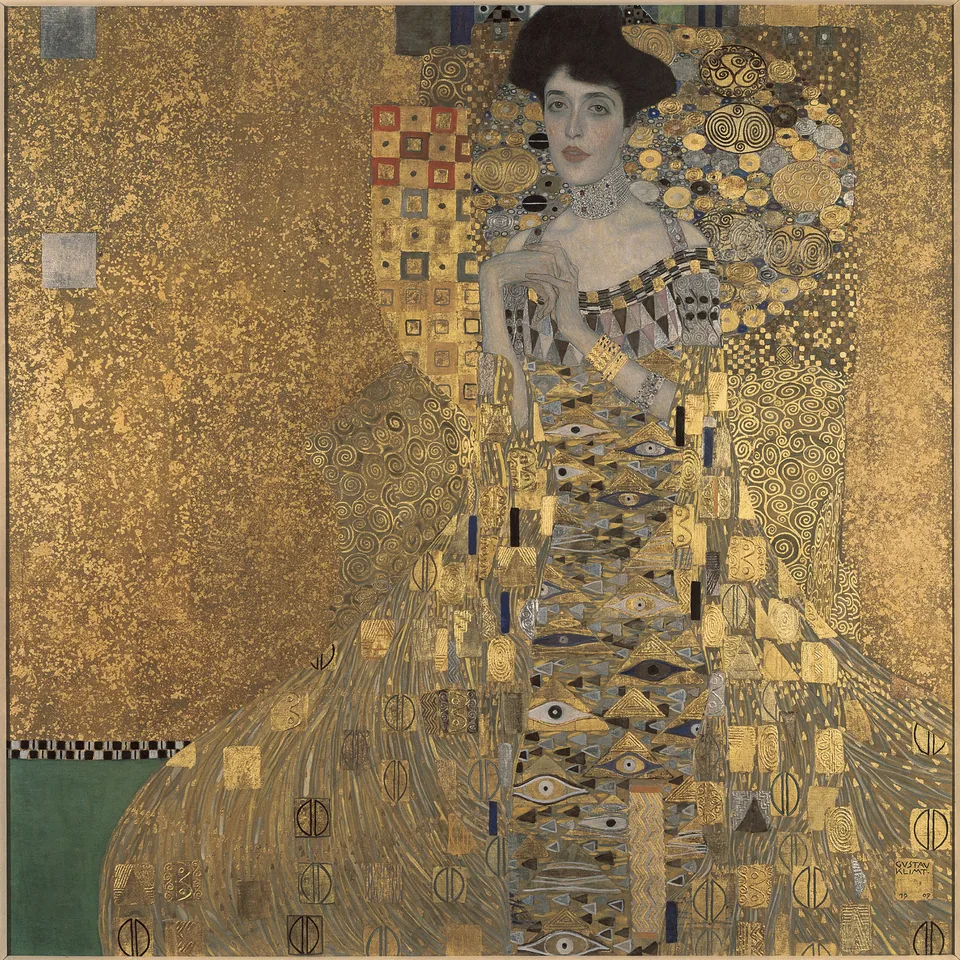
Gustav Klimt painted this work in Austria in 1905, marking a major turning point in his artistic career. In that same year, Klimt broke away from the Vienna Secession, an artists’ group he had helped establish eight years earlier. The break allowed him to pursue his personal creative vision without committee restrictions or academic obligations. The painting belongs firmly to Klimt’s famous gold period, a phase defined by heavy ornamentation, flattened spatial depth, and the deliberate use of gold and metallic paints. During this period, he also produced celebrated works such as The Kiss and the portrait Golden Adele.
This work holds a central place among Klimt’s symbolic allegories. Rather than painting an everyday portrait or an observed historical event, Klimt turned to universal themes of mortality and time. The stark contrast between the flat, poster-like background and the three-dimensional rendering of human flesh reflects an approach Klimt had explored earlier in his controversial university mural Jurisprudence. In both paintings, flat geometric ornament frames sculpted, exposed human bodies. The decorative elements and linear contours place the work within the international Art Nouveau movement, which favored organic rhythms and decorative abstraction.
Klimt executed the painting on a large square canvas measuring 180 by 180 centimeters. The square format was a favorite compositional tool for Klimt, who chose its symmetry to give his pictures a balanced, contemplative character. Art historians note that the symmetry of the square provided a mystical dimension well suited to existential subjects like physical decay and the transience of life. The Russian avant-garde painter Kazimir Malevich later adopted the square format with a similar intent when he created his famous work Black Square on a White Ground.
To achieve the distinct surface qualities of the painting, Klimt relied on an impasto technique, applying thick layers of oil paint with visible brushwork and ridges. He mixed drying solvents directly into his oil pigments. These solvents helped the paint dry without developing an unwanted glossy sheen, preserving a flat, matte appearance across large sections of the composition. Klimt worked slowly and frequently retouched his canvases over long periods, making fine adjustments to contours, colors, and decorative spots. This meticulous retouching process restricted the total number of paintings he was able to finish each year, making each completed square canvas a major undertaking in his career. You can study the full chronology of his career and locate his other major canvases across our catalog of every Klimt painting.
Where to see it
You can see The Three Ages of Woman in person at the Galleria Nazionale d’Arte Moderna in Rome. The painting has spent more than a century in Italy, where it remains a celebrated highlight of the nation’s public art collections.
Klimt first presented the finished canvas to the public in Germany. It debuted in Berlin from May to October 1905 during the second exhibition of the Deutsche Künstlerbund, where it appeared under the German title Die drei Lebensalter. Five years later, in 1910, the work traveled to Italy when the Venice Biennale honored Klimt with a dedicated exhibition room filled with his paintings. The Venice presentation introduced Italian critics and collectors to his decorative style.
In 1911, the canvas traveled to Rome for an international art exhibition organized to mark the fiftieth anniversary of the unification of Italy. The painting made a strong impression on Italian cultural officials. In 1912, the Italian State acquired the canvas directly for the permanent collection of the Galleria Nazionale d’Arte Moderna. The painting has remained in Rome ever since. It represents a rare cultural treasure for the country, as it is one of only three Klimt paintings held in Italian public collections.
Details of The Three Ages of Woman
Questions about The Three Ages of Woman
What does The Three Ages of Woman by Klimt show?
The Three Ages of Woman by Gustav Klimt shows three female figures at different life stages standing on a decorative pedestal. An old woman stands on the left with her face covered by gray hair, bowing her head in grief. On the right, a young mother with flowers in her hair stands upright while cradling a sleeping toddler against her chest. Both the mother and young child rest peacefully with their eyes closed.
When did Klimt paint The Three Ages of Woman?
Gustav Klimt completed The Three Ages of Woman in Austria in 1905. That same year, Klimt chose to leave the Vienna Secession. After finishing the canvas in 1905, he exhibited it for the first time in Berlin from May to October of that year under the German title Die drei Lebensalter, during the second annual exhibition organized by the Deutsche Künstlerbund.
Where is The Three Ages of Woman by Klimt?
The Three Ages of Woman by Gustav Klimt is in Rome, Italy, at the Galleria Nazionale d'Arte Moderna. The Italian State bought the oil painting for the museum collection in 1912 after displaying it in Rome at an international fine art exhibition in 1911. The canvas remains on display there and is one of only three Klimt paintings held in Italian public collections.
How big is The Three Ages of Woman by Klimt?
The Three Ages of Woman by Gustav Klimt is a large square painting that measures exactly 180 centimeters high by 180 centimeters wide. Klimt chose this balanced square canvas format deliberately because its geometric symmetry gave an added mystical dimension to his painted scenes, allowing him to examine existential human subjects such as physical aging, decay, and the natural cycle of life.
What is The Three Ages of Woman by Klimt made of?
The Three Ages of Woman by Gustav Klimt is painted with oil paint on canvas. Klimt applied his pigments using an impasto technique to build up thick textures across the surface, and he incorporated metallic paints and gold accents. To keep his colors from drying with an unwanted glossy sheen, he added drying solvents directly to the paint before brushing it onto the fabric.