Select the painting to see it full screen and zoom in.
What the painting shows
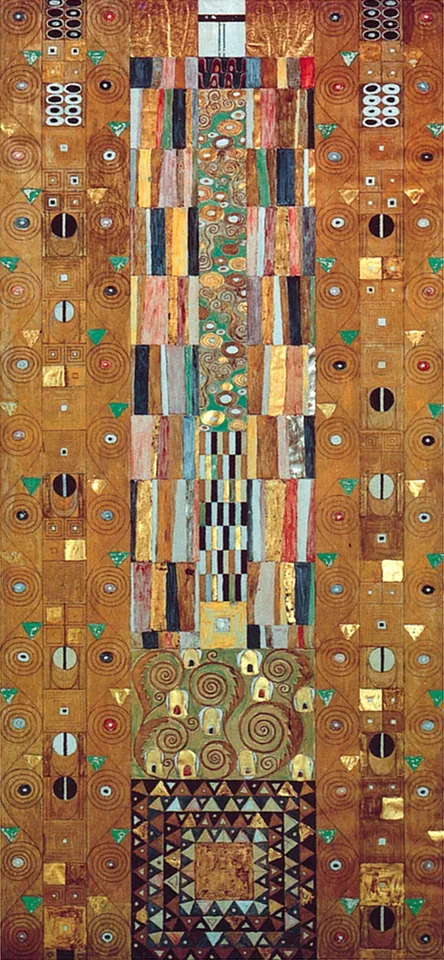
The Stoclet Frieze by Klimt is a grand three-part mosaic cycle designed to cover three walls of a rectangular dining room. Across two facing longitudinal walls, Klimt arranged long horizontal compositions dominated by spiral branches, while a narrower geometric panel occupied the short end wall between them. The visual scheme combines figurative allegory with rich ornamental patterning, matching the high point of Klimt’s gold period.
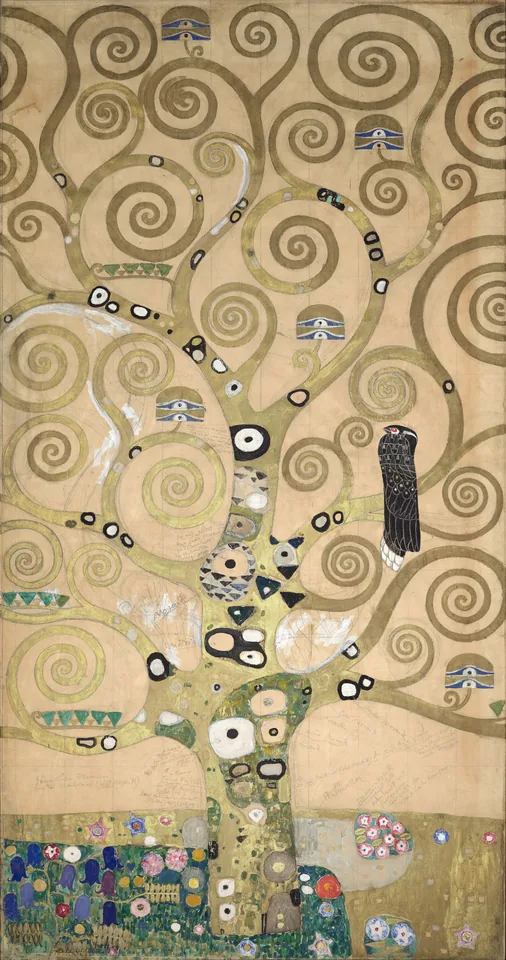
When you look at the frieze, your eye immediately follows the sweeping spiral tendrils of the Tree of Life. The pale gold branches curl outward from a central trunk, repeating rhythmic spiral loops across the pale background. Klimt dotted the pale cream trunk with oval, eye-like knots and small circular rings. The branches unfurl across the entire height of the upper zone, filling the space with continuous curves.
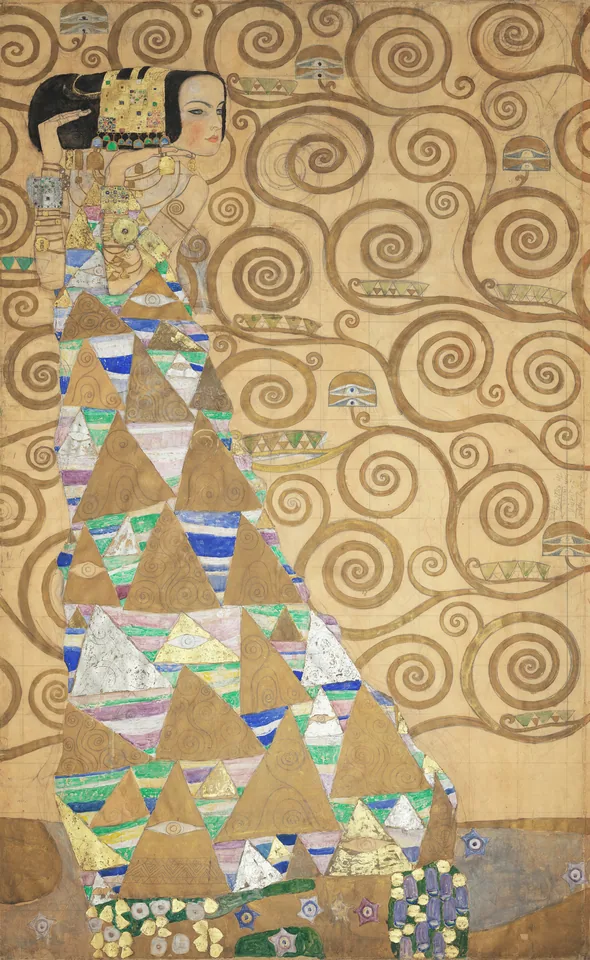
On the left section of the long wall stands the solitary figure of Expectation. A slender woman stands in strict profile facing toward the center. Her head and hairstyle recall ancient Egyptian wall paintings and East Asian scroll art. Dark hair sits piled atop her head, while delicate golden hairpins secure the coils. Her body disappears beneath a stiff, triangular robe decorated with repeated geometric motifs. Klimt covered her garment in stacked gold triangles, green blocks, dark lozenges, and tiny floral accents. Her pale hands emerge from the dress, poised in a deliberate, theatrical gesture.
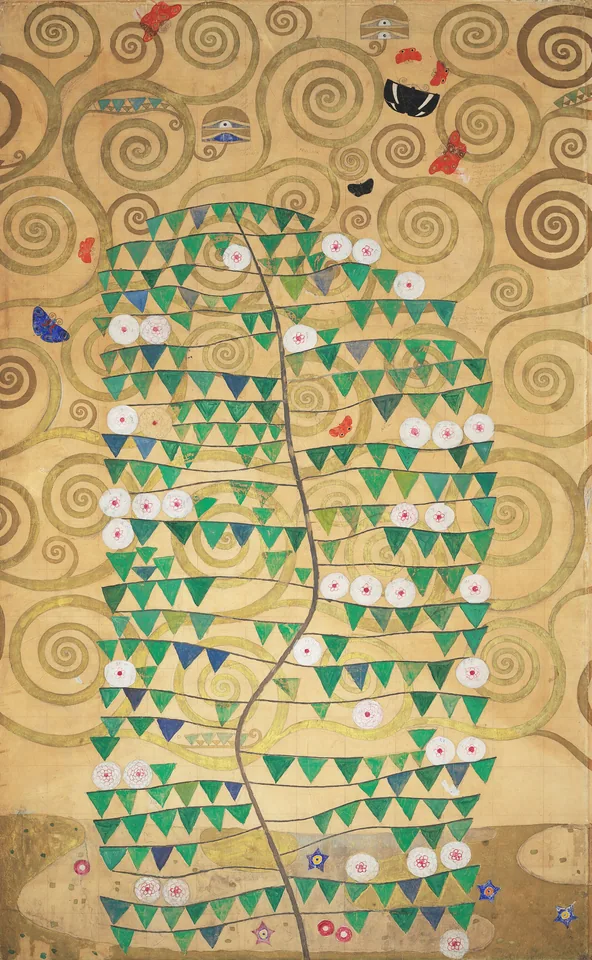
Beside the spreading boughs of the tree, Klimt introduced subtle figurative and natural contrasts. In one section of the branches, a solitary black raven perches silently, facing left against the coiling golden loops. Near the center, a dense vertical shrub rises from the earth, formed from horizontal bands of green triangles and dotted with delicate white rosettes. This rigid vegetal column anchors the flowing spirals and gives the composition architectural structure.
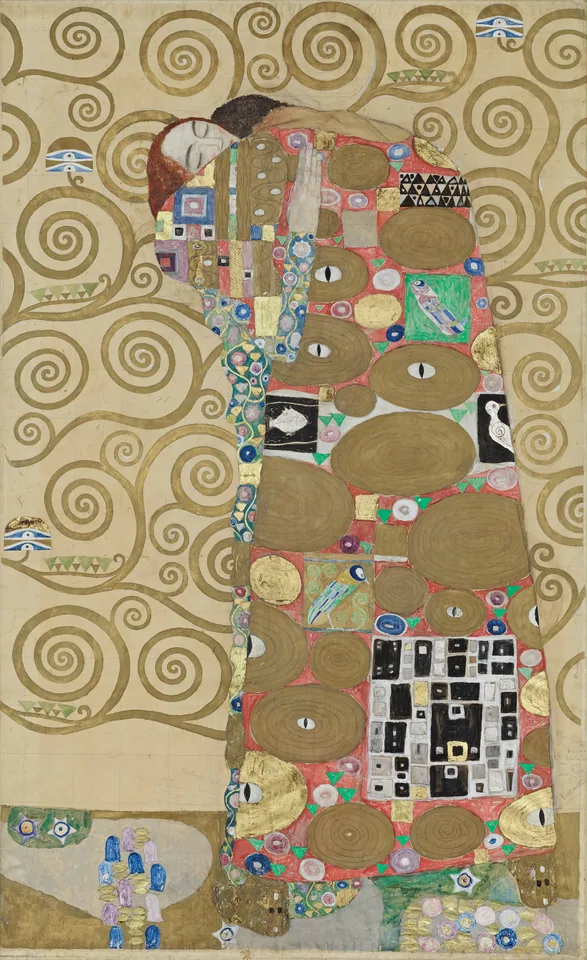
On the right side of the frieze stands Fulfilment, represented by an embracing couple. The two lovers press tightly together, their bodies merging into an unbroken column of ornament. The man turns his back, showing dark hair and a heavy robe dominated by large circular discs, black ovals, and rectangular patches that suggest eyes. The woman tilts her face upward with closed eyes, her head cradled against his cheek. Below both figure groups and the tree runs a continuous base of stylized earth, speckled with round pebbles, green mounds, and flat floral blossoms.
The short connecting panel features the Golden Knight, a standing figure rendered almost entirely through abstract geometric shapes. Constructed from vertical bars of pink, gold, silver, and white, the knight stands rigid like an architectural pillar. Beneath the figure sits a square plinth packed with triangular mosaic inlays, grounding the geometric guardian between Expectation and Fulfilment.
The story behind it
The Stoclet Frieze grew out of an ambitious architectural commission initiated in Brussels in the early twentieth century. In 1904, Belgian financier and art collector Adolphe Stoclet and his wife Suzanne hired Austrian architect Josef Hoffmann to design a private mansion. The couple had met Hoffmann in Vienna, where Adolphe was supervising railroad construction projects. The Stoclets initially considered building on the Hohe Warte in Vienna, but relocated to Brussels after the sudden death of Adolphe’s father in 1904. On April 8, 1905, Adolphe purchased a building plot on Avenue de Tervueren.
Hoffmann received complete creative freedom and an unlimited budget from his patrons. He approached the project as a Gesamtkunstwerk, a total work of art in which the architecture, interior furnishings, gardens, and fine art formed one harmonious whole. Hoffmann turned to the Wiener Werkstätte, the Viennese design collective he co-founded in 1903, to craft every detail from lighting fixtures to cutlery. Fritz Wärndorfer, the business manager of the Wiener Werkstätte, commissioned Gustav Klimt to design the dining room wall decoration. Klimt had already gained renown for large-scale architectural friezes in Vienna.
The eclectic private collection of Adolphe and Suzanne Stoclet exerted a strong influence on the project. Their home held Egyptian sculpture, Chinese ceramics and jades, Byzantine icons, Persian and Armenian miniatures, and medieval European paintings. Art historian M.E. Warlick notes that Klimt must have been delighted to find that their eclectic collection matched so many of his own recent artistic interests. Klimt drew inspiration from these ancient and Asian traditions when shaping the stylized motifs and symbolic figures for the room.
Klimt began preparatory work on the frieze in 1905, using paper mounted on canvas to draft a paradise setting filled with golden tendrils, flowers, birds, and human figures. In 1908, he carried out substantial revisions to the design. Physical fabrication of the mosaics began in 1909 under the direction of Leopold Forstner and his Vienna Mosaic Workshop. Forstner worked alongside master craftsmen specializing in goldsmithing, metalwork, ceramics, and enamel. Detailed documentation of this creative process can be explored in our guide to the Stoclet Frieze and the Tree of Life.
The fabrication involved extraordinary materials. The artisans translated Klimt’s painted designs into complex inlays of marble, glass, glazed ceramics, enamel, pearls, and semi-precious stones. Catalog records also list bronze, silver, gold, and platinum within the mosaic surfaces. The craftsmen assembled each room setting in Vienna to evaluate the aesthetic effect before packing the components for transport to Belgium. In 1911, the completed panels were mounted inside the dining room of Palais Stoclet in Klimt’s presence. Klimt forbade any public exhibition of the finished panels in Vienna before their departure, though he permitted his friend Berta Zuckerkandl to view them privately.
Where to see it
The original mosaics of the Stoclet Frieze remain in their original setting inside the Palais Stoclet on Avenue de Tervueren in Brussels. The palace remains a private residence and is closed to the public. Adolphe Stoclet lived in the house until his death on November 3, 1949, after which his daughter-in-law Annie Stoclet inherited the estate. Following her death in 2002, ownership passed to her four daughters. The Belgian state classified the palace as a protected historical monument in 1976, while Austrian records cite 1979, with official protection extended to the gardens in 2005. UNESCO inscribed the mansion as a World Heritage Site in 2009. In 2024, the Brussels Parliament approved a motion requiring the palace to open to the public for up to 15 days each year.
Although the installed mosaics in Brussels cannot be viewed freely, you can see Klimt’s original full-scale working designs in Vienna. The Museum of Applied Arts, known as the MAK, preserves Klimt’s eight-part cartoon for the frieze. Klimt created these life-size studies on heavy packing paper of varying thickness, applying gold leaf, silver leaf, and detailed handwritten instructions for the mosaic craftsmen. Following a multi-year restoration carried out for the 150th anniversary of Klimt’s birth, the cartoons are displayed in the Jugendstil and Art Déco department of the MAK’s study collection. You can compare these studies with the rest of Klimt’s output across our chronological index of every Klimt painting.
Details of Stoclet Frieze
Questions about Stoclet Frieze
What does Stoclet Frieze by Klimt show?
The Stoclet Frieze by Klimt shows a swirling Tree of Life, a standing woman representing Expectation, an embracing couple representing Fulfilment, and a geometric panel with the Golden Knight. Across the long panels, golden branches coil in spirals above a floral ground. A solitary black bird sits among the branches, while a stylized flowering bush rises beside the tree.
When did Klimt paint Stoclet Frieze?
Klimt designed the Stoclet Frieze between 1905 and 1911. He began working on drawings in 1905, revised the compositions substantially in 1908, and saw physical fabrication begin in 1909. The completed mosaic panels were transported from Vienna to Brussels and installed inside the Palais Stoclet dining room in 1911 in Klimt's presence.
Who owns Stoclet Frieze by Klimt?
The Stoclet Frieze by Klimt is owned by the heirs of the Belgian financier Adolphe Stoclet. Following the death of Adolphe Stoclet in 1949, the palace and its decorations passed to his daughter-in-law Annie Stoclet. After her death in 2002, the property was inherited by her four daughters, keeping the frieze within the private collection of the Stoclet family.
How big is Stoclet Frieze by Klimt?
The Stoclet Frieze by Klimt measures 200 centimetres in height and covers walls across a grand dining room. Sources list its total dimensions as 200 by 730 centimetres. The two long side wall panels measure 200 by 738 centimetres each, while the smaller end wall panel featuring the Golden Knight measures 200 by 89 centimetres.
What is Stoclet Frieze by Klimt made of?
The Stoclet Frieze by Klimt is a mixed-media mosaic made of luxury materials. The panels incorporate marble, glass, ceramic, gilded tiles, enamel, pearls, and semi-precious stones, along with metals including gold, silver, bronze, and platinum. Klimt's original preparatory cartoons in Vienna were executed with gold leaf and silver leaf on heavy packing paper.