Select the painting to see it full screen and zoom in.
What the painting shows
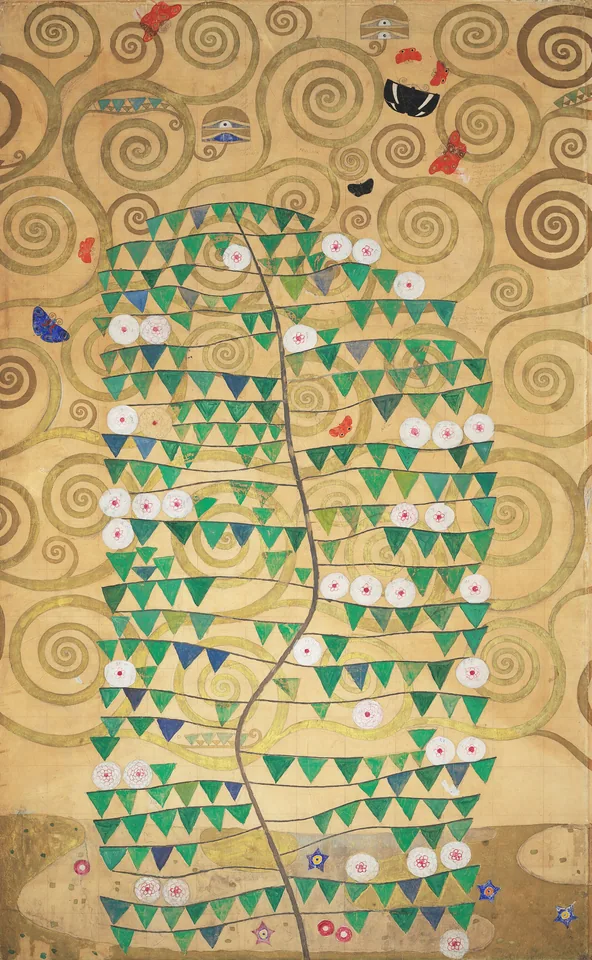
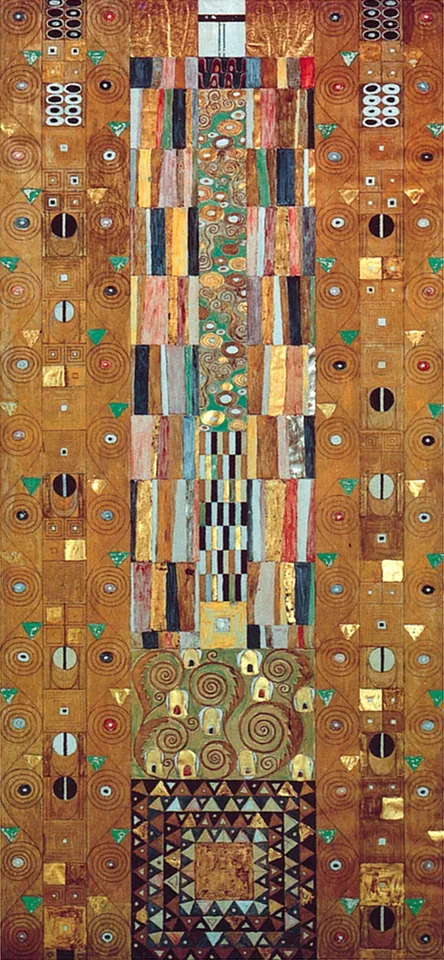
The Tree of Life by Klimt presents a towering golden tree that unfurls across a vertical sheet of paper. As you look at the work, the central trunk rises straight from a bed of stylized wildflowers at the bottom edge. Spiraling branches spread to the left and right, twisting into tight coils that fill almost the entire surface of the composition. Klimt created this piece as a full-size working cartoon, so you can see visible pencil lines, squaring marks, and handwritten technical instructions scattered across the pale packing paper.
The base of the picture anchors the composition with a band of rich green grass and meadow flowers. Blue bell-shaped blossoms stand in rows alongside pink, white, and red rosettes. To the right of the trunk, a clump of round pink flowers sits enclosed within a pale oval border. You can also spot tiny star shapes and circular blue discs tucked between the stems. These floral patterns remain flat and decorative, giving the ground the quality of an ornamental garden border.
The trunk itself functions as a pillar of dense pattern. Klimt covered the golden surface of the bark with dark geometric shapes, including black ovals, white circles, and green triangles. Toward the lower section of the trunk, concentric oval forms suggest staring eyes. Higher up, the trunk splits into primary limbs that arch upward and outward. Each branch tapers into fluid, circular scrolls that curl back on themselves in repeating spirals. You can observe horizontal branch segments accented with rows of green inverted triangles and white dots.
Perched on a limb to the right of the central trunk, a single black bird faces toward the center. Klimt drew the bird with a sharp silhouette, dark body plumage, patterned wing feathers, and white tail feathers, accented by a small red eye. Above and around the bird, arched motifs resembling abstract eyes with blue, white, and golden bands sit among the spirals. These motifs appear at various heights on the left and right sides of the tree, creating visual balance across the vertical surface.
Because this sheet served as a practical guide for craftsmen, Klimt left his working process visible. You can see faint pencil inscriptions noting materials such as mosaic and specific treatments for individual segments. Traces of silver leaf and gold leaf catch the light across the branches. The work sits firmly in the gold period, combining rich metallic finishes with linear drawing.
The story behind it
The story of this design begins in Brussels with the Belgian financier and art collector Adolphe Stoclet and his wife, Suzanne Stoclet. The couple met the Viennese architect Josef Hoffmann while Adolphe was overseeing railroad construction in Vienna. The Stoclets initially considered building a home on Vienna’s Hohe Warte, but they relocated to Brussels after the unexpected death of Adolphe’s father in 1904. In April 1905, Adolphe purchased a parcel of land on Avenue de Tervueren to build a grand city mansion.
Hoffmann designed the Stoclet Palace between 1905 and 1911 in the Vienna Secession style. He served as co-founder of the Wiener Werkstätte, an artistic collective established in 1903. The Stoclets granted Hoffmann an unlimited budget and total artistic freedom. As a result, the palace became the collective’s first major residential commission. Hoffmann conceived the building as a Gesamtkunstwerk, or total work of art, coordinating architecture, furnishings, metalwork, lighting, bathroom fixtures, and even custom clothing for Suzanne Stoclet. The exterior featured white Norwegian Turili marble slabs edged with gilded bronze and sculpted metal mouldings, crowned by a 20-metre stair tower with nude bronze sculptures by Franz Metzner.
To decorate the formal dining room, Fritz Wärndorfer, the business manager of the Wiener Werkstätte, commissioned Gustav Klimt. The room required monumental decoration across its long side walls. Klimt created the Stoclet Frieze, an ambitious decorative cycle conceived across three walls. The Stoclets owned a vast art collection that included Egyptian sculpture, Chinese jades and ceramics, Byzantine icons, Persian and Armenian miniatures, and medieval paintings. Art historian M.E. Warlick notes that Klimt must have been delighted to find the Stoclets’ eclectic tastes matched many of his own artistic interests at the time.
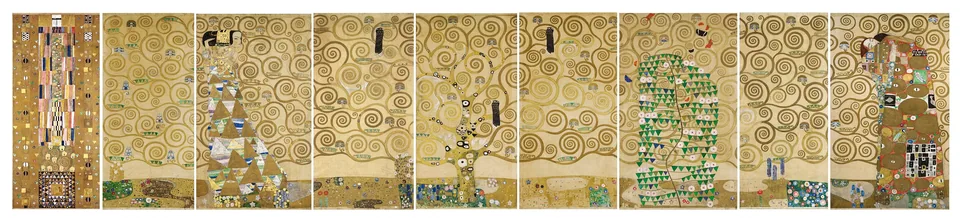
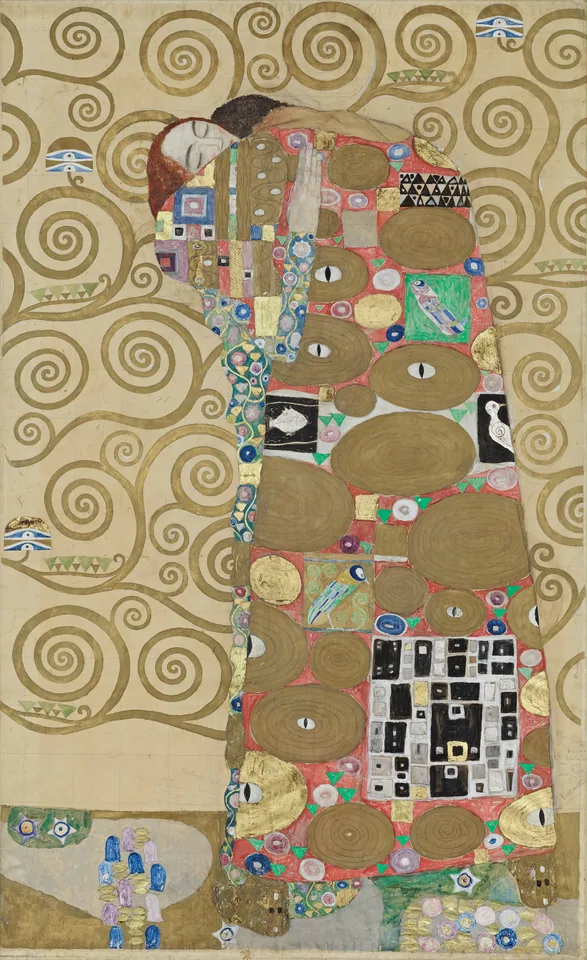
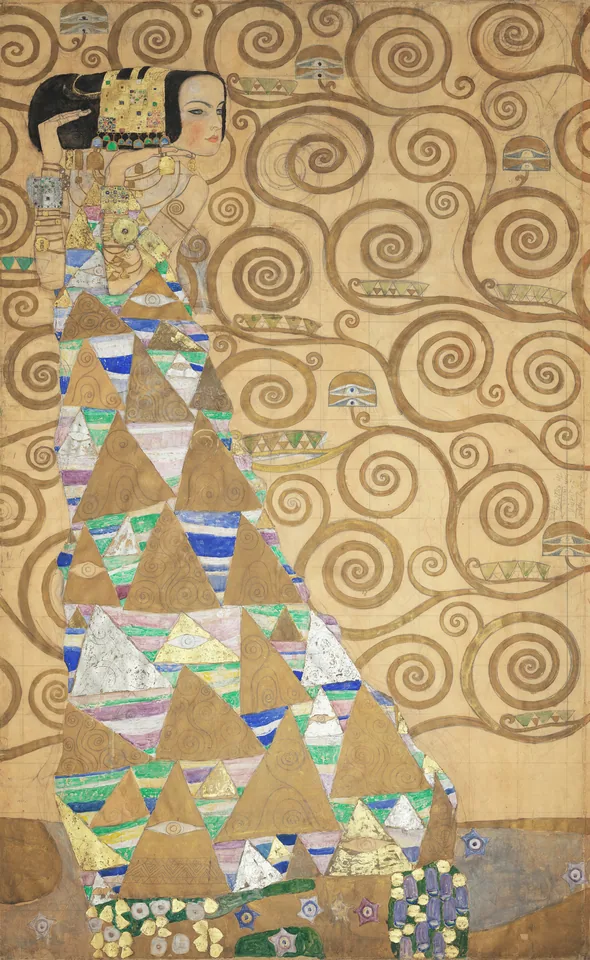
Klimt began working on the frieze sketches in 1905. He made substantial revisions to his concepts in 1908. To plan the final mosaics, Klimt drew eight full-scale cartoons on packing paper using tempera, watercolor, gold leaf, and silver leaf. This study of the Tree of Life formed the core decorative field for the long walls. Within the overall frieze program, the swirling branches frame two major figural compositions that face each other across the dining room: a standing woman representing Expectation on one wall, and an embracing couple representing Fulfilment on the opposite wall. On the short connecting wall, a smaller panel displayed a geometric composition centered on the Golden Knight. These compositions belong to Klimt’s celebrated allegories and decorative friezes.
Execution of the mosaics began in 1909. Klimt entrusted the fabrication to the Viennese mosaic workshop run by Leopold Forstner, working alongside master goldsmiths, ceramicists, and enamel specialists. The artisans translated Klimt’s paper cartoons into stone and precious metals. They set marble, ceramic tiles, gilded tesserae, enamel, pearls, and semi-precious stones directly into the panels. Wikidata also lists bronze, silver, gold, and platinum among the materials used in the frieze. Before shipping the finished parts to Belgium, the craftsmen assembled each interior room in Vienna to review the visual harmony of the furnishings and walls.
Klimt traveled to Brussels in 1911 to oversee the installation of the panels in the dining room. Although he showed the completed designs privately to his close friend Berta Zuckerkandl, Klimt strictly forbade any public exhibition of the finished frieze in Vienna. Beyond its historical setting in Brussels, the design captured the imagination of later architects. Klimt’s spiraling tree composition directly inspired the colorful exterior facade of the 21-story student residence hall known as the Tree House at the Massachusetts College of Art and Design in Boston.
Where to see it
You can see the original working cartoon of The Tree of Life in Vienna, Austria. It belongs to the permanent collection of the MAK, the Museum of Applied Arts. The museum preserves Klimt’s full-scale, eight-part working drawings on paper. Curators display the frieze cartoons in the Jugendstil and Art Déco gallery of the MAK study collection. Ahead of the 150th anniversary of Klimt’s birth, the museum completed a multi-year restoration project to stabilize the fragile packing paper, secure the applied gold and silver leaf, and preserve Klimt’s handwritten notes.
The finished mosaic frieze remains inside the dining room of the Stoclet Palace in Brussels, Belgium. The palace has stayed in private hands since its completion. Adolphe Stoclet lived in the residence until his death on November 3, 1949. His daughter-in-law, Annie Stoclet, then inherited the property and lived there until her death in 2002. Today, Annie Stoclet’s four daughters own the mansion.
The Belgian government protected the Stoclet Palace as a historical monument, with English Wikipedia dating this classification to 1976 and German Wikipedia noting the palace was protected in 1979, followed by its gardens in 2005. In 2009, UNESCO inscribed the palace as a World Heritage Site. Despite its international reputation, the mansion has remained closed to the public throughout its history. In 2024, the Brussels Parliament approved a motion mandating public access to the palace for a maximum of 15 days per year, though access remains strictly limited. As a result, the MAK in Vienna provides the primary public setting where you can view Klimt’s original full-scale designs for this decorative project.
Details of The Tree of Life
Questions about The Tree of Life
What does The Tree of Life by Klimt show?
The Tree of Life by Klimt shows an ornamental tree spreading across a tall vertical panel. Its golden branches curl into spirals across the pale background. A single black bird perches on a branch to the right of the central trunk. At the bottom, stylized blue, pink, and white flowers bloom in a grassy meadow beneath the patterned trunk.
When did Klimt paint The Tree of Life?
Gustav Klimt worked on the designs between 1905 and 1911. Museum records date this specific design cartoon to 1910–1911, while English Wikipedia dates the study to 1909. Klimt began initial design work for the project in 1905 and carried out substantial revisions in 1908 before craftsmen began mosaic execution in 1909.
Where is The Tree of Life by Klimt?
The Tree of Life cartoon by Gustav Klimt is in Vienna, Austria, at the Museum of Applied Arts, known as the MAK. Curators display the work within the Jugendstil and Art Déco section of the museum study collection. The completed mosaic version remains inside the private dining room of the Stoclet Palace in Brussels, Belgium.
How big is The Tree of Life by Klimt?
The Tree of Life design cartoon measures 200 centimetres high by 102 centimetres wide according to the Museum of Applied Arts and Wikidata records. English Wikipedia lists the dimensions of the study as 195 by 102 centimetres. This tall, narrow vertical format matches the scale of the central tree sections in the completed dining room frieze.
Which series does The Tree of Life belong to?
The Tree of Life belongs to the Stoclet Frieze, a three-part decorative cycle designed for the Stoclet Palace in Brussels. The wider frieze includes two other principal subjects: a standing female figure representing Expectation and an embracing couple representing Fulfilment. A smaller panel depicting the Golden Knight connects the two long walls of the room.