Gustav Klimt: Life, Paintings and Style
Gustav Klimt was an Austrian painter born in 1862 in Vienna. He is famous for his decorative portraits with gold leaf, expressive female figures, and tranquil lake landscapes.
Who Gustav Klimt was
Gustav Klimt was an Austrian painter who lived from 1862 to 1918 and became one of the central figures of European modern art. Working in Vienna, he gained international fame for decorative oil paintings that integrated shimmering metal leaf with figures drawn from everyday life and mythology. His career spanned academic theater murals, rebellious avant-garde exhibitions, private golden portraits, and square landscapes painted during summer retreats.
Klimt grew up in severe financial hardship as the second of seven children born to Anna Klimt and Ernst Klimt the Elder, a Bohemian gold engraver. The family moved between at least five addresses across Vienna between 1862 and 1884 as his father struggled to secure steady work. Family sorrow marked his youth: his five-year-old sister Anna died in 1874, his sister Klara suffered severe mental illness, and his mother experienced deep bouts of depression.
Klimt entered Vienna’s artistic world by training in drawing and architectural decoration, but he soon challenged the conservative traditions of the imperial capital. In his mature years, he lived an unconventional life. He never married, fathered at least fourteen children, and worked inside his studio wearing sandals and a long robe without undergarments. His lifelong close companion was the Viennese fashion designer Emilie Flöge, with whom he maintained a deep and lasting bond.
Early years and the Künstler-Compagnie
Recognized early at school for his drawing skill, Klimt received a scholarship to attend the Vienna Kunstgewerbeschule from 1876 to 1883. He trained in architectural painting under teachers such as Ferdinand Laufberger, Victor Berger, Michael Rieser, Karl Hrachowina, and Ludwig Minnigerode. Klimt held great respect for Hans Makart, the leading Viennese history painter of the era, and sought to match his grand style.
By 1880, Gustav Klimt formed a collaborative studio called the Künstlercompagnie with his younger brother Ernst Klimt and fellow artist Franz von Matsch. The team secured commissions for theater curtains and ceiling decorations across the Austro-Hungarian Empire, completing decorative cycles in Fiume, Karlsbad, and Reichenberg. In 1885, they painted ceilings for the Hermesvilla on the outskirts of Vienna, and between 1886 and 1888, they produced staircase murals for the new Burgtheater.
These public projects brought high honors. Emperor Franz Joseph I awarded Klimt the Gold Cross of Merit in 1888, and Klimt won the inaugural Kaiserpreis in 1890 for his gouache painting of the audience inside the old Burgtheater. The company also executed grand staircase murals for Vienna’s Kunsthistorisches Museum and ancestral portraits for Peleș Castle in Romania. The collaborative firm dissolved after Ernst Klimt died of pericarditis in December 1892, a blow that followed the death of their father from a stroke earlier that same year, leaving Gustav with financial responsibility for both households.
The Vienna Secession
Frustrated by the conservative exhibition policies of the Vienna Künstlerhaus, Klimt resigned on 24 May 1897 to establish a new collective. Together with progressive artists and architects, he formed the Vienna Secession and served as its first president until 1899. The group rejected historicism and sought to connect Viennese art with radical modern currents across Europe.
Klimt contributed directly to the design of the Secession Building designed by Joseph Maria Olbrich, creating the building’s metal entrance doors. Between 1898 and 1903, he supplied illustrations, borders, and decorative templates for the Secession’s printed journal, Ver Sacrum. His art shifted decisively away from realistic historicism toward flat planes, stylized outlines, and expressive symbolic forms.
In 1902, the Secession staged its fourteenth exhibition, built around a statue of Ludwig van Beethoven by Max Klinger. For this event, Klimt painted the Beethoven Frieze directly onto the gallery walls using light materials. The face of the frieze’s central knight bore a recognized resemblance to the composer and conductor Gustav Mahler. Internal aesthetic conflicts led Klimt and allies such as Carl Moll to resign from the Secession in 1905, after which his works were taken down from the building.
The golden phase
During the early 1900s, Klimt entered the period known as his golden phase. Travels to Venice and Ravenna gave him direct contact with historic Byzantine mosaics, whose flat gold backgrounds and stylized figures reshaped his visual thinking. You can explore this period in depth through our guide to Klimt’s golden phase.
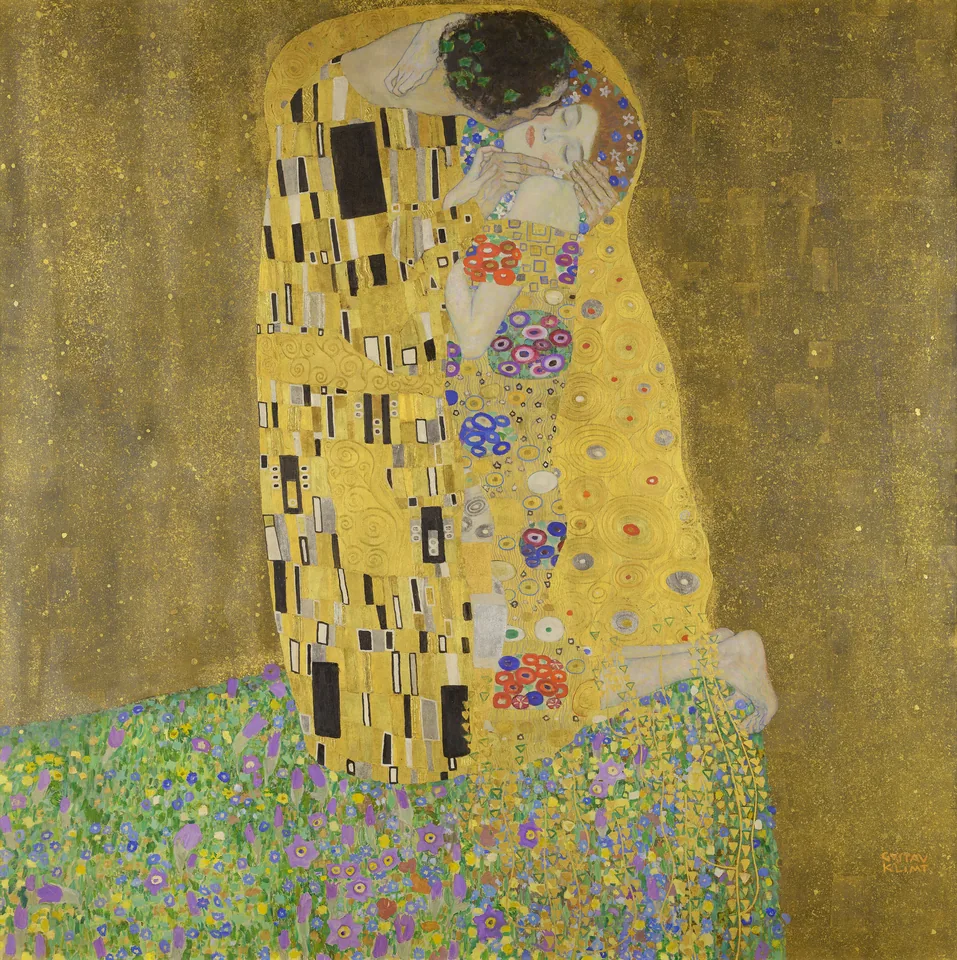
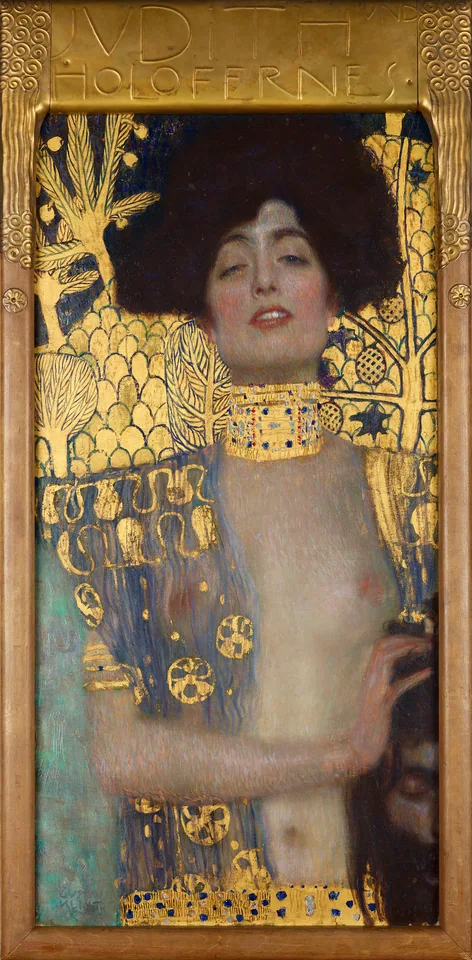
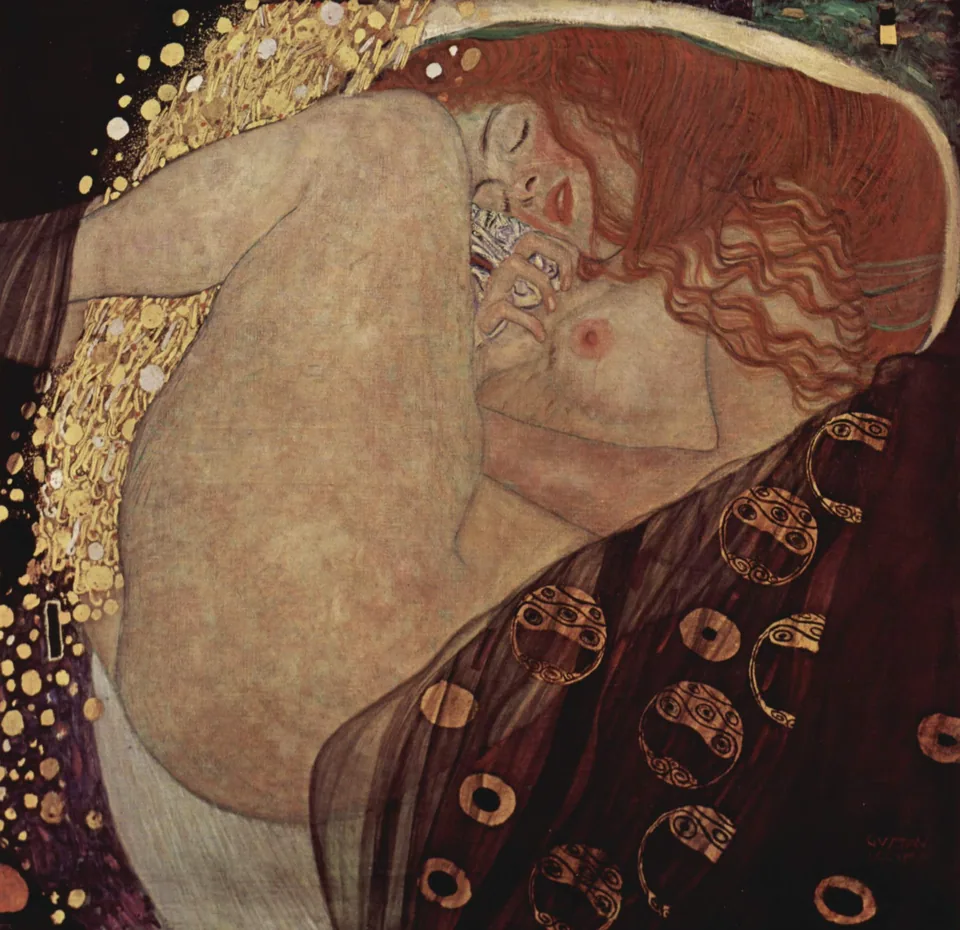
In these works, Klimt suspended realistic human flesh within dense fields of geometric pattern, spiral shapes, and pure gold leaf. The human faces and hands retain delicate modeling, but clothing and backgrounds dissolve into two-dimensional surfaces. Major works from this sequence include Judith I in 1901, Danaë in 1907, and the famous square canvas of The Kiss.
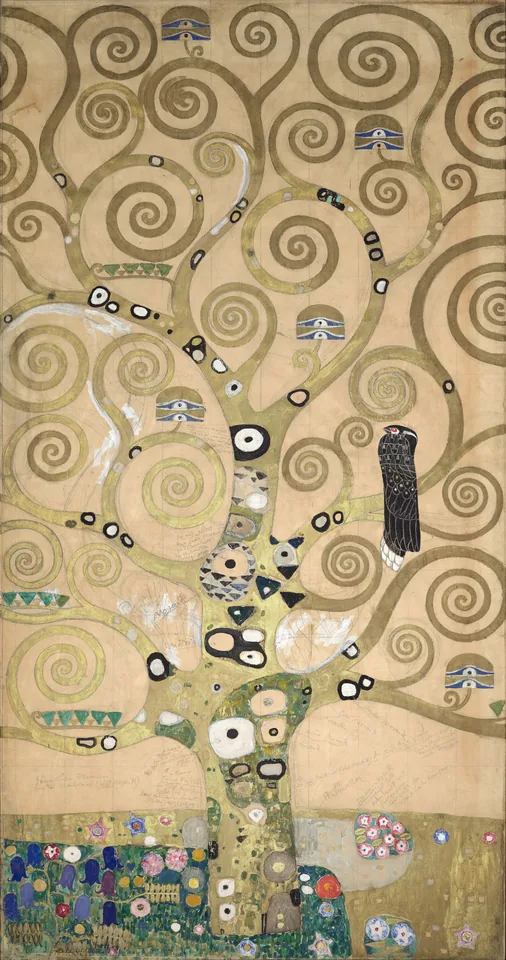
Between 1905 and 1911, Klimt also applied this approach to architectural decoration. Architect Josef Hoffmann commissioned him to create mosaic friezes for the dining room of the Palais Stoclet in Brussels. Klimt designed panels based on the Tree of Life, Expectation, and Fulfillment, using fine marbles, ceramics, and gilded tesserae. He later described these dining room friezes as the ultimate stage in the development of his ornament.
Landscapes and late portraits
Outside his busy studio routine in Vienna, Klimt spent quiet summers in Upper Austria. From 1900 to 1916, he traveled annually to the Attersee, staying at the villa of Friedrich Paulick with the Flöge family. The vast majority of his pure landscape paintings emerged during these summer months, which you can read about in our guide to Klimt’s landscapes and the Attersee.
Local residents near the lake nicknamed Klimt the forest demon because of his intense focus while working outdoors. He often viewed his subjects through a telescope or handheld binoculars to compress depth, collapsing trees, foliage, and lake surfaces into flat fields of color. Canvases such as Avenue in the Park of Schloss Kammer, Poppy Field, and Cottage Garden demonstrate this tapestried visual density.
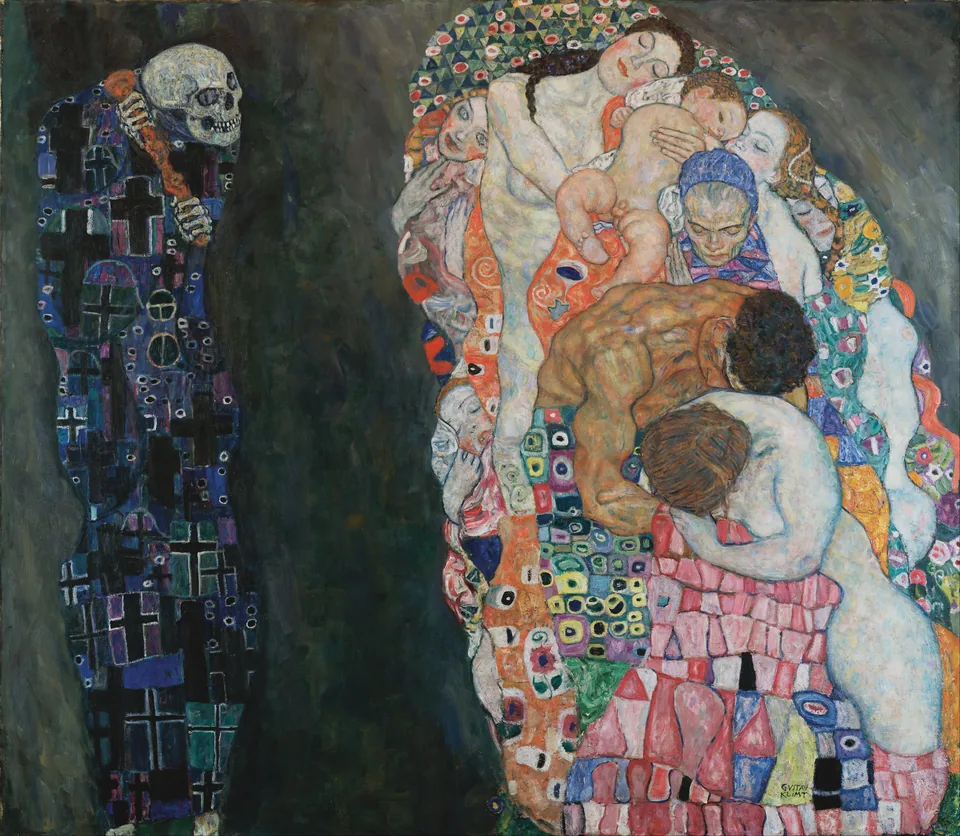
After concluding his golden phase around 1911, Klimt shifted toward a richer chromatic palette with looser brushwork. His large painting Death and Life, which won first prize at the Rome International Exhibition in 1911, underwent reworking in 1915 when he replaced the original gold background with deep blue. His final portraits, including Lady with a Fan painted in 1918, featured vibrant colors and Asian textile patterns surrounding the sitter.
Why Klimt was controversial
Klimt faced severe public scandals throughout his mature career, beginning with an imperial state commission. In 1894, the Ministry of Education hired Klimt and Franz Matsch to paint ceiling panels for the Great Hall of the University of Vienna. Klimt received the commission for three faculties: Philosophy, Medicine, and Jurisprudence. Read the complete story of these murals in our guide to the University Paintings.
Instead of illustrating wisdom and human progress, Klimt presented humanity caught in raw cycles of birth, sickness, suffering, and mortality. When exhibited, eighty-seven university faculty members signed a formal protest denouncing the works as crude and pornographic. Even though Philosophy received a gold medal at the Paris World Exhibition in 1900, the dispute in Vienna escalated. Klimt withdrew from the commission in 1905, bought back his canvases with money borrowed from private collectors, and vowed never again to work on an imperial public project. All three ceiling paintings were destroyed by fire at Schloss Immendorf in May 1945 during the retreat of German soldiers.
Hostility continued to follow Klimt’s private artwork. Public exhibitions of his erotic figurative drawings at Galerie Miethke in 1910 and in Vienna in 1913 drew vehement criticism from conservative viewers. His focus on the unclothed female body, combined with the dangerous femme fatale figures in canvases like Judith and Nuda Veritas, disturbed a Viennese public unaccustomed to such naked candor.
Illness and death
On 11 January 1918, while at his apartment on Westbahnstraße in Vienna, Klimt suffered a sudden stroke. The stroke caused severe paralysis down the right side of his body, putting an end to his daily painting routine.
Klimt entered the Vienna General Hospital for treatment. While hospitalized, he caught the Spanish influenza virus that was sweeping across Europe. The infection developed into severe pneumonia, and he died on 6 February 1918 at the age of 55.
Following his death, friends and colleagues mourned the loss of the city’s foremost modern painter. Klimt was interred at Hietzing Cemetery in Vienna, where his grave is located in group 5, grave number 194.
Klimt’s most famous paintings
Klimt produced dozens of celebrated canvases, which you can browse chronologically in our index of every Klimt painting. Several works stand out for their visual power and fame:
- The Kiss (1907–1908): Klimt’s most celebrated canvas, housed in Vienna’s Belvedere. You can explore the figures, patterns, and history of this painting in our detailed guide to The Kiss.
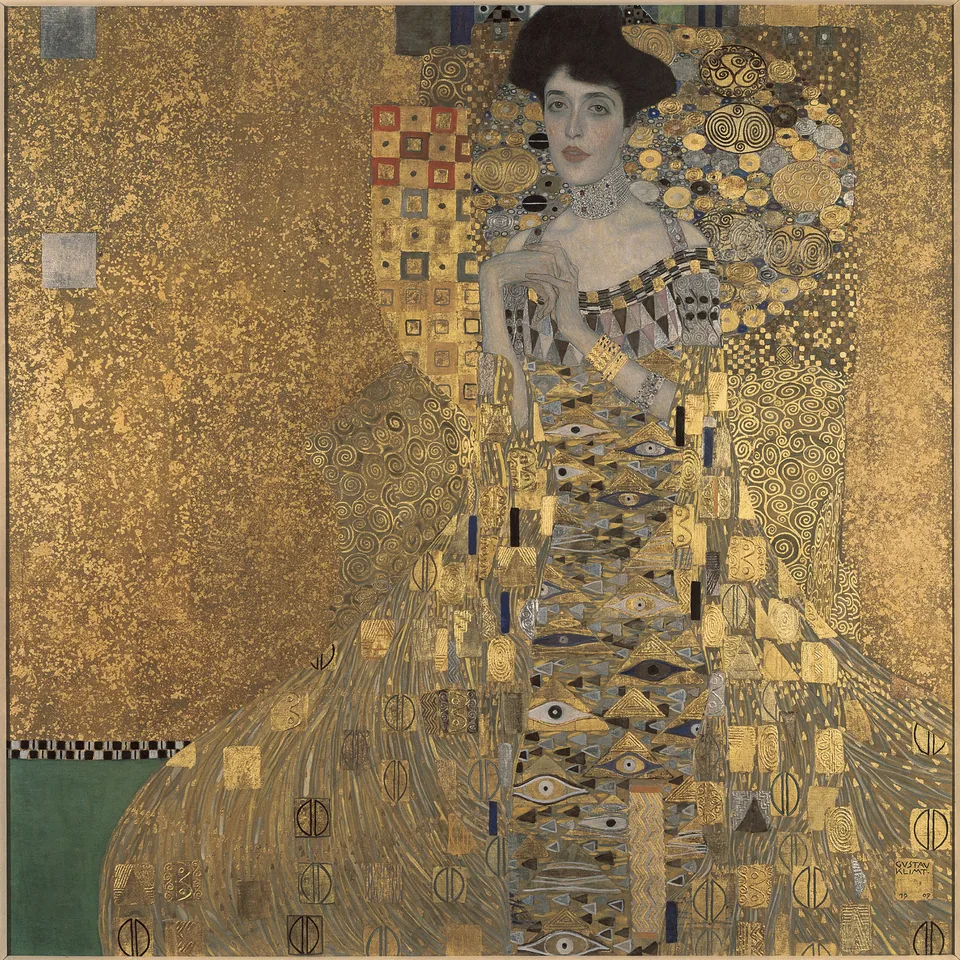
- Portrait of Adele Bloch-Bauer I (1907): A towering golden portrait covered in silver, gold, and geometric symbols, commissioned by Ferdinand Bloch-Bauer and preserved at the Neue Galerie New York.
- Judith I (1901): An arresting biblical composition featuring a golden choker and stylized foliage, showing the biblical heroine with the severed head of Holofernes.
- Death and Life (1910–1915): An allegorical canvas showing the grinning figure of Death wrapped in a dark patterned shroud beside an interwoven cluster of human generations.
- Danaë (1907): A compact oil painting depicting the mythological princess curled asleep amid a shower of gold, on display at the Leopold Museum in Vienna.
- Lady with a Fan (1918): Klimt’s last completed portrait, featuring fluid floral designs and colorful birds behind a seated woman holding an open fan.
Where to see Klimt’s work today
Most of Klimt’s surviving paintings remain in Vienna, though prominent institutions around the globe also display his work. For detailed visitor advice and travel itineraries, consult our guide on where to see Klimt paintings.
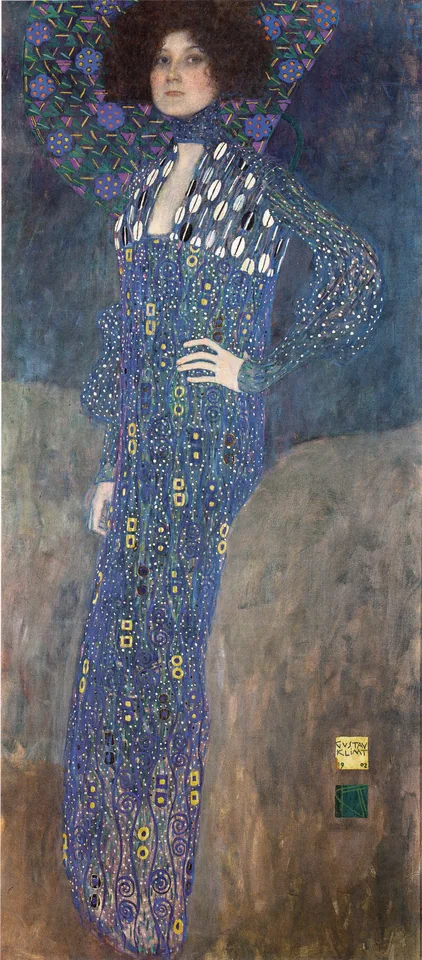
In Vienna, the Belvedere holds the world’s most significant assembly of Klimt’s oil paintings, including The Kiss, Judith I, and numerous Attersee landscapes. The Leopold Museum houses Danaë, Death and Life, and On Lake Attersee, while the Albertina preserves an extensive collection of his figurative drawings. The Austrian Museum of Applied Arts holds the original full-scale working designs for the Palais Stoclet mosaic frieze, and the Vienna Museum displays Pallas Athena and his 1902 portrait of Emilie Flöge.
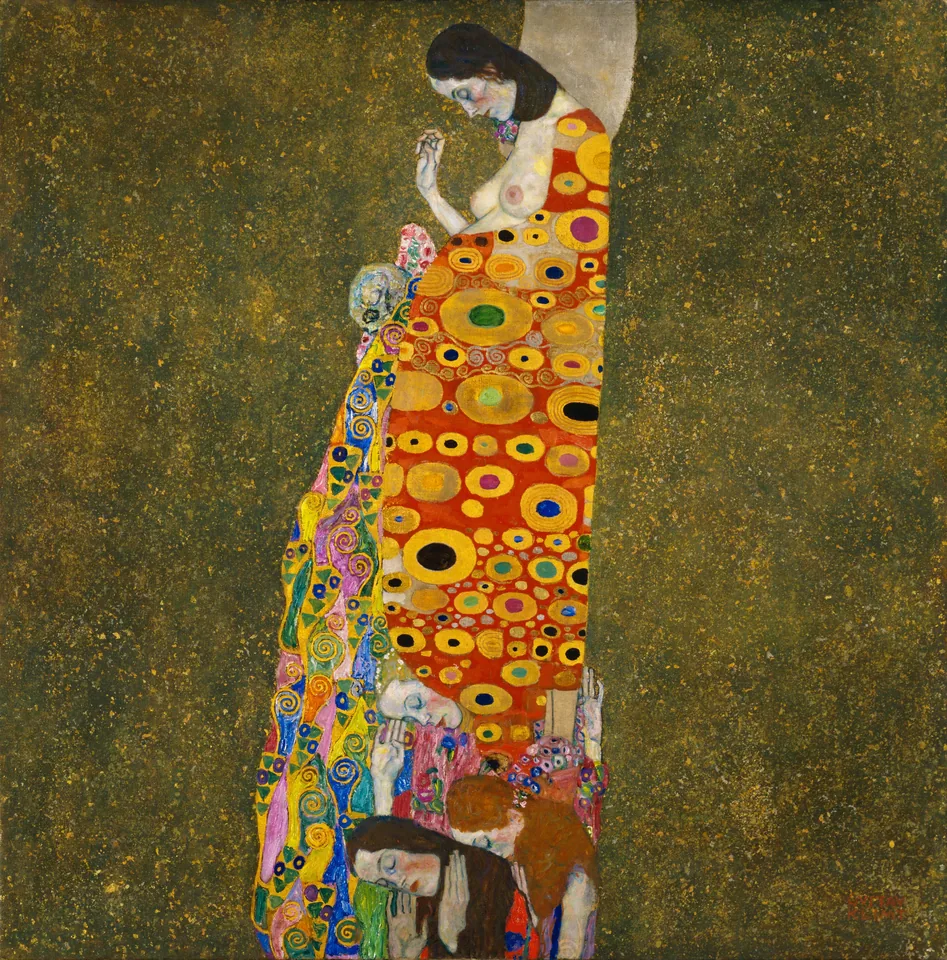
Outside of Austria, major works hang in select European and North American museums. The Neue Galerie in New York exhibits the Portrait of Adele Bloch-Bauer I alongside Park at Kammer Castle. The Museum of Modern Art in New York owns Hope II and The Park, while the Metropolitan Museum of Art displays portraits including Serena Pulitzer Lederer and Mäda Primavesi. London’s National Gallery displays his Portrait of Hermine Gallia, the National Gallery of Canada in Ottawa holds Hope I, and the National Gallery Prague preserves The Maiden and Water Castle.
Questions and answers
Who was Gustav Klimt?
Gustav Klimt was an Austrian painter who lived from 1862 to 1918. He served as the first president of the Vienna Secession art movement. Klimt gained international recognition for his decorative paintings that combined gold leaf with frank depictions of the human figure, as well as atmospheric square landscapes painted during his summer holidays in Upper Austria.
What is Gustav Klimt's most famous painting?
The Kiss is Gustav Klimt's most famous painting, completed during his golden phase between 1907 and 1908. The square oil painting depicts a man embracing a kneeling woman on a flower meadow under a shared decorative mantle. The Austrian government acquired the canvas directly from the Kunstschau exhibition in 1908, and it hangs in the Belvedere museum today.
Why was Klimt controversial?
Klimt caused public controversy because his artwork presented open eroticism and stripped away traditional allegorical decorum. His ceiling murals for the University of Vienna provoked a petition by eighty-seven professors who viewed his portrayals of naked human figures as scandalous. Exhibitions of his erotic drawings in Vienna galleries also drew fierce public hostility from conservative critics and viewers.
How did Gustav Klimt die?
Gustav Klimt died in Vienna on 6 February 1918 at the age of 55. After a stroke paralyzed the right side of his body in January, he was admitted to the Vienna General Hospital. While hospitalized, Klimt developed pneumonia caused by the Spanish flu, which proved fatal. He was later buried in Vienna at the Hietzing Cemetery.
Where was Gustav Klimt born?
Gustav Klimt was born on 14 July 1862 in Baumgarten, a settlement near Vienna in the Austrian Empire. His birthplace stood at Baumgarten number four, an address that later became Linzer Straße 247 in Vienna's fourteenth municipal district. Klimt grew up there as the second child in a family of seven children supported by his engraver father.