Where to See Klimt's Paintings: Museums in Vienna and Beyond
You can see Gustav Klimt paintings primarily in Vienna, Austria, with the largest collection at the Belvedere museum. Key works also hang in the Leopold Museum, New York's Neue Galerie, and major galleries across Europe.
Where most of Klimt’s paintings are
You can see Gustav Klimt’s paintings primarily in Vienna, Austria, which holds the greatest concentration of his work across several public collections. The Belvedere preserves his most prominent oil paintings, while other Viennese institutions display key portraits, landscapes, and architectural commissions. If you want a complete list of his works, our catalogue details every /paintings/ by year and location.
Outside Austria, you can find significant paintings in New York City, Rome, Prague, Venice, and London. Major institutions like the Neue Galerie and the Museum of Modern Art display key canvases from his career. Even so, any thorough journey through Klimt’s art centers on Vienna, where he produced his most recognized decorative cycles and portraits.
Belvedere, Vienna
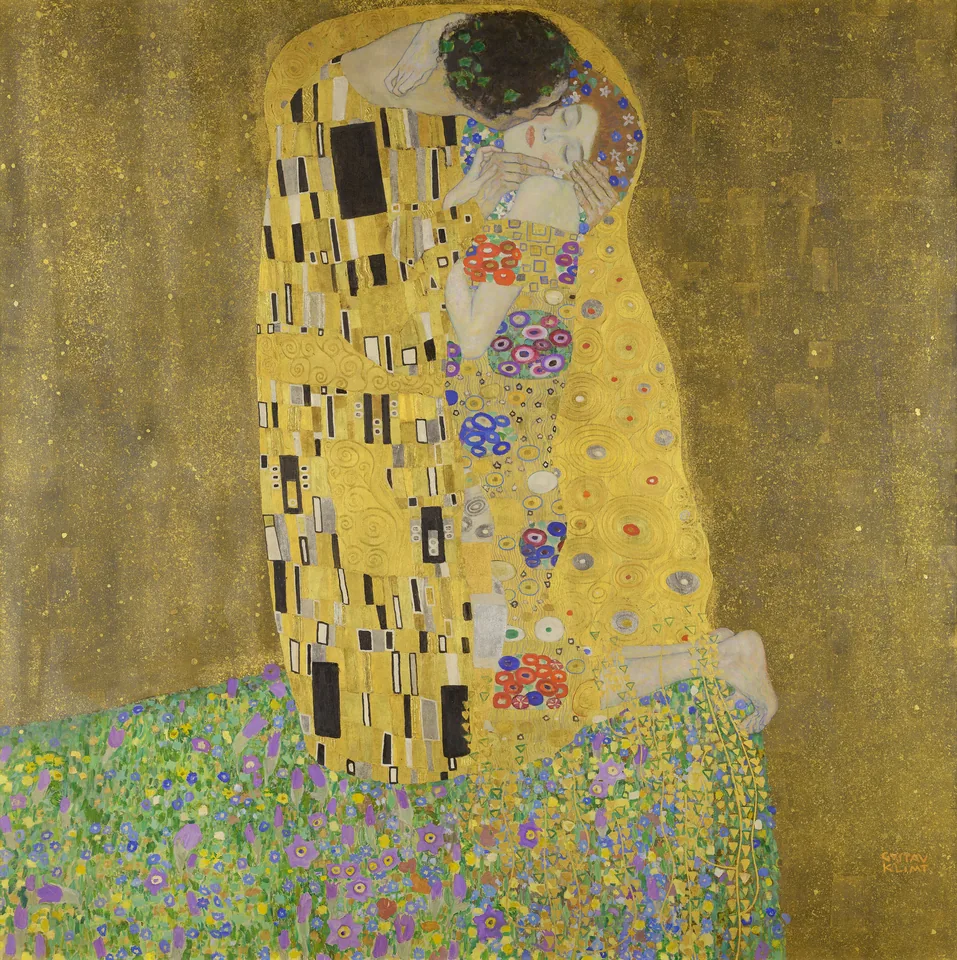
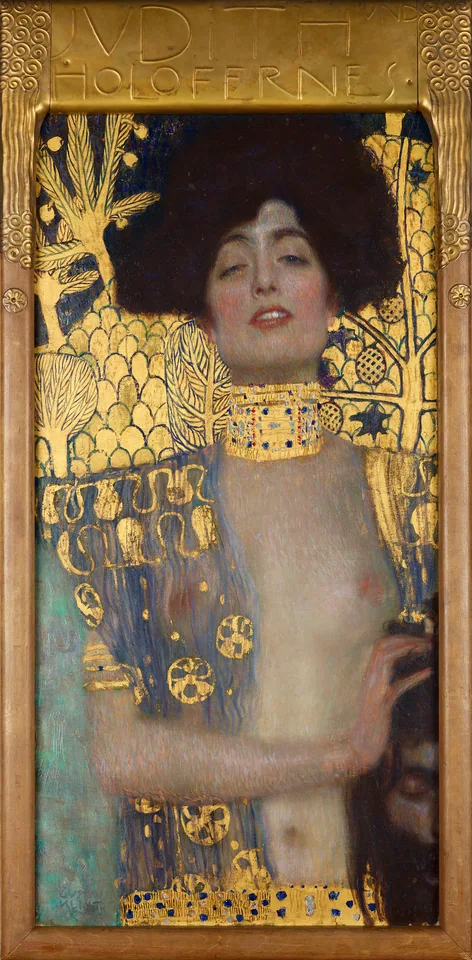
The Belvedere holds an important collection of works by Gustav Klimt, making it the central museum for his art. Its most famous possession is /the-kiss/, dated 1907 and measuring 180 by 180 centimeters. On this square canvas, two lovers embrace on a flowery meadow, wrapped in gold leaf and geometric patterns. Beside it hangs Judith I from 1901, measuring 84 by 42 centimeters, which portrays Judith holding the head of Holofernes against a golden decorative ground.
The museum also features major society portraits and late figurative compositions. You can see Fritza Riedler (1906, 153 by 133 cm), Lady in White (1917, 70 by 70 cm), and Portrait of Johanna Staude (1917, 70 by 50 cm). Adam and Eve, dated 1917 and measuring 173 by 60 centimeters, stands alongside the unfinished Portrait of Amalie Zuckerkandl (1917, 128 by 128 cm). In 2006, an Austrian arbitration panel decided that the Zuckerkandl portrait should remain in the Belvedere. In that same year, Austria returned five paintings by Klimt to the heirs of Ferdinand and Adele Bloch-Bauer.
Landscape paintings complete the Belvedere collection. These include Bauerngarten mit Sonnenblumen (1906, 110 by 110 cm), Sunflower (1907, 110 by 110 cm), and Poppy Field (Mohnfeld) (1907, 110 by 110 cm). You can also view Avenue in the Park of Schloss Kammer (1912, 110 by 110 cm), Birch Forest (1903, 110.1 by 109.8 cm, listed as Belvedere and Paul G. Allen Collection), and the small painting The Hydra (1906, 50 by 20 cm).
Leopold Museum, Vienna
Founded in 2001 by Rudolf Leopold in Vienna’s MuseumsQuartier, the Leopold Museum holds key paintings and drawings by Gustav Klimt. The collection presents important figurative works alongside quiet natural landscapes.
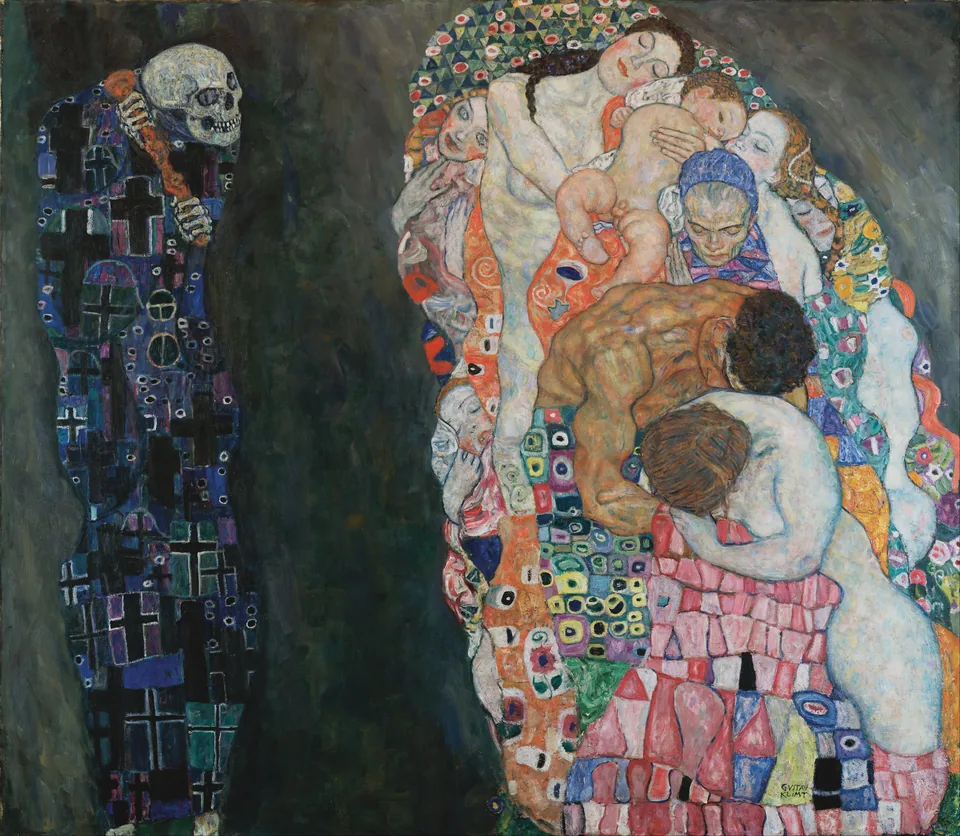
Death and Life, dated 1910 and measuring 180.5 by 200.5 centimeters, stands as one of the museum’s primary works. It contrasts a solitary, patterned figure of Death with a crowded, colorful cluster of infants, women, and men.
The museum also displays Danaë, dated 1907 and measuring 77 by 83 centimeters, showing the mythological figure curled inside a square frame beneath golden rain. Two landscape paintings round out the Leopold collection: On Lake Attersee (1900, 80.2 by 80.2 cm) and Litzlbergkeller (1916).
Secession building, Vienna
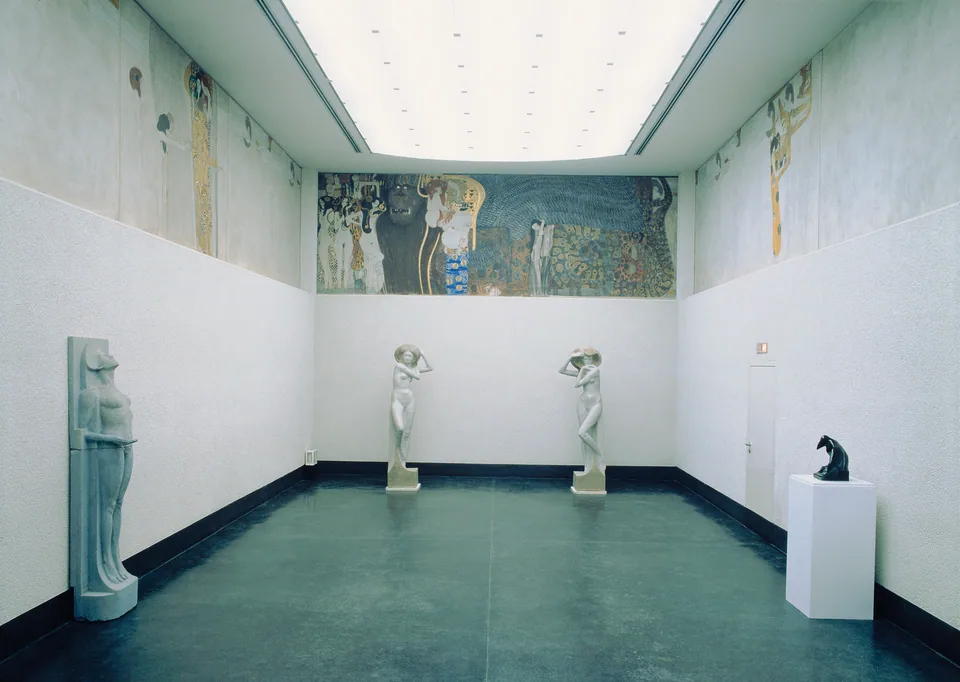
The Secession building in Vienna stands as an essential site in the history of Gustav Klimt and the Viennese avant-garde. Klimt created a massive wall painting for this building, and you can learn about its panels and themes in our guide to the /beethoven-frieze/.
The frieze features floating figures, personifications of human suffering, and symbolic protectors executed on plaster surfaces. An exhibition running from 2007 to 2008 at the Neue Galerie in New York featured a recreation of Klimt’s Beethoven Frieze, but the original work remains tied to the architectural setting of Vienna’s Secession.
More Klimt in Vienna
Several other Viennese institutions display original works, architectural murals, and design studies. The Wien Museum owns Pallas Athena (1899, 75 by 75 cm), the tall Portrait of Emilie Flöge (1902, 181 by 84 cm), and Auditorium of the old Burgtheater (1888, 91.2 by 103 cm).
At the MAK (Museum of Applied Arts), you can examine Klimt’s working cartoons for the mosaic frieze of the Stoclet Palace in Brussels, discussed in our guide to the /stoclet-frieze/. The MAK collection includes The Tree of Life (1909, 200 by 102 cm) and Fulfillment (1907, 200 by 121 cm).
On the Ringstraße, you can look up to see major early decorative cycles. The staircase of the Kunsthistorisches Museum features spandrel and intercolumniation paintings completed in 1891 by the Maler-Compagnie, which comprised Gustav Klimt, Ernst Klimt, and Franz Matsch. Its collection includes The Quattrocento in Rome and in Venice, Ancient Greece and Ancient Egypt, Old Italian Art, and Florence of the Cinquecento and Quattrocento. Nearby, the interiors of the new Burgtheater contain frescoes by Gustav Klimt, Ernst Klimt, and Franz von Matsch depicting theatrical history.
Other sites in Vienna preserve drawings and rare canvases. The Albertina holds roughly 65,000 drawings and roughly 1 million old master prints, though after World War II it fought against families’ requests that the museum restitute works by Klimt and Egon Schiele. Klimt Villa in Vienna’s Hietzing district incorporates his last studio, used from 1911 or 1912 until 1918. Its reconstructed studio displays reproductions of Lady with Fan (1917/18) and the unfinished The Bride (1917/18) on easels, alongside drawings and Josef Hoffmann furnishings. In addition, the Austrian Theatre Museum owns Nuda Veritas (1899, 252 by 55.2 cm), Bank Austria Kunstforum Wien holds Silverfishes (Nixen, Sirens) (1899, 86 by 67 cm), and the University of Vienna holds Medicine (1907).
Klimt outside Austria
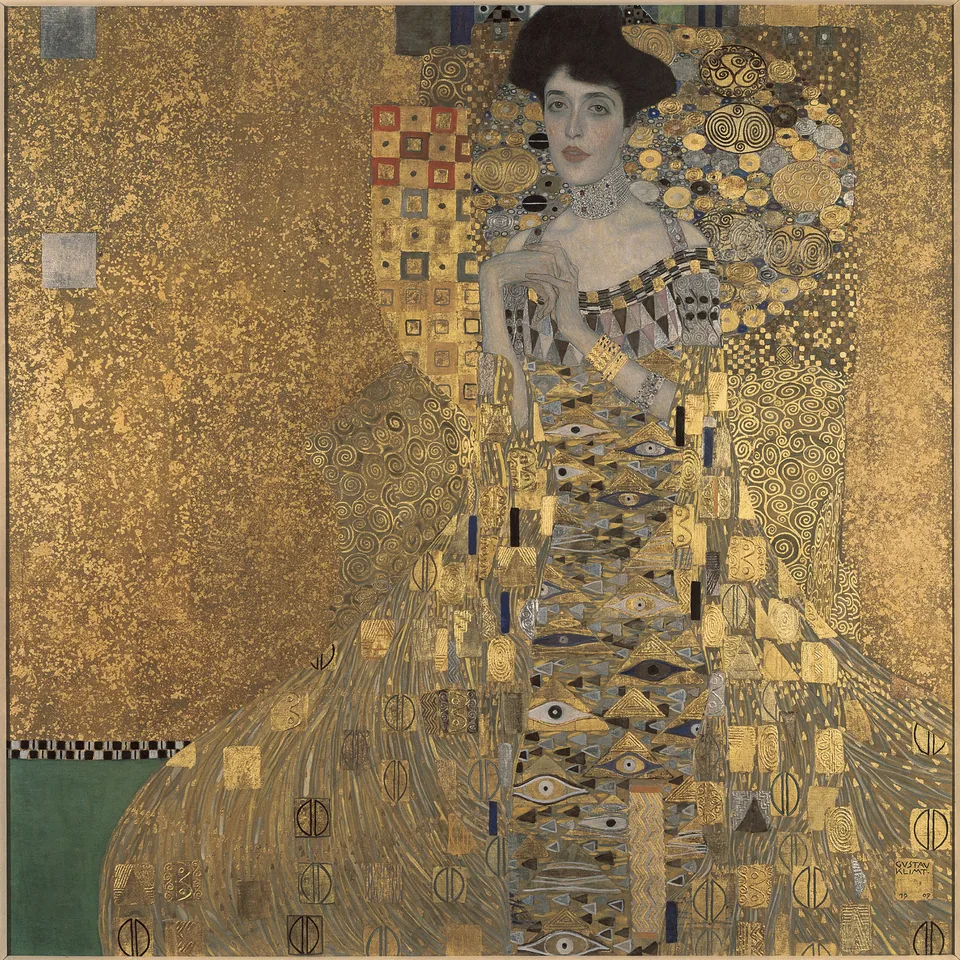
Outside Austria, New York City holds the largest selection of Klimt paintings. The Neue Galerie exhibits Austrian fine art on its second floor, including Portrait of Adele Bloch-Bauer I (1907, 138 by 138 cm), covered in our guide to /woman-in-gold/. In 2006, Ronald S. Lauder purchased this portrait from Maria Altmann for the museum. The Neue Galerie also holds two square landscapes: Forester’s House in Weissenbach II (Garden) (1914, 110 by 110 cm) and Park at Kammer Castle (1909, 110 by 110 cm).
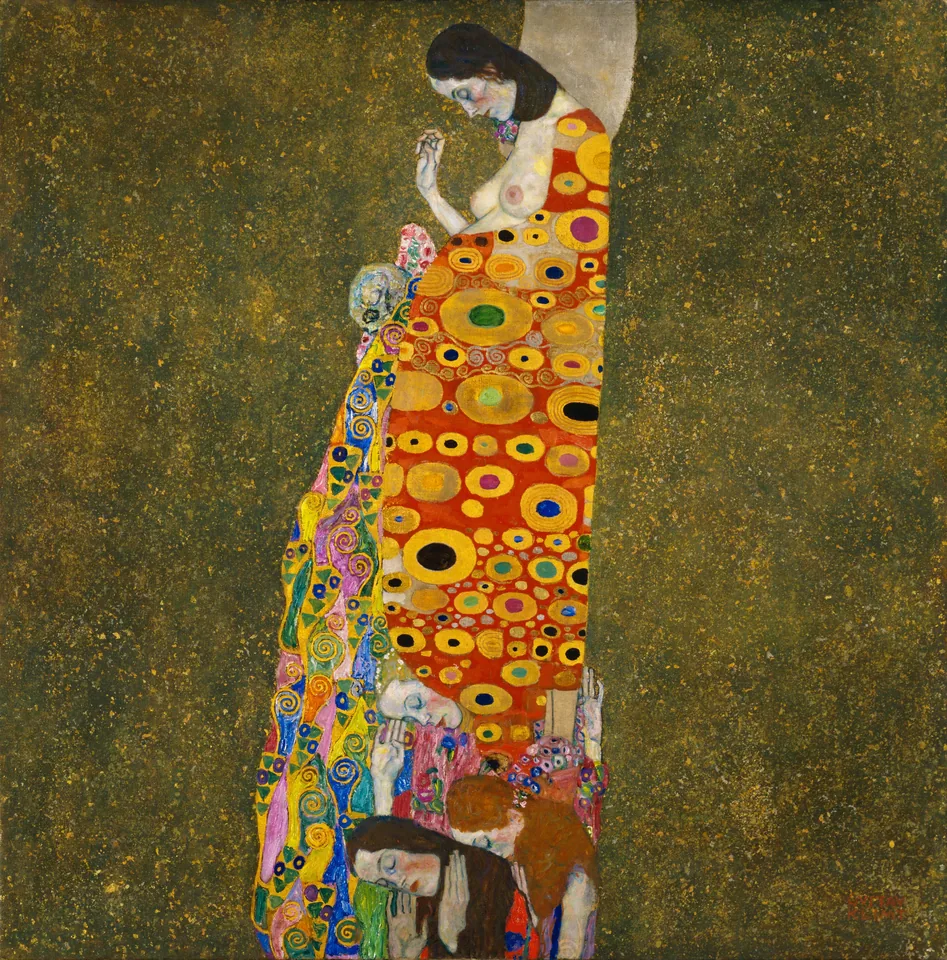
Other New York collections feature prominent works. The Museum of Modern Art holds Hope II (1907, 110.5 by 110.5 cm) and The Park (1909). The Metropolitan Museum of Art displays two full portraits: Serena Pulitzer Lederer (1899, 190.8 by 85.4 cm) and Mäda Primavesi (1912, 149.9 by 110.5 cm). In Cambridge, Harvard Art Museums and Busch-Reisinger Museum hold Pear Tree (1903, 101 by 101 cm).
Across Europe, you can view major paintings in several public galleries. The National Gallery Prague displays The Maiden (1913, 190 by 200 cm) and Water Castle (1908, 110 by 100 cm). In Italy, the Galleria Nazionale d’Arte Moderna e Contemporanea di Roma owns The Three Ages of Woman (1905, 180 by 180 cm), Ca’ Pesaro in Venice holds Judith II (1909, 178 by 46 cm), and Galleria d’arte moderna Ricci Oddi in Piacenza holds Portrait of a Lady (1916, 60 by 55 cm).
Further afield, London’s National Gallery preserves Portrait of Hermine Gallia (1904, 170.5 by 96.5 cm), and the Bavarian State Painting Collections in Munich hold Portrait of Margaret Stonborough-Wittgenstein (1905, 179.8 by 90.5 cm). Kunstmuseum Solothurn owns Goldfish (1902, 181 by 67 cm), and the Louis Vuitton Foundation in Paris holds Apple Tree II (1916, 80 by 80 cm). The National Gallery of Canada in Ottawa holds Hope I (1903, 189 by 67 cm). In Japan, Toyota Municipal Museum of Art holds Portrait of Eugenia Primavesi (1913, 140 by 85 cm), and the Aichi Prefectural Museum of Art owns The Golden Knight (1903).
Planning your visit
If you want to organize your viewing efficiently, start at the Belvedere. That collection gives you direct contact with his gold period, including The Kiss and Judith I, along with his square floral landscapes.
From the Belvedere, head to the MuseumsQuartier to visit the Leopold Museum for Death and Life, Danaë, and Lake Attersee views. You can then stop at the Vienna Museum for Pallas Athena and Emilie Flöge, followed by the MAK to inspect the full-scale Stoclet cartoons.
Finish your route with Klimt’s architectural decorations and working studio. View the staircase paintings at the Kunsthistorisches Museum and the ceiling frescoes at the Burgtheater. Finally, take a trip out to the Hietzing district to see the reconstructed studio and rooms at Klimt Villa.
Questions and answers
Where can I see Gustav Klimt's paintings?
You can see Gustav Klimt's paintings mostly in Vienna, Austria. The Belvedere holds the largest public collection, featuring famous canvases like The Kiss and Judith I. The Leopold Museum, Vienna Museum, and MAK also display his work in the city. Outside Austria, you can find original Klimt paintings in New York at the Neue Galerie, the Museum of Modern Art, and the Metropolitan Museum of Art, alongside galleries in Rome, Prague, Venice, and London.
Where is The Kiss by Klimt located?
The Kiss by Gustav Klimt hangs in the Belvedere museum in Vienna, Austria. Painted in 1907, the square oil painting measures 180 by 180 centimeters. It belongs permanently to the Belvedere collection, where visitors can see the figures wrapped in gold leaf, floral patterns, and geometric ornaments. The artwork remains one of the central attractions of Vienna's public art collections.
Which museum has the most Klimt paintings?
The Belvedere in Vienna holds the most significant and extensive collection of oil paintings by Gustav Klimt. Its holdings include key works such as The Kiss, Judith I, Fritza Riedler, and Avenue in the Park of Schloss Kammer. The museum also displays landscapes like Sunflower and unfinished late portraits including Adam and Eve and Portrait of Amalie Zuckerkandl, making it the primary institution for studying Klimt's development.
Where can I see Klimt in the United States?
In the United States, you can see Gustav Klimt's paintings primarily in New York City. The Neue Galerie displays Portrait of Adele Bloch-Bauer I, Park at Kammer Castle, and Forester's House in Weissenbach II. The Museum of Modern Art holds Hope II and The Park, while the Metropolitan Museum of Art displays Mäda Primavesi and Serena Pulitzer Lederer. In Massachusetts, the Harvard Art Museums collection includes the 1903 landscape Pear Tree.