Select the painting to see it full screen and zoom in.
What the painting shows
The Knight by Klimt is an upright design cartoon created in 1910–1911 using mixed media on paper. The work measures 197 by 91 centimeters and presents a stylized, armored figure built from geometric ornaments and gold foil.
Down the center runs a tall, vertical column. At the top sits a pale headpiece or mask with strict black vertical lines. Beneath it, you see bands of colorful stripes in red, yellow, slate blue, and gold. A band of swirling green circles and golden spots flows into a black-and-white checkerboard panel. Near the bottom, curled brown spirals surround small pale arches, resting above a square grid of dark and light triangles. Two broad, ochre side borders flank the central column, filled with concentric rings, gold squares, and green triangles.
The story behind it
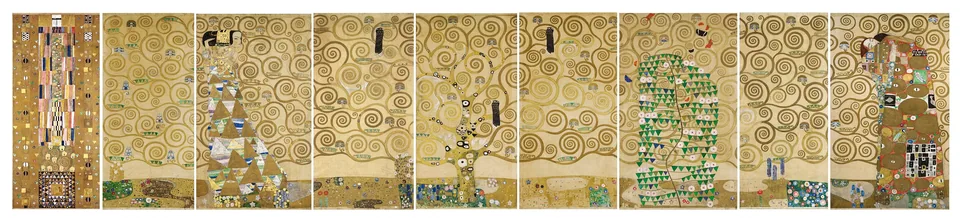
Klimt designed this piece as a working cartoon for the Stoclet Frieze, a decorative mosaic cycle for the Palais Stoclet in Brussels. Also known under the German titles Ritter and Goldener Ritter, it belongs directly to Klimt’s gold period. The cartoon served as the full-scale plan that craftsmen used to assemble the finished wall frieze.
Where to see it
You can see the cartoon in Vienna, Austria, at the MAK (Museum of Applied Arts). The museum preserves the original cartoon on paper in its permanent collection, where you can study the hand-applied paint, pencil lines, and gold leaf.
Questions about The Knight
Where is The Knight by Klimt?
The Knight by Klimt is in the collection of the MAK (Museum of Applied Arts) in Vienna, Austria. This institution holds Klimt's original preparatory cartoons for the Palais Stoclet project. The work is preserved on paper, showing the painter's original design notes and layered mixed media.
What is The Knight by Klimt made of?
The Knight by Klimt is made of mixed media on paper. Klimt created it as a full-scale working cartoon, combining paint, pencil, and applied gold foil. Because it served as a practical design plan rather than a canvas painting, it shows the precise layout intended for the craftsmen who produced the finished mosaics.