Select the painting to see it full screen and zoom in.
What the painting shows
Lady with a Fan by Klimt presents an unidentified woman standing against an intense, golden-yellow backdrop filled with Asian patterns. The square canvas measures 100.2 by 100.2 centimeters, creating a balanced space where the figure and background receive equal attention. Klimt completed the work in oil on canvas between 1917 and 1918.
When you look at the composition, your eye settles first on the woman’s face and upper body. She turns her head in profile to gaze calmly toward the left edge of the frame. Her dark chestnut curls are swept up in a loose arrangement, leaving a few soft wisps brushing her cheek. Her skin appears pale and smooth, accented by rosy cheeks and deep red lips.
The model wears an open, richly decorated silk robe that slides off her left shoulder. The exposed skin of her shoulder, chest, and neck creates a clear contrast with the dense garments around her. She holds a folded fan in her right hand, positioning it across her chest to conceal her bosom. The fan displays vibrant red, blue, and golden accents, mirroring the intricate designs of her clothing.
Her robe gathers in dark, expressive folds around her waist and arm. The textile shows thick swirling bands of cobalt blue, dark brown, and black, alongside gilded highlights and curling lines. Klimt rendered these textures with loose, rhythmic strokes, giving the fabric a heavy, draped feeling that bunches below the fan.
Asian Motifs and Color Palette
Behind the model, Klimt replaced the traditional domestic interior with an array of East Asian symbols. The entire background glows with a warm, flat chrome yellow field that recalls enameled Chinese porcelain. Across this field, Klimt painted several traditional creatures and botanical forms using brilliant shades of cobalt blue, pink, and red ochre.
In the upper left area, a large flying phoenix sweeps downward through the air. In Chinese culture, the phoenix represents immortality, rebirth, and good fortune. Klimt painted the bird with spread wings of vivid turquoise and lapis, trailing plumes of red and green that twist across the yellow plane.
To the right of the woman’s head stands a long-legged crane, perched gracefully among curling blossoms. Lower down on the right side sits a golden pheasant, rendered in warm ochre, orange, and blue tones. Both birds add a decorative, storybook quality to the scene, balancing the dramatic wings of the phoenix on the left.
Lotus blossoms drift throughout the yellow backdrop in shades of bright pink, soft violet, and white. Chinese tradition treats the lotus as a symbol of love and immutable beauty. These flowers float around the figure without stems or soil, creating a decorative field rather than a realistic garden.
Technique and Surface
You can see a distinct shift in technique when you compare this piece to Klimt’s earlier output. Klimt applied his paint with freer and more rapidly executed brushstrokes than he used during his golden phase. The colors appear directly brushed onto the canvas, giving the surface a lively, spontaneous texture.
The decorative flatness across the backdrop reflects the visual language of Japanese ukiyo-e woodblock art. Klimt collected Asian textiles and art objects, and he adapted their flat spatial planes to flatten the distance between figure and ornament. The yellow background does not recede into perspective, but instead presses forward against the sitter.
Small areas of bare canvas remain visible under close inspection. For example, near the junction where the model’s bare upper arm meets the edge of her slipping robe, the unpainted linen shows through. Some art historians view these uncovered patches as evidence that Klimt left the painting unfinished. Other scholars, such as art critic Kelly Grovier, argue that flux and fragmentation give the painting power, concluding that its unfinishedness completes it.
The story behind it
Klimt began painting Lady with a Fan in 1917 as an uncommissioned project. Because no patron paid for the work or dictated its subject, Klimt had complete freedom over the composition, colors, and choice of model. The painting became the final portrait that Klimt ever produced.
When Klimt suffered a stroke in early 1918, this canvas was still resting on an easel in his Vienna studio. It stood side by side with his unfinished canvas titled The Bride. Klimt died shortly after in February 1918, leaving both works just as he had stepped away from them.
The Sitter’s Identity
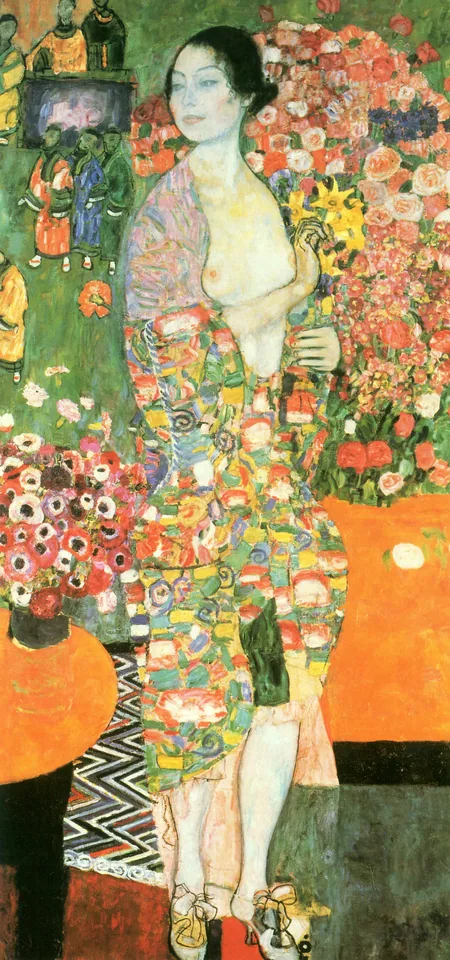
The true identity of the woman in the portrait remains uncertain. Over the decades, art historians have proposed several candidates from Klimt’s personal and professional circle. Some suggest she might be Johanna Staude, a model who posed for another famous portrait by the artist. Others wonder if she was Klimt’s lifelong companion Emilie Flöge, though the facial features differ from known photographs of Flöge.
Another prominent theory points toward the world of performance. When the Belvedere Museum in Vienna examined early exhibition records, it noted that the work appeared under the title Dancer (Tänzerin) shortly after its creation. This title suggests that the model may have worked as a ballet dancer or music hall performer in Vienna.
Connections to Other Late Works
Lady with a Fan connects directly to other paintings from the final years of Klimt’s life. Compositionally, the pose shares clear similarities with his 1916 portrait Wally, where the model’s left shoulder is also left bare by an off-the-shoulder garment. You can find similar approaches to character and posture throughout Klimt’s portraits.
The background motifs also echo earlier experiments. Klimt previously used Oriental motifs, including a prominent phoenix, in his 1916–1917 painting Girlfriends (Two Women Friends). Both Wally and Girlfriends were destroyed in 1945 during the fire at Immendorf Castle, making Lady with a Fan the only surviving major work from this group that showcases these specific Asian motifs.
Exploring the complete catalog of Klimt’s paintings shows how his late style evolved away from metallic gold leaf toward rich pigments and open brushwork. In this final year, his fascination with East Asian art reached its most vivid expression.
Where to see it
Lady with a Fan currently resides in a private collection, which means it is not on regular display in any public museum. If you wish to see it in person, you must wait for rare museum loans or special exhibitions. Over the course of more than a century, the public has had the chance to view the painting on only four occasions.
The first public exhibition took place in 1920 at the Vienna Kunstschau. More than sixty years passed before its next public appearance, which occurred in 1981 across several institutions in Japan, including museums in Tokyo, Osaka, Iwaki, and Yamanashi. In 1992, the portrait hung at the International Cultural Centre in Krakow, Poland. Most recently, the Belvedere in Vienna exhibited the portrait from 2021 to 2022.
Provenance and Auction History
The painting has passed through several distinguished hands since leaving Klimt’s studio. Following the artist’s death in February 1918, the portrait entered the gallery of Gustav Nebehay in Vienna. By 1920, the Austrian industrialist, patron, and friend of Klimt, Erwin Böhler, bought the painting. It subsequently passed to Erwin’s brother, Heinrich Böhler.
In 1940, Mabel Böhler of Lugano, Switzerland, inherited the portrait from her husband Heinrich. The canvas later moved to Vienna collector Rudolf Leopold, who owned it from around 1963 until 1981. After Leopold, the New York art dealer and collector Serge Sabarsky acquired the painting. American art collector and entrepreneur Wendell Cherry then purchased it from Sabarsky in 1988.
Major auction houses have handled the painting on two landmark occasions. On 11 May 1994, Sotheby’s sold the work from the Wendell Cherry collection. Decades later, on 27 June 2023, Sotheby’s in London offered the painting once again. Art dealer Patti Wong purchased the piece at the 2023 sale on behalf of a Hong Kong collector.
The June 2023 sale set an auction record for Gustav Klimt. It also became the highest price ever achieved in Europe for any artwork sold at auction. Because so few of Klimt’s major canvases remain outside public institutions, opportunities to buy an original Klimt are extraordinarily rare. Today, Lady with a Fan remains in that private collection in Hong Kong.
Details of Lady with a Fan
Questions about Lady with a Fan
What does Lady with a Fan by Klimt show?
Lady with a Fan by Klimt depicts an unidentified woman turned to her left against a bright yellow background. She holds an ornate fan over her chest while a decorated robe slips off her shoulder. Mythological and natural motifs surround her, including a flying phoenix, a standing crane, a golden pheasant, and pink lotus flowers that recall Chinese art traditions.
When did Klimt paint Lady with a Fan?
Gustav Klimt painted Lady with a Fan between 1917 and 1918 in Vienna. He created the square portrait without a formal commission during the final months of his life. The painting was still resting on an easel in Klimt's studio alongside another late canvas when the artist suffered a fatal stroke in early 1918.
Who owns Lady with a Fan by Klimt?
A private collector based in Hong Kong owns Lady with a Fan by Gustav Klimt. Art dealer Patti Wong purchased the artwork on behalf of this private collector at a London auction in 2023. Because the painting belongs to an individual rather than a public museum, the artwork is not on regular display to museum visitors.
How big is Lady with a Fan by Klimt?
Lady with a Fan by Gustav Klimt measures 100.2 centimeters high by 100.2 centimeters wide. This square format was a favored shape for the Austrian artist in his later years. The canvas offers equal width and height, giving the portrait balanced proportions that accommodate the central sitter alongside the surrounding birds, flowers, and patterns.
What is Lady with a Fan by Klimt made of?
Lady with a Fan by Gustav Klimt is made of oil paint on canvas. Klimt applied the paint with rapid, fluid brushstrokes across the surface. Small areas of bare fabric remain visible on the canvas, such as near the woman's shoulder, leading several scholars to view the oil painting as an unfinished work.