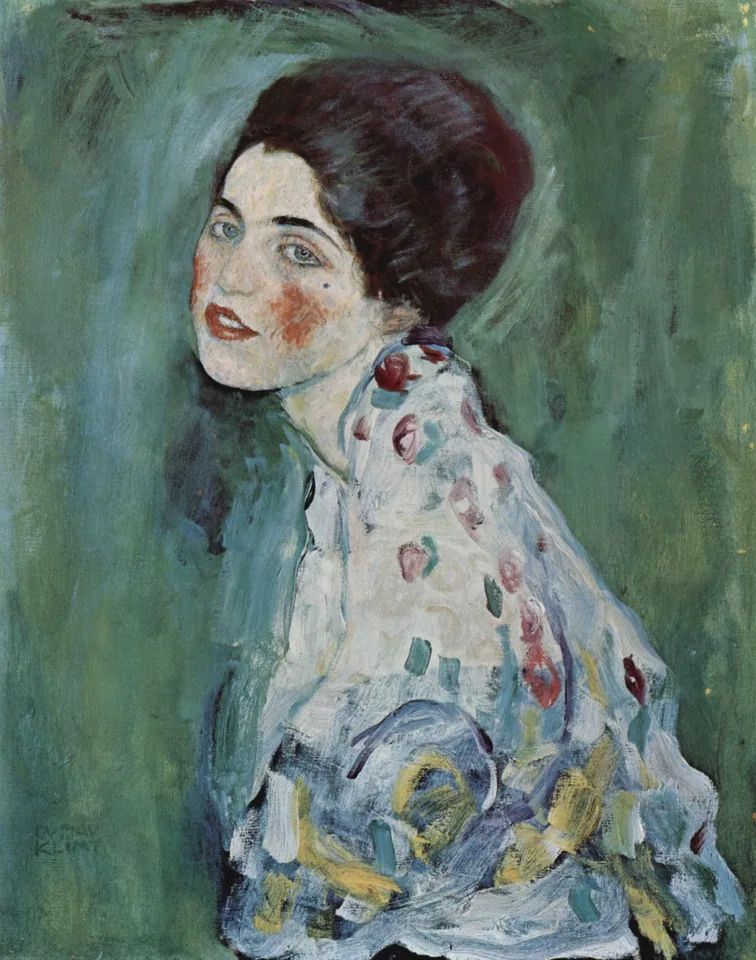
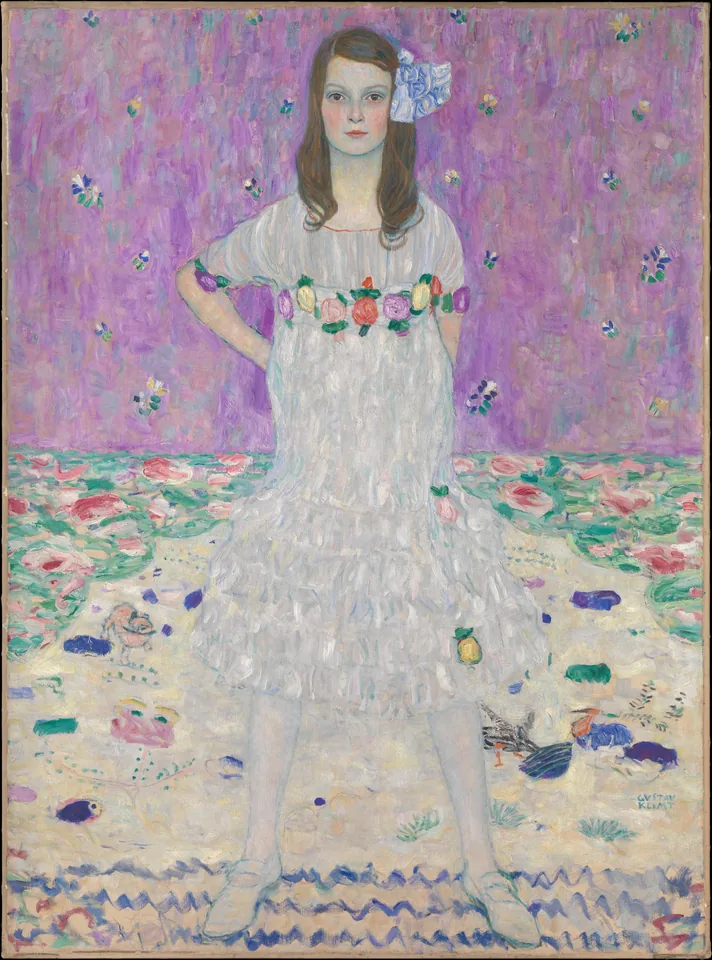
Select the painting to see it full screen and zoom in.
What the painting shows
Portrait of Amalie Zuckerkandl is an oil on canvas painting by Gustav Klimt, created in 1917–1918. The artist left the square, 128 by 128 centimeter canvas unfinished when he suffered a stroke in early 1918 and died on February 6. If a 1914 preparatory study in the Albertina graphic collection belongs to this project, Klimt worked on the composition for four years. Today the work is among the most noted late portraits in Austrian art.
You see Amalie Zuckerkandl facing forward, her dark hair framing pale skin, pink cheeks, and blue-grey eyes. A black neckband edged with a white lace ruff circles her throat. Art historians note that this ruff resembles a noose that could tighten at any moment. She looks outward with an impassive gaze, an expression shared with Klimt’s portrait of Adele Bloch-Bauer.
The background features loose strokes of mint green, turquoise, and yellow. In contrast to the finished head and shoulders, the rest of the canvas shows Klimt’s working process. Zuckerkandl wears a wide, pale gown spreading toward the corners, mostly left as an outline sketched in charcoal or pencil over bare canvas. You can see pencil sketches of floral motifs on the skirt, alongside small test dabs of pink, turquoise, and blue paint.
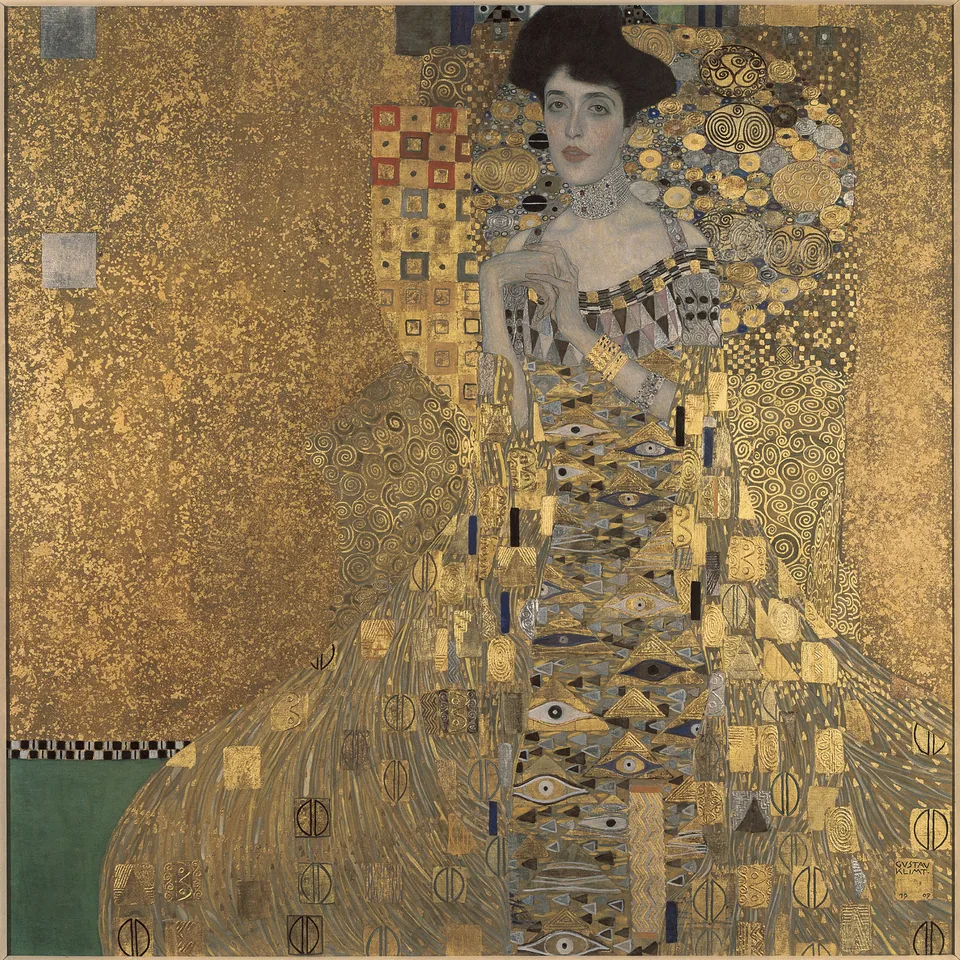
Art historians contrast this painting with Klimt’s golden portraits adorned with rubies and sapphires. Rather than dense ornament, this portrait appears cleared and empty, conveying defeat. This shift reflects the devastation of World War I, seventeen million lost lives, and the collapse of the Austro-Hungarian monarchy. Because Zuckerkandl was later murdered during the Shoah, the painting is also called the Portrait of a Murdered Woman.
Who the sitter was
Amalie Schlesinger married the physician Otto Zuckerkandl on July 7, 1895, after converting to Judaism for his sake. The couple had three children: Victor, Eleonore, and Hermine. Otto was a close friend of writer Arthur Schnitzler, while his sister-in-law Bertha Zuckerkandl was a journalist and confidante of Gustav Klimt. When the portrait was commissioned, Amalie was a respected Viennese figure courted by young officers.
The commission likely came through family connections. Broadcaster ORF suggests Otto Zuckerkandl approached Klimt through Bertha Zuckerkandl, or through Otto’s brother Victor and wife Paula, major collectors of Klimt’s art. Amalie and Otto divorced in 1919, and Otto died on July 1, 1921. Amalie then lived in modest circumstances at Sanatorium West in Purkersdorf near Vienna, where her former brother-in-law gave her living rights.
Persecution followed the annexation of Austria, as Sanatorium West was Aryanized and Amalie moved into the home of Mathilde Szeps. In July 1938, Amalie declared receiving a pension from the Jewish Community and monthly support from Ferdinand Bloch-Bauer. In November 1941, the 72-year-old Amalie and her daughter Eleonore were relocated to a collective apartment in Vienna. On April 9, 1942, they were arrested, deported to Izbica, and murdered, presumably at Belzec extermination camp.
Where to see it
You can see Portrait of Amalie Zuckerkandl at the Upper Belvedere in Vienna. Since March 2023, the painting hangs in the Contour and Character room. To explore more public collections, read our guide on where to see Klimt, or browse our index of Klimt paintings.
The canvas followed a difficult journey to the Belvedere after Otto Zuckerkandl transferred it to Amalie following their divorce. In the late 1920s, Amalie sold it to Ferdinand Bloch-Bauer for a pension. When Bloch-Bauer fled Austria, he protected the work from Nazi confiscation and returned it to Amalie’s family. In distress, the family sold the portrait to gallery director Vita Künstler, whose husband Gustav Künstler kept it in his office and home.
Vita Künstler willed the painting to Schloss Belvedere and transferred it in 1988, prior to her death in 2001. In 2006, an arbitration tribunal rejected restitution claims by the heirs of Ferdinand Bloch-Bauer and Hermine Müller-Hofmann. The Austrian Supreme Court confirmed this ruling in April 2008, establishing the Belvedere as lawful owner. The museum also loaned the work to the National Gallery in London in 2013 for the exhibition Facing the Modern.
Details of Portrait of Amalie Zuckerkandl
Questions about Portrait of Amalie Zuckerkandl
Where is Portrait of Amalie Zuckerkandl by Klimt?
Portrait of Amalie Zuckerkandl by Gustav Klimt is located at the Upper Belvedere museum in Vienna, Austria. The Austrian gallery holds the oil painting in its permanent collection, where it has been displayed in the Contour and Character room since March 2023. Vita Künstler transferred the unfinished canvas to the Belvedere in 1988, and Austrian courts confirmed the museum as the legal owner in 2008 following restitution disputes.
Who was Amalie Zuckerkandl?
Amalie Zuckerkandl was a prominent Viennese society figure married to the physician Otto Zuckerkandl. Born Amalie Schlesinger, she converted to Judaism before her 1895 wedding and had three children. Her extended family included prominent cultural figures, including journalist Bertha Zuckerkandl. During the Nazi regime, Amalie faced intense persecution due to her Jewish heritage. She was arrested in Vienna and deported in 1942 to Izbica, where she was murdered during the Shoah.
When did Klimt paint Portrait of Amalie Zuckerkandl?
Gustav Klimt painted Portrait of Amalie Zuckerkandl between 1917 and 1918. He began preliminary studies as early as 1914 according to sketches preserved in the Albertina graphic collection. The portrait remained unfinished on his easel because Klimt suffered a stroke in early 1918 and died on February 6, 1918. As a result, the sitter’s face and shoulders are fully painted, while the dress remains primarily an unpainted line drawing.