Select the painting to see it full screen and zoom in.
What the painting shows
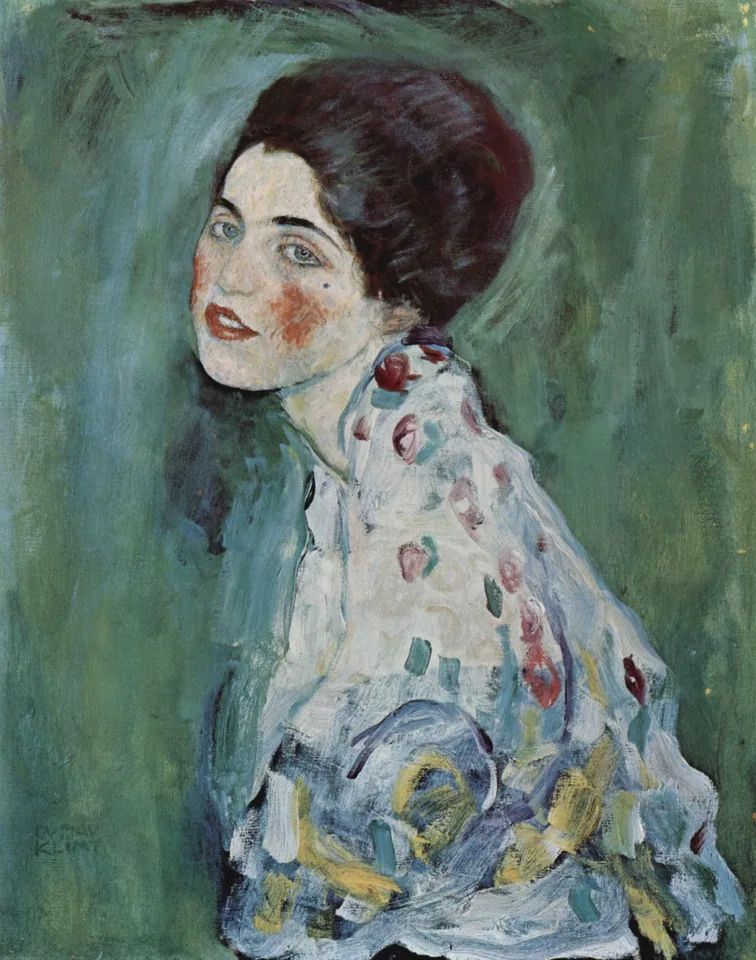
Portrait of Fräulein Lieser is a 1917 painting by Gustav Klimt that depicts a young woman in a frontal three-quarter pose against a red backdrop. Klimt painted the work during the final year of his life and left it unsigned in his studio when he died in 1918. After spending decades out of view, the painting resurfaced in 2024 and currently belongs to a private collection.
When you look at the canvas, your eyes focus on the woman standing upright in the center of the vertical composition. She wears a long, light green dress with a squared white collar. Over her shoulders hangs a loose blue cloak covered in a dense pattern of painted flowers. Klimt arranged these blossoms in bright clusters of red, pink, yellow, orange, and white, framed by touches of deep green foliage and blue shading.
The figure looks directly forward with a calm, open gaze, framed by dark curly hair and soft pink cheeks. Her pale skin contrasts with the warm, brushed red tone of the surrounding background. If you inspect the field behind her, you can spot faintly pencilled shapes across the surface. These pencil lines show that Klimt planned to continue adding decorative patterns before work was cut short.
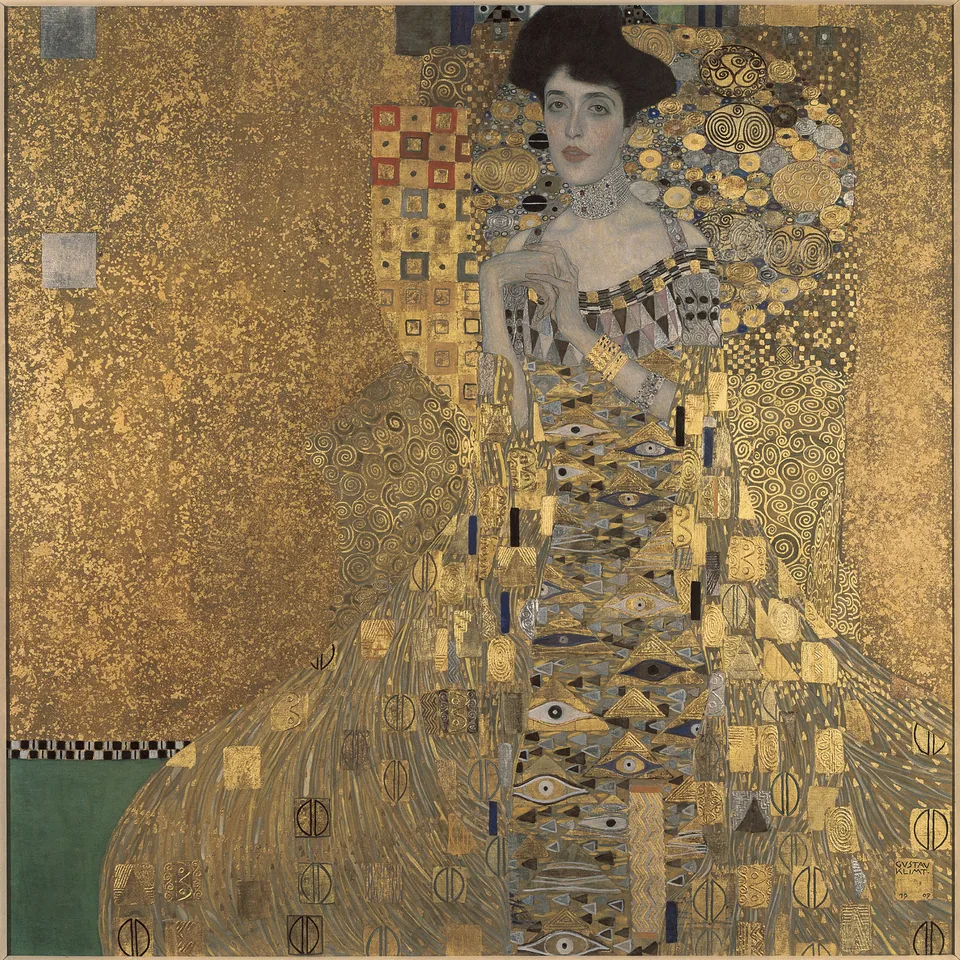
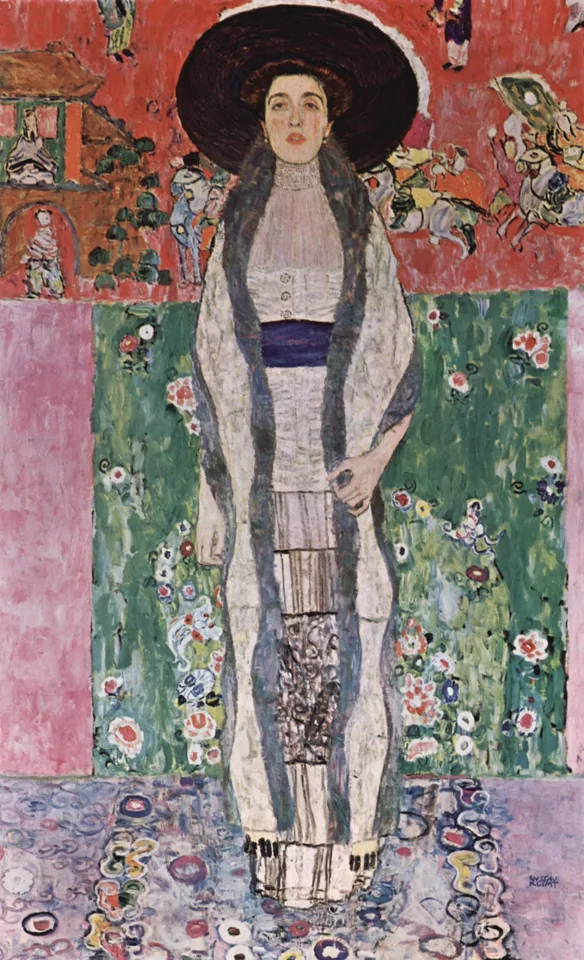
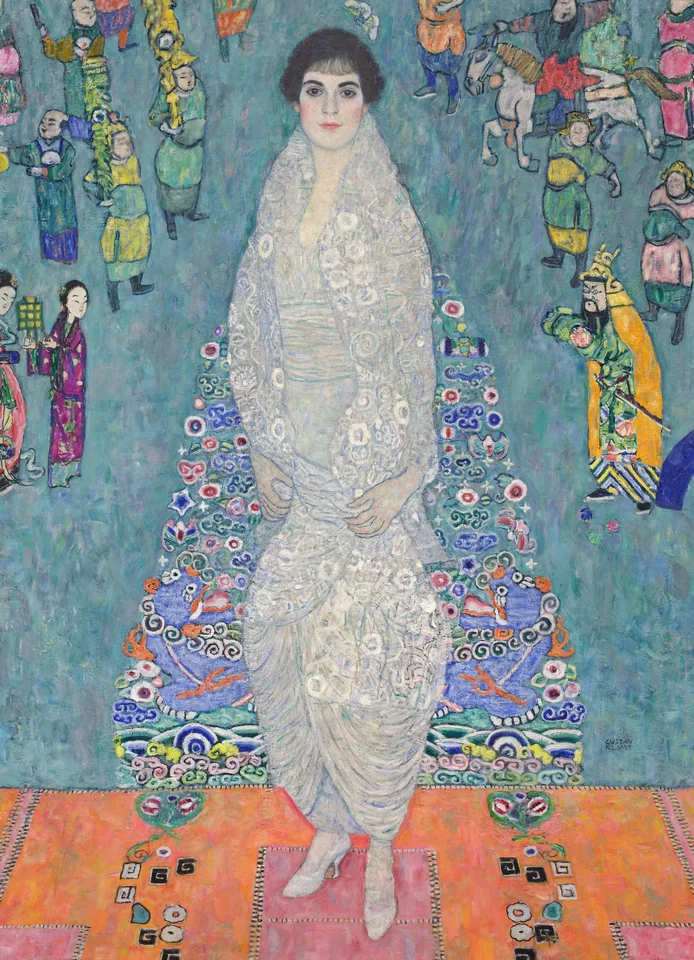
The color palette reflects the style of Klimt’s late career, moving away from gold leaf toward looser brushstrokes and saturated colors. Art historian Dobai noted that the composition and the position of the subject’s hands recall two earlier works: the second portrait of Adele Bloch-Bauer and the portrait of Elisabeth Bachofen-Echt. Klimt placed her right hand down near her hip and her left hand slightly raised, holding the edge of her cloak alongside a bright orange drape. Among Klimt’s female portraits, this work stands out for its direct frontal stance and luminous palette.
The story behind it
The Lieser family were prominent Viennese industrialists who moved in the city’s artistic circles. Between April and May 1917, the young woman visited Klimt’s studio nine times for sittings. When Klimt died suddenly in 1918, the unfinished portrait was handed over to the Lieser family.
The exact identity of the sitter remains an open debate among art historians and family descendants. The im Kinsky auction house identified the young woman as Helene Lieser, the daughter of Justus and Henriette “Lilly” Lieser, arguing that Henriette commissioned the work. In contrast, Klimt scholar Tobias G. Natter concluded that the sitter is Margarethe Constance Lieser, daughter of Silvia Lieser. Natter based his finding on testimony from Erich Lederer’s son and Margarethe’s sister-in-law, who confirmed the sitter’s identity twice in 1984. Margarethe’s son, Baron William de Gelsey, also believed the painting showed his mother, who had spoken to him about sitting for Klimt.
Following the 1938 Anschluss, the Lieser family suffered severe persecution under Nazi anti-Jewish legislation. The authorities stripped the family of their assets and properties through forced aryanization. Henriette Lieser was deported to Riga in January 1942 and was murdered there in December 1943.
Baron William de Gelsey spent his adult life searching for his mother’s lost portrait. The canvas had been displayed at the Neue Galerie in Vienna in 1925, where it was documented in a single black-and-white photograph. After that exhibition, its path vanished. The painting entered an unknown private collection, and its exact movements between 1925 and 1960 remain unaccounted for today.
Where to see it
Because Portrait of Fräulein Lieser belongs to a private collection, it is not on regular display in any public museum. You can track other works across his career in our overview of Gustav Klimt paintings.
For nearly a century, scholars feared the painting had been destroyed or permanently lost. Around 1960, an Austrian citizen acquired the work, and it passed down to an anonymous owner without the wider art world knowing. The portrait reappeared in adequate condition in 2024, only one year after Baron William de Gelsey passed away at the age of 99.
Before heading to auction in 2024, the painting traveled for public viewings in Germany, Hong Kong, Switzerland, and the United Kingdom. Auction house im Kinsky in Vienna then offered the canvas under the Washington Principles, which address artworks with unresolved ownership histories from the Nazi era. An anonymous buyer from Hong Kong secured the work at the April 2024 sale.
The legal history surrounding the portrait remains complicated. In April 2025, the Hong Kong buyer decided to withdraw the painting from the auction because of unresolved provenance concerns. At the same time, legal representatives for the family of Margarethe’s brother Hans raised claims regarding the commission and family agreements. For readers curious about how private sales and ownership disputes unfold for historical artworks, read our guide on how collectors buy an original Klimt.
Details of Portrait of Fräulein Lieser
Questions about Portrait of Fräulein Lieser
What does Portrait of Fräulein Lieser by Klimt show?
Portrait of Fräulein Lieser by Gustav Klimt shows a young woman in a frontal three-quarter pose against a warm red background. She wears a pale green dress with a white neckline and a blue floral cloak over her shoulders. The cape is filled with colorful flowers, while the red backdrop has faint pencil marks where Klimt planned further painted details before his death.
When did Klimt paint Portrait of Fräulein Lieser?
Gustav Klimt painted Portrait of Fräulein Lieser in 1917, during the final year before his death. The sitter is thought to have visited his studio nine times between April and May 1917. Klimt left the painting unsigned and incomplete in his studio when he died in 1918, after which it was given to the Lieser family.
Who owns Portrait of Fräulein Lieser by Klimt?
Portrait of Fräulein Lieser by Gustav Klimt is held in a private collection. The painting was acquired by an anonymous Austrian citizen around 1960 before appearing at auction in Vienna in 2024. An anonymous Hong Kong buyer purchased the work at that sale, but chose to withdraw the painting from the auction in April 2025 due to mounting provenance doubts.