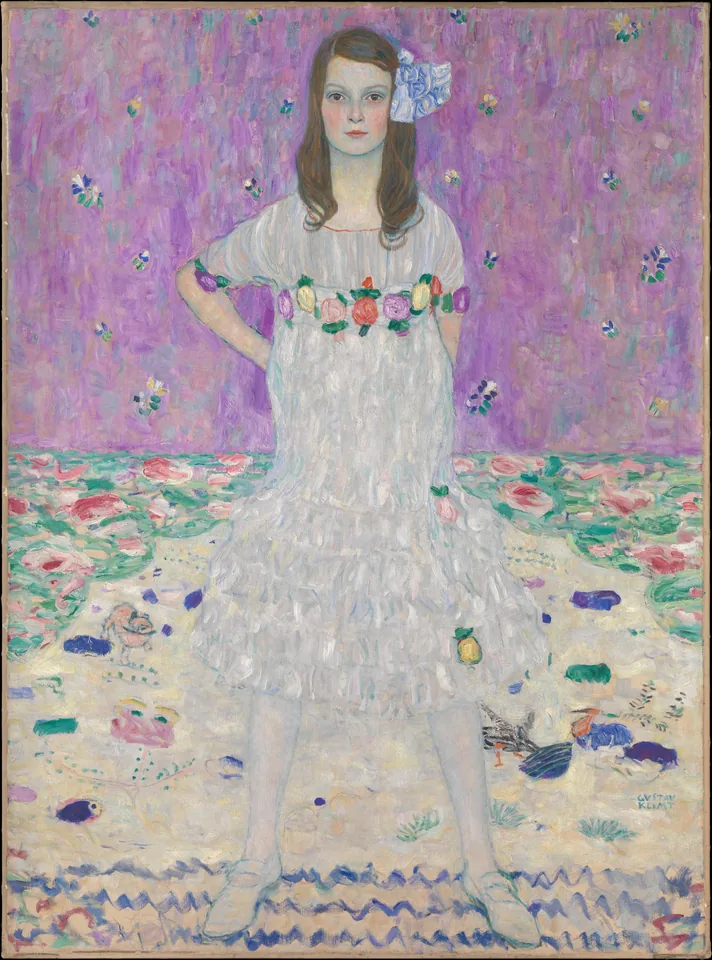
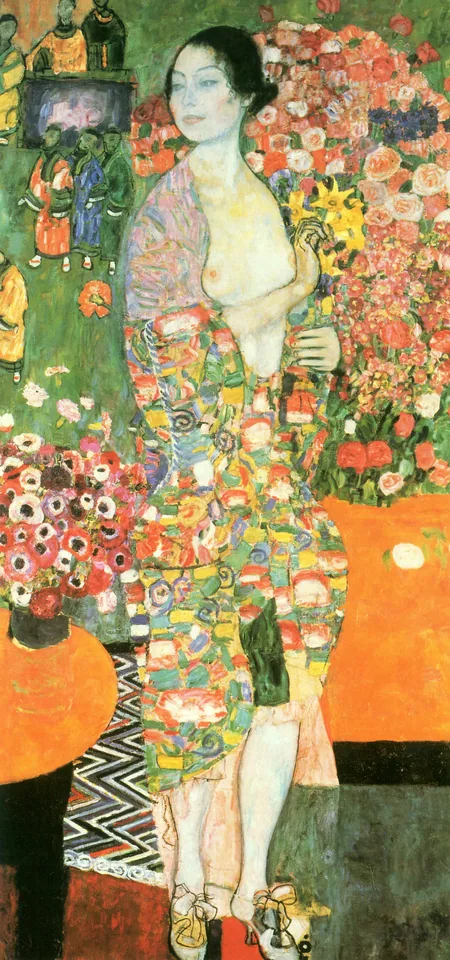
Select the painting to see it full screen and zoom in.
What the painting shows
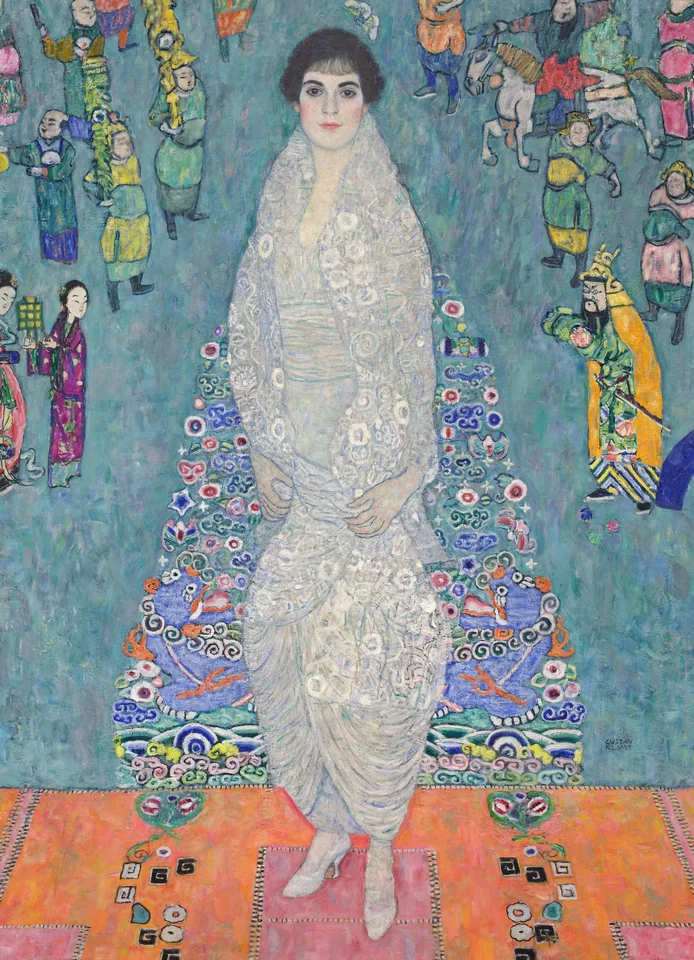
Portrait of Adele Bloch-Bauer II by Klimt is an oil on canvas painted in 1912 that presents the Viennese socialite Adele Bloch-Bauer standing in an upright, frontal pose. Klimt sets his subject in the center of the vertical composition, surrounded by geometric zones of vivid color and ornamental decoration. The work marks a clear shift from the dense metallic leaf of his earlier period toward bright pigments and distinct color fields.
The figure and fashion
When you look at the figure, your eyes immediately travel to Adele’s face and dramatic headwear. She wears an enormous black hat with a rounded brim that frames her head like a dark halo. Her pale skin, dark hair, and defined dark eyebrows stand out against the shadowed curve of the hat. Her expression remains calm and detached, meeting your gaze directly with slightly parted red lips.
A delicate, high-collared white lace piece covers her neck entirely, reaching up toward her chin. Below this collar, she wears a full-length gown constructed from pale, pleated fabrics arranged in vertical bands. A wide, dark violet sash wraps tightly around her waist, anchoring the center of the vertical column of her body. Klimt details the folds of her skirt with dark graphic lines, ending in fringed tassels just above her small black shoes.
A long, pale stole or boa drapes across Adele’s shoulders and cascades straight down both sides of her body to the floor. Klimt rims this garment with a thick border of grey and bluish-black fur. Adele holds one hand near her hip, gathering the folds of her garment, while her other arm hangs straight along her side. Her body appears slender and elongated, functioning almost as an architectural column within the surrounding space.
The divided background and Asian motifs
The background splits into distinct horizontal and vertical zones rather than describing a realistic room. The upper third of the canvas features a vibrant scarlet field filled with figurative scenes. On the left side of this red section, you can see a Chinese-style pavilion sheltering a seated figure, accompanied by a small standing person nearby. On the right, Klimt paints riders on horseback and standing figures dressed in East Asian robes, creating an active decorative frieze.
Beneath the red frieze lies a large rectangular section of deep green, covered in loose daubs of paint that suggest a lush garden wall or floral screen. Red, pink, white, and blue blossoms float across this green field on either side of Adele’s waist and hips. Flanking the central green rectangle, two vertical pink stripes rise along the left and right edges of the canvas, framing the scene with crisp, contrasting color blocks.
Adele stands on an elaborate floor covering that fills the bottom section of the canvas. Klimt covers this carpet in swirling motifs, concentric rings, and organic shapes rendered in soft lavender, blue, white, and pink. In the lower right corner, set directly against the patterned floor, Klimt placed his neat, block-letter signature.
Who the sitter was
Adele Bloch-Bauer was a prominent Vienna socialite, arts patron, and close friend of Gustav Klimt. Born in 1881, she grew up in an influential family and married Ferdinand Bloch-Bauer, a wealthy sugar industrialist who sponsored the arts and supported Klimt throughout his career. Adele hosted regular cultural gatherings in Vienna, welcoming leading writers, musicians, and painters to the family home.
Adele holds an exceptional place in Klimt’s body of work: she was the only individual whose portrait he painted twice in full-scale, formal commissions. If you browse through the wider catalog of Klimt paintings, you will notice that he rarely revisited private portrait subjects for a second major oil canvas. The Bloch-Bauer commissions show the deep artistic and personal relationship between the painter and the Bloch-Bauer household.
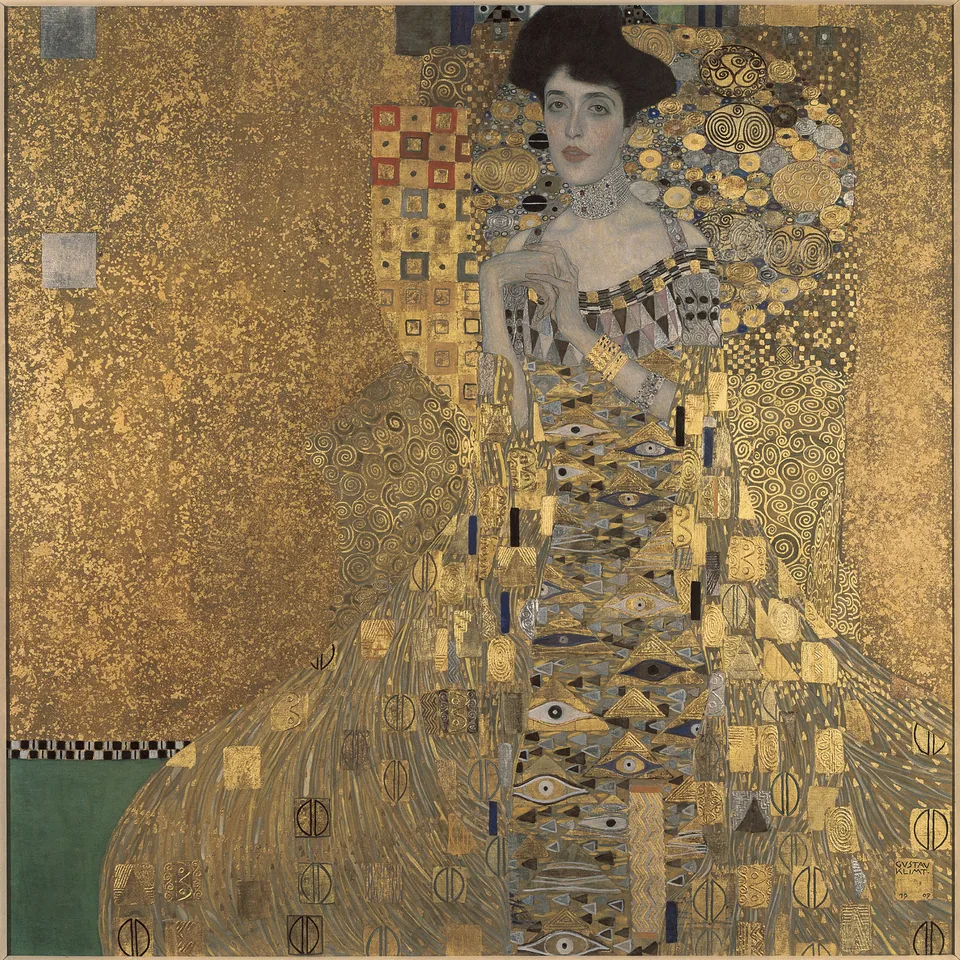
Klimt completed his first portrait of her, Portrait of Adele Bloch-Bauer I, in 1907. That earlier work represents the height of Klimt’s Golden Phase, encasing Adele in elaborate gold leaf, silver, and complex geometric symbols. By the time Klimt returned to paint her in 1912, his artistic approach had changed dramatically. Portrait of Adele Bloch-Bauer II sets aside gold surfaces in favor of vibrant color contrasts, influenced by Asian decorative art and modern European palettes. Both canvases belong to the central group of Klimt portraits that defined high society in Vienna before the First World War.
Adele died young in 1925 at the age of forty-three. Before World War II, both of her portraits hung together inside the Bloch-Bauer family home, serving as centerpiece family heirlooms that celebrated her life and patronage.
Where to see it
Portrait of Adele Bloch-Bauer II resides in a private collection, which means you cannot view it on regular public display. The painting reached its current private home after decades of conflict, restitution, and prominent auction sales.
During World War II, the Nazis stole both portraits of Adele Bloch-Bauer from her family along with the rest of their art collection. After the war ended, the Austrian government transferred Portrait of Adele Bloch-Bauer II to the Österreichische Galerie Belvedere in Vienna, where it hung on public view for decades. A protracted legal battle eventually took place in both the United States and Austria because the Austrian museum proved reluctant to return the looted works to their rightful owners.
In January 2006, an Austrian arbitration panel ruled in favor of Ferdinand Bloch-Bauer’s heirs. The panel ordered the Belvedere to return both portraits of Adele Bloch-Bauer, along with three landscape paintings by Klimt, to Ferdinand’s niece, Maria Altmann. Following the restitution, the five paintings traveled to the United States. Los Angeles County Museum of Art exhibited the group from 4 April to 30 June 2006. The works then moved to the Neue Galerie in New York City, where they went on view from 13 July to 9 October 2006.
Later that year, the family decided to sell the canvas. In November 2006, Christie’s auction house in New York sold Portrait of Adele Bloch-Bauer II at auction to Oprah Winfrey. At the time of that 2006 sale, the portrait ranked as the fourth-highest priced piece of art ever sold at auction. If you follow the market to see whether private collectors can still buy an original Klimt, this historic auction demonstrated the extraordinary demand for Klimt’s major works.
In the fall of 2014, Oprah Winfrey placed the painting on a special long-term loan to the Museum of Modern Art in New York City. MoMA displayed the work in a dedicated exhibition titled ‘Gustav Klimt’s Adele Bloch-Bauer II’ from 5 September 2014 to 15 August 2016. During the summer of 2016, Winfrey sold the portrait to an unidentified Chinese buyer, who allowed the painting to complete scheduled museum loans.
From 22 September 2016 to 16 January 2017, the painting hung at the Neue Galerie New York in the exhibition ‘Klimt and the Women of Vienna’s Golden Age, 1900–1918’. That loan temporarily reunited Portrait of Adele Bloch-Bauer II with Portrait of Adele Bloch-Bauer I. The canvas has since appeared in two major European loans: the Van Gogh Museum featured it in Amsterdam from 7 October 2022 to 8 January 2023, and the Belvedere in Vienna exhibited it from 9 November 2023 to 11 February 2024. Outside of such temporary museum loans, the painting remains closed to the public.
Details of Portrait of Adele Bloch-Bauer II
Questions about Portrait of Adele Bloch-Bauer II
What does Portrait of Adele Bloch-Bauer II by Klimt show?
Portrait of Adele Bloch-Bauer II by Klimt shows the Viennese socialite Adele Bloch-Bauer standing in a full-length pose. She wears a tall black hat, a high lace collar, a long dress with vertical pleats, and a fur-trimmed stole. Behind her, Klimt painted a decorative background composed of a red upper frieze with Asian figures, a green floral field, and a patterned floor.
Who was Adele Bloch-Bauer?
Adele Bloch-Bauer was a Vienna socialite, arts patron, and close friend of Gustav Klimt. She lived from 1881 to 1925 and was married to the wealthy sugar industrialist Ferdinand Bloch-Bauer, who supported Klimt financially. She holds a unique position in art history as the only individual whose portrait Gustav Klimt painted twice in major standalone oil compositions.
When did Klimt paint Portrait of Adele Bloch-Bauer II?
Gustav Klimt painted Portrait of Adele Bloch-Bauer II in 1912. This date places the painting five years after he finished his famous first portrait of the same sitter, Portrait of Adele Bloch-Bauer I, which he completed in 1907. The 1912 work reflects a distinct shift in Klimt's style away from solid gold surfaces toward colorful, block-like decorative planes.
Who owns Portrait of Adele Bloch-Bauer II by Klimt?
Portrait of Adele Bloch-Bauer II by Klimt belongs to an unidentified Chinese private buyer. The buyer purchased the painting during the summer of 2016 from American media mogul Oprah Winfrey, who had acquired it at auction in 2006. Because the work remains in private hands, it does not hang on permanent display, appearing only during occasional museum loans.
What is Portrait of Adele Bloch-Bauer II by Klimt made of?
Portrait of Adele Bloch-Bauer II by Gustav Klimt is made of oil paint applied to canvas. Klimt used oil on canvas to create smooth skin tones on the face of Adele Bloch-Bauer and applied textured brushwork across her garments, the floral green backdrop, the patterned carpet, and the upper Asian frieze without using the gold leaf found in his 1907 portrait.