Select the painting to see it full screen and zoom in.
What the painting shows
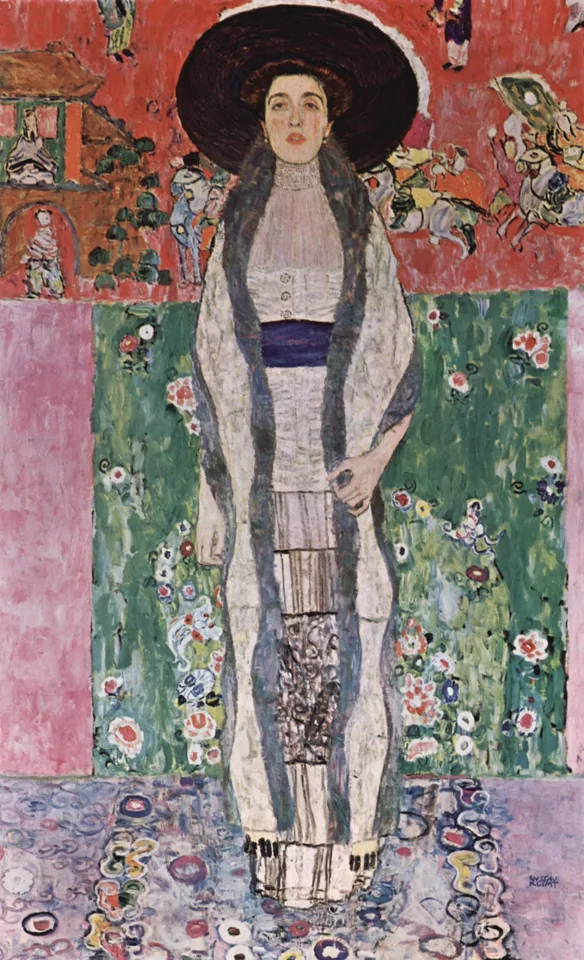
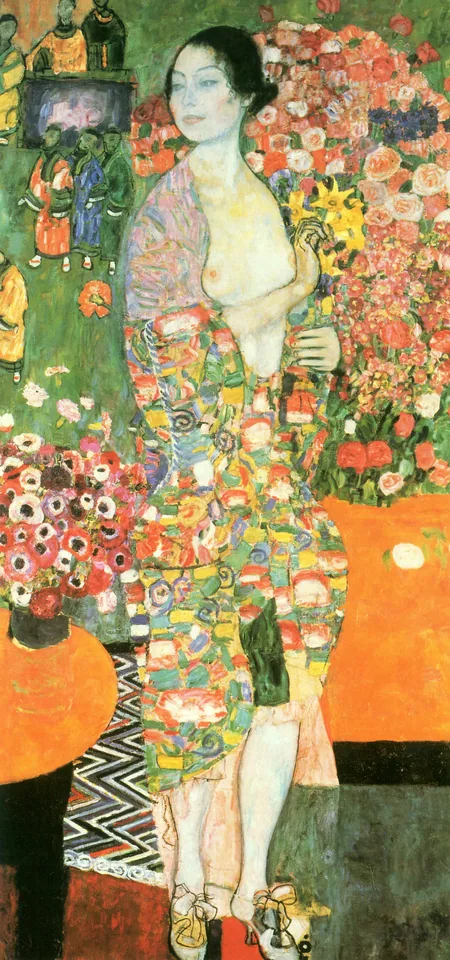
Portrait of Elisabeth Lederer by Klimt presents a full-length, life-size view of a young woman standing upright against an atmospheric background. The palette relies on soft greens, pale turquoise, bright orange, and shimmering whites rather than the metallic leaf of Klimt’s earlier golden period. Elisabeth stands facing forward, looking directly toward you with dark, cropped hair, pale skin, and a calm expression. Traces of original charcoal or conté underdrawing remain visible beneath the delicate white paint of her dress.
Her costume shows the influence of contemporary Parisian fashion, echoing the harem pantaloons and Chinese-inspired tunics created by designer Paul Poiret. She wears a close-fitting top and a gathered skirt whose tapered cut gives the ambiguous look of Eastern trousers or a Western hobble skirt. Art historian Tobias G. Natter compared the gathered silhouette of this lower garment to plus fours. Draped over her shoulders is a translucent white chiffon shawl patterned with soft floral motifs that fall in gentle folds around her torso and legs. She completes the ensemble with pointed white silk shoes.
Directly behind Elisabeth rises an ornamental structure shaped like a tall triangle. This decorative pillar features stylized blue and green waves, crests of sea foam, floral blooms, and scrolling cloud bands reminiscent of Chinese jade carvings. Emily Braun observed that this rising triangular shape stabilizes the composition around Elisabeth’s figure, anchoring her light attire within the open space.
Beneath her feet sits an Oriental runner or carpet painted in warm pink-orange hues. Along its edges, you can see geometric black-and-white borders in the signature style of the Wiener Werkstätte, alongside irregular circular designs that suggest Chinese jade rings. Swedish art historian Andreas Lindblom noted in 1917 that the sitter appears to walk on flowers toward a magic carpet.
Above the carpet, the background opens into a mottled blue-green expanse filled with floating figures drawn from Chinese culture, Peking opera, and Asian ceramics. You can pick out courtiers, scholars, and warriors on horseback or on foot, rendered in vibrant shades of yellow, purple, and green. A fierce warrior figure in a yellow cape and helmet gestures dramatically near the right edge, while female figures and court attendants populate the left. Braun pointed out that Klimt owned Asian textiles, Qing court robes, Japanese woodblock prints, and Asian art books, which inspired these lively background figures. The upper area retains an airy, slightly unfinished texture, reflecting the moment when work on the canvas halted.
Who the sitter was
Elisabeth Lederer was born into one of the most prominent cultural dynasties in early twentieth-century Austria. Her parents, August and Serena Lederer, were leading industrial figures and the second wealthiest family in Vienna after the Rothschilds. The family divided their time between an apartment at Bartensteingasse 8 in Vienna, an estate in Győr, and the Ledererschlössel in Weidlingau. August and Serena Lederer built a legendary art collection, becoming Klimt’s most dedicated private patrons.
Elisabeth was the only daughter in the family, raised alongside two younger brothers, Erich and Friedrich. She demonstrated an aptitude for the arts at an early age and eventually trained as a sculptor. Klimt was a close neighbor and frequent guest in the Lederer household, and Elisabeth referred to him affectionately as uncle. Her biological paternity remains unclarified, attributed by historians either to August Lederer or to Klimt himself. Her mother Serena had sat for Klimt in 1899, and Klimt later painted Elisabeth’s grandmother, Charlotte Pulitzer, in 1915.
In 1914, Serena and August commissioned Klimt to paint their twenty-year-old daughter. The creative process proved lengthy and frustrating for the artist. Elisabeth recalled in her notes that Klimt cursed, threw his pencil, and struggled with the emotional challenge of painting someone so close to him. He produced numerous preparatory drawings on paper while testing decorative arrangements directly on the canvas. Infrared reflectography reveals that he initially painted figures lower down in the composition before painting over them. By 1916, Serena Lederer grew impatient with Klimt’s reluctance to declare the work finished. She arrived at his studio, loaded the canvas into her car, and took it home despite his protests. Klimt received thirty-five thousand crowns for the commission.
Elisabeth’s later life was marked by turbulent political events. In 1921, she married Baron Wolfgang von Bachofen-Echt, the owner of the Nußdorf brewery, and converted to Protestantism. She gave birth to a son, August, in 1934, who died in 1938. That same year, Elisabeth divorced and returned to Judaism. Following the 1938 Anschluss, Nazi authorities seized the Lederer family’s art holdings, and most of her relatives fled abroad.
Elisabeth remained in Vienna under extreme danger. To avoid deportation and death, she obtained a descent certificate confirming that Klimt was her biological father, supported by a sworn statement from her mother Serena. A former brother-in-law who served as a senior Nazi official also intervened to protect her. Officially classified by the regime as a half-Jew, Elisabeth stayed in Vienna until she died from a brain tumor on 19 October 1944. She was buried at the Hietzing Cemetery in Vienna. While fifteen Klimt paintings from the Lederer collection were destroyed in 1945 when German troops burned Immendorf Castle, Elisabeth’s portrait survived because Nazi authorities left portraits of Jewish subjects at the Dorotheum auction house.
Where to see it
Portrait of Elisabeth Lederer currently resides in a private collection and is not on regular public view. Because it remains in private hands, seeing the original requires tracking temporary museum loans or special exhibitions. To explore other works by the artist and see where they hang in public galleries across the world, you can consult our directory of /paintings/.
The painting has made several notable museum appearances over the past century. Its first public exhibition took place in Stockholm at the Austrian Art Exhibition in 1917. In the Lederer home, the painting hung as a centerpiece of the family collection; a photograph by Martin Gerlach captured Serena Lederer standing proudly in front of the canvas in her Vienna apartment. Following the war, the portrait was restituted in 1948 to Elisabeth’s brother, Erich Lederer, who lived in Geneva.
Erich Lederer kept the canvas until 1983, when he sold it to New York art dealer Serge Sabarsky. In 1985, collector Leonard Lauder acquired the portrait for his private residence in New York. Lauder generously shared the work with the public on several occasions. He lent the canvas to the Belvedere in Vienna in 2000, placed it on loan to the National Gallery of Canada for three years, and included it in an exhibition at the Neue Galerie New York between 2016 and 2017.
Following Lauder’s death, the painting appeared at a Sotheby’s New York auction in November 2025. It ranks as the most expensive modern art work and the second most expensive artwork ever sold at auction, purchased by an undisclosed telephone bidder. If you are interested in the market history of Klimt’s works, you can read our guide on how to /buy-original-klimt/. You can also explore how Klimt captured Vienna’s high society by browsing our overview of his society /portraits/.
Details of Portrait of Elisabeth Lederer
Questions about Portrait of Elisabeth Lederer
What does Portrait of Elisabeth Lederer by Klimt show?
Portrait of Elisabeth Lederer by Klimt shows Elisabeth Lederer standing full-length against a soft blue-green background filled with Chinese figures. She wears a draped white garment, a sheer floral shawl, and pointed white shoes. Below her feet lies a bright pink-orange carpet with black-and-white borders. Behind her rises a decorated triangular column of blue, green, and white ornamental motifs.
Who was Elisabeth Lederer?
Elisabeth Lederer was the daughter of August and Serena Lederer, wealthy Viennese art patrons who formed an extensive collection of works by Gustav Klimt. She grew up in Vienna, showed early artistic talent, and became a sculptor. In 1921, she married Baron Wolfgang von Bachofen-Echt. She survived Nazi persecution in Vienna after receiving a descent certificate naming Klimt as her biological father, before dying in 1944.
When did Klimt paint Portrait of Elisabeth Lederer?
Gustav Klimt painted Portrait of Elisabeth Lederer between 1914 and 1916. Her parents commissioned the work in 1914 when she was twenty years old. Klimt worked on the canvas over several years in his Vienna studio, constantly adjusting the decorative patterns and figures. Her mother eventually took the canvas directly from the studio by car in 1916 before Klimt felt fully ready to release it.
Who owns Portrait of Elisabeth Lederer by Klimt?
Portrait of Elisabeth Lederer by Klimt belongs to an undisclosed private collector who bought the canvas at a Sotheby's New York auction in November 2025. Before that sale, the painting belonged to Leonard Lauder, who acquired it in 1985 from art dealer Serge Sabarsky. Sabarsky had bought it in 1983 from Elisabeth's brother, Erich Lederer, following its restitution after World War II.
What is Portrait of Elisabeth Lederer by Klimt made of?
Portrait of Elisabeth Lederer by Klimt is an oil painting on canvas. Klimt began the composition with an underdrawing using charcoal or conté crayon to sketch Elisabeth's figure, clothing, and ornamental zones. Traces of this original underdrawing remain visible through the thin white paint of her garment. He built the surrounding background with layered brushstrokes of oil paint, creating patterned borders and delicate figures.