Select the painting to see it full screen and zoom in.
What the painting shows
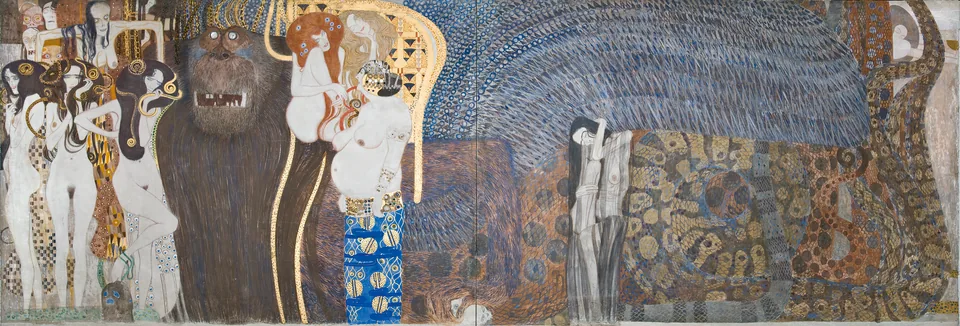
The Well-Armed Strong One by Klimt shows a standing warrior clad in shining golden armor, flanked by symbolic figures against a pale plaster wall. The knight grips a tall silver sword pointing down toward the ground, with a round gold helmet resting near his feet. Behind his shoulders, two women watch over him, one raising a circular green wreath above his head.
On the left side of the scene, pale human figures reach toward the warrior. Two kneeling figures extend their bare arms in an earnest plea, while a slender nude woman stands behind them with clasped hands. Klimt surrounded these delicate outlines with fields of fine grey speckles and geometric patterns.
The story behind it
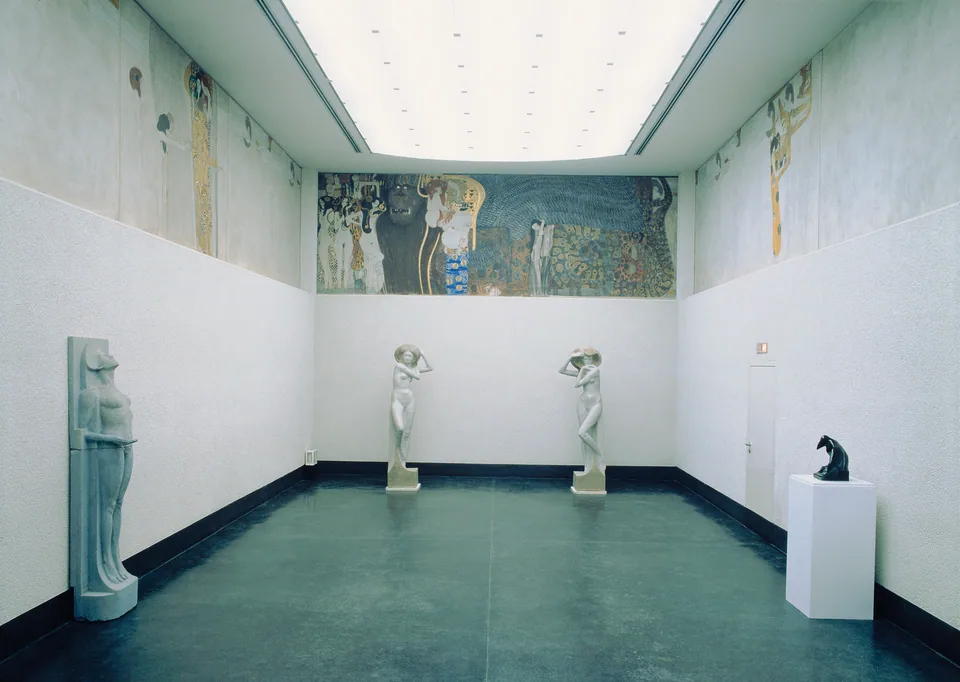
Klimt created this large mural between 1901 and 1902 as part of the Beethoven Frieze on the left wall of the Secession Building. The work represents an important step into his gold period, pairing gilded surfaces with flat, rhythmic forms. Klimt executed the composition directly on plaster using casein paint, gold leaf, and applied materials. Historical records also catalog the section under titles such as The Knight and The Sufferings of Weak Humanity.
Where to see it
You can view the mural in Vienna, Austria. The work is held in the collection of the Belvedere, and visitors can see it on site inside the Secession Building, where Klimt originally painted it.
Details of The Well-Armed Strong One
Questions about The Well-Armed Strong One
Where is The Well-Armed Strong One by Klimt?
The Well-Armed Strong One by Klimt is located in Vienna, Austria, displayed inside the Secession Building. The artwork belongs to the permanent collection of the Belvedere. Klimt painted the scene on the left wall of the exhibition hall, where the original wall painting remains preserved for visitors to view as part of the complete frieze installation.
What is The Well-Armed Strong One by Klimt made of?
The Well-Armed Strong One by Klimt was made with casein paint, gold leaf, and applied materials on plaster. Measuring 215 by 276 centimeters, the large mural combines textured metallic elements on the armor with delicate linework for the figures. Klimt used this mix of media between 1901 and 1902 to produce matte and reflective finishes across the wall.