Select the painting to see it full screen and zoom in.
What the painting shows
Medicine by Klimt is an oil on canvas allegory created between 1900 and 1907. It presents an ambiguous unity of life and death rather than a celebration of medical science or the art of healing. In this composition, you see human existence suspended between birth and decay, divided into two distinct vertical masses.
On the right side of the canvas rises a towering column of semi-nude bodies known as the river of life. Entwined figures of various ages drift together, while a skeleton stands among them to represent death within the flow of existence. Toward the lower section of this column, the figures curve inward, leading down toward dark depths.
To the left of the column, a young nude female figure floats in an open, glowing space. At her feet lies a newborn infant, an image of fresh life entering the world. A man seen from behind extends his arm across the void toward her outstretched hand. These two reaching arms form the only physical link between the floating woman and the dense river of bodies.
At the bottom center of the painting stands Hygieia, the ancient goddess of health. She turns her back to humanity, facing you directly with a detached expression. Coiled around her arm is the Aesculapian snake, extending toward a cup of Lethe held in her hand. Her gown features dense, geometric patterns and golden ornamentation that anchor the lower edge of the composition.
The story behind it
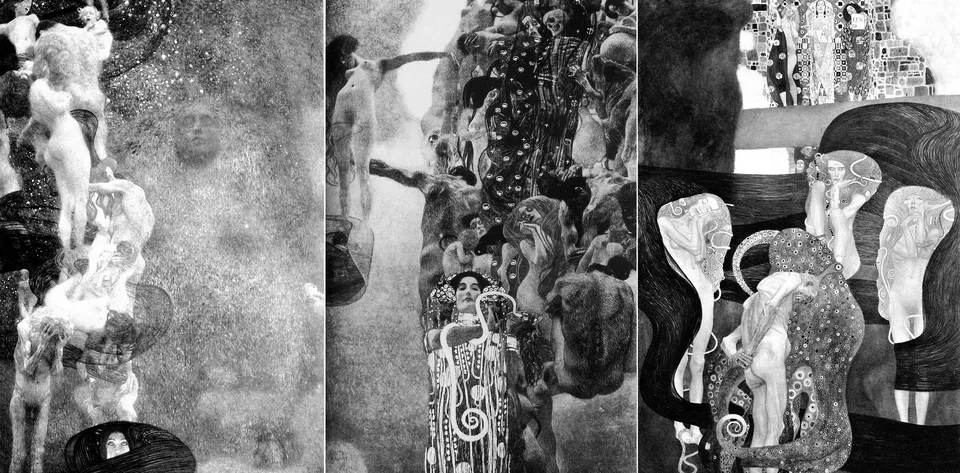
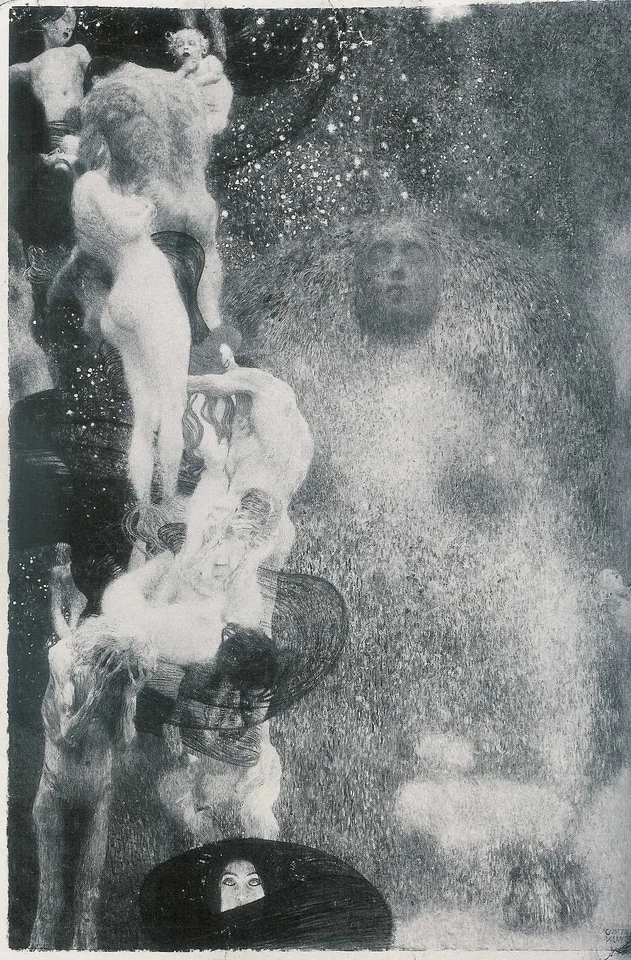
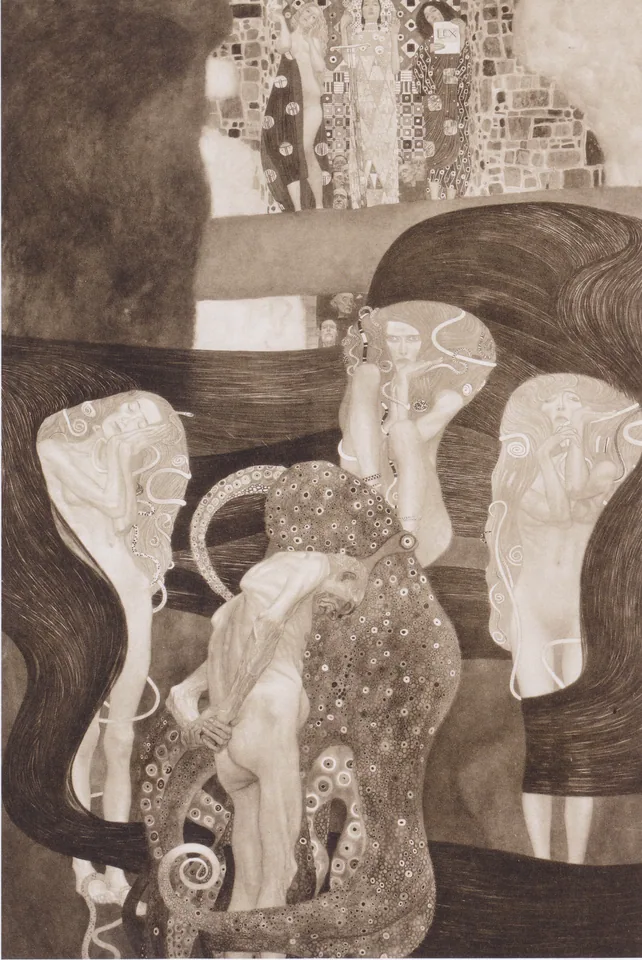
In 1894, the Austrian Ministry of Education commissioned Gustav Klimt to create three ceiling panels for the Great Hall of the University of Vienna. This project, known as the University (Faculty) Paintings, also included Philosophy and Jurisprudence. Medicine was the second panel Klimt presented, making its public debut in March 1901 at the tenth Vienna Secession Exhibition.
The reaction was immediate outrage. Critics attacked the work for what they called pornography and perverted excess. Eighty-seven faculty members signed a formal protest against the murals, rejecting Klimt’s vision. An editorial in the Medizinische Wochenschrift complained that the artist completely ignored the two primary achievements of modern doctors: prevention and cure. According to art historian Gilles Néret, the paintings offended contemporary sensibilities because they contradicted the era’s tendency to sublimate reality and show only favourable aspects of life.
The scandal quickly moved into politics. In 1901, a public prosecutor stepped in, and the dispute sparked the first cultural debate ever held in the Parliament of Austria. Only the minister of education spoke in Klimt’s defense. That same year, Klimt was elected professor at the Academy of Fine Arts, but the government refused to ratify his appointment. He was never offered another teaching post.
The artist answered his detractors in his own way. Between 1901 and 1902, he produced the painting Goldfish, originally titled To my critics. In 1903, writer Hermann Bahr published Gegen Klimt, a book compiling the hostile attacks to demonstrate their absurdity. Deeply embittered by the controversy and state censorship, Klimt resolved never again to accept an official state commission. Within his broader catalog of allegories, the university panels marked a permanent shift toward private patronage.
What happened to it
None of the Faculty Paintings ever hung in the University of Vienna. In November 1903, the ministry’s artistic commission suggested hanging them in the Österreichische Galerie instead, but Klimt refused. In 1904, the ministry blocked a request to exhibit the works at the Louisiana Purchase Exposition in St. Louis. On 3 April 1905, Klimt resigned his commission so he could keep the canvases.
When state officials sent staff to retrieve the panels, Klimt threatened them with a shotgun. With financial support from his patron August Lederer, Klimt repaid his 30,000 crowns advance to the Austrian state. In 1911, the artist Koloman Moser purchased Medicine and Jurisprudence. The canvas later entered the collection of a Jewish family before Nazi authorities seized it in 1938.
During World War II, the Austrian authorities moved the seized panels to Schloss Immendorf in Lower Austria in 1943 for protection. In May 1945, retreating German SS forces set fire to the castle. Medicine is widely believed to have burned in the blaze. While art historian Tina Marie Storkovich found that no conclusive proof confirms their destruction, the original paintings have never reappeared. You can explore how this tragic loss fits into Klimt’s wider career in our complete index of every Klimt painting.
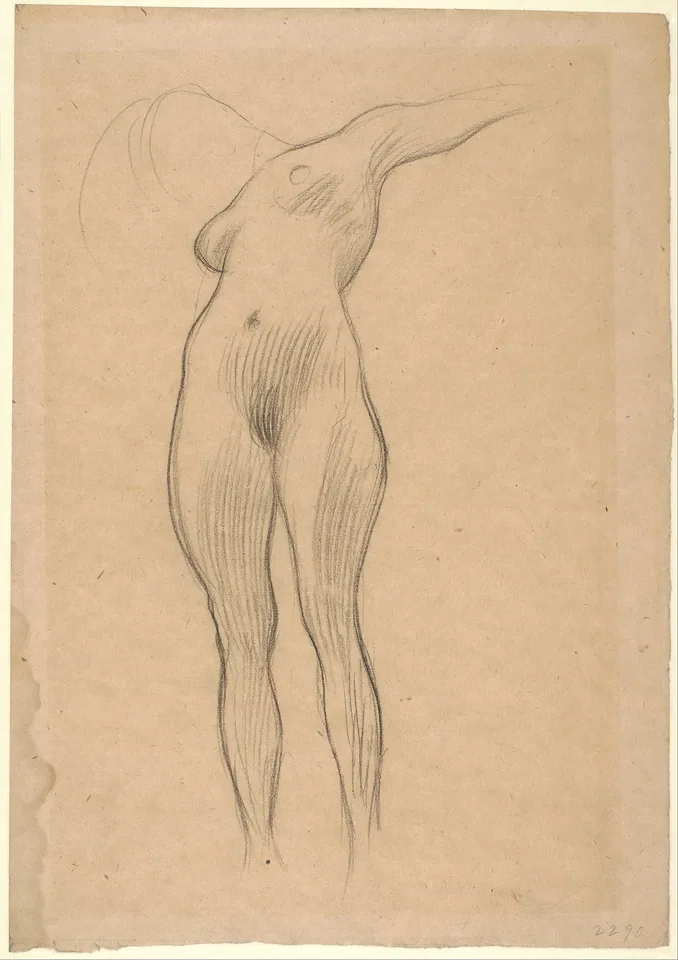
Today, the complete composition survives only through preparatory sketches and a single black-and-white photograph taken just before the castle fire. In late 2021, Google and Vienna’s Leopold Museum used deep learning and expert retouching to reconstruct the possible original colors of the lost work.
Details of Medicine
Questions about Medicine
What happened to Medicine by Klimt?
Medicine by Klimt was stored at Schloss Immendorf, where it is believed to have burned when retreating German SS troops torched the building in May 1945. Nazi authorities had confiscated the painting in 1938 from a Jewish family. Although researcher Tina Marie Storkovich found no final proof of its destruction, the original canvas vanished. Only preparatory sketches and one black-and-white photograph remain today.
What does Medicine by Klimt show?
Medicine by Klimt depicts an allegorical unity of life and death instead of celebrating modern healing. On the right side, a tall mass of semi-nude figures forms the river of life alongside a skeleton. To the left, a nude woman with an infant floats in space, touching a man's outstretched arm. At the bottom, the goddess Hygieia stands with an Aesculapian snake and the cup of Lethe.
Which series does Medicine belong to?
Medicine by Klimt belongs to the University of Vienna ceiling paintings, also known as the Faculty Paintings. Commissioned in 1894 for the university Great Hall, the group includes three large allegorical works: Philosophy, Medicine, and Jurisprudence. Because of intense protests from professors and cultural officials over their explicit themes, none of these ceiling panels were ever installed inside the university building.