Select the painting to see it full screen and zoom in.
What the painting shows
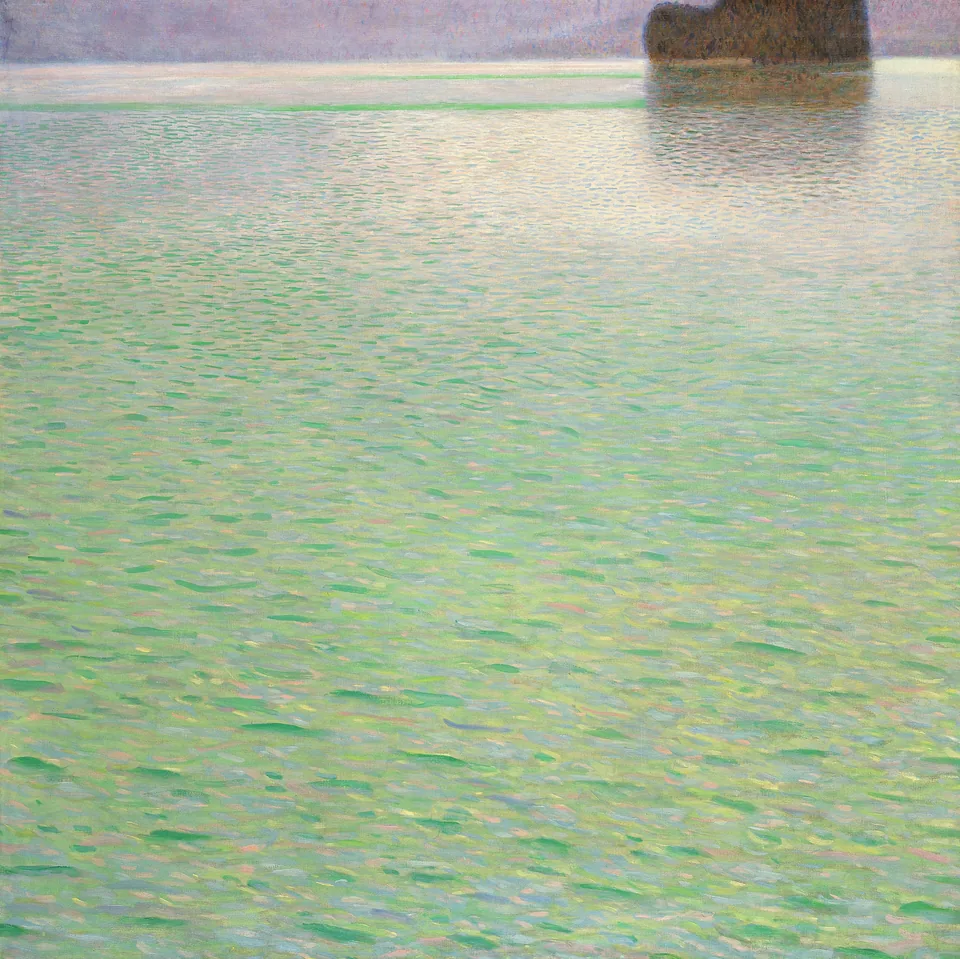
On Lake Attersee by Klimt captures an open body of water filled with small, repetitive dabs of paint. Klimt filled almost the entire canvas with the lake, using lively marks of vivid turquoise, seafoam green, and soft gray. These short strokes give the water a rippling, mosaic texture across the square surface.
A narrow band of darker blue water, hazy mountains, and pale gray sky sits along the top edge. In the upper right corner, a dark, rounded shore projects slightly into the water. By lifting the horizon so close to the top, Klimt flattened the view and focused your attention directly onto the shifting surface of the lake.
The story behind it
Klimt painted the work in 1900, also known by the German title Am Attersee. The square canvas measures 80.2 by 80.2 cm and belongs to the body of Klimt’s landscapes and the Attersee.
It forms an important part of Klimt’s summer landscapes. Rather than showing grand panorama views, Klimt used oil on canvas to study the natural light and patterns found along the lake.
Where to see it
You can see On Lake Attersee in Vienna. The painting belongs to the permanent collection of the Leopold Museum.
Details of On Lake Attersee
Questions about On Lake Attersee
Where is On Lake Attersee by Klimt?
On Lake Attersee by Klimt is in the permanent collection of the Leopold Museum in Vienna, Austria. Painted in 1900, this square oil painting measures 80.2 by 80.2 cm. Visitors to Vienna can see the work displayed alongside other early twentieth-century Austrian art in the museum.
What does On Lake Attersee by Klimt show?
On Lake Attersee by Klimt shows an expanse of water covered in short, rhythmic brushstrokes of bright turquoise and muted gray. A high horizon line leaves only a narrow strip of hazy sky and distant mountain shore across the top of the canvas, pushing the textured surface of the lake forward.