Select the painting to see it full screen and zoom in.
What the painting shows
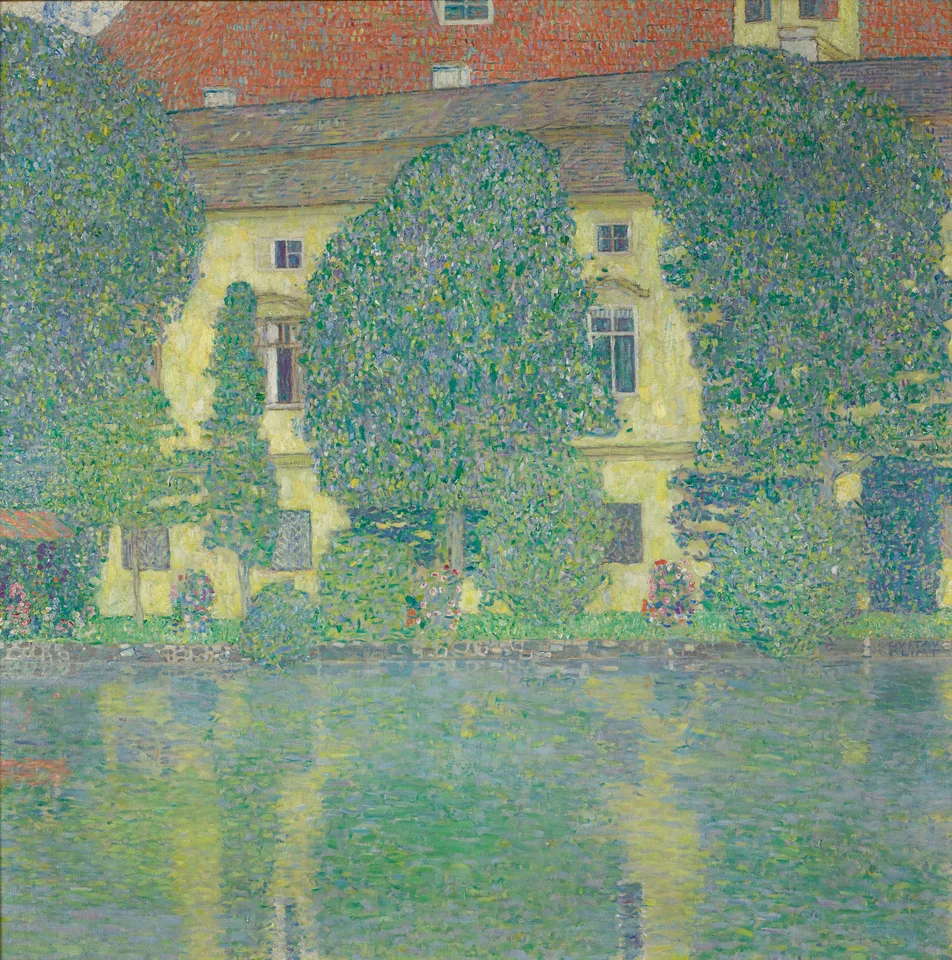
Schloss Kammer on the Attersee I by Klimt presents the Austrian castle of Schloss Kammer viewed from across the surface of the lake. The composition organizes nature and architecture into horizontal and vertical bands. The lower half of the canvas consists of the dark green water of the lake, marked with vertical reflections of the buildings and trees above. A small wooden boat hut sits right at the water’s edge, half hidden by a thick band of green foliage that stretches across the middle of the view.
Behind this dense layer of greenery rise the ochre and pale yellow facades of the castle. Klimt painted the central structure with a steep, dark hip roof, small dark window openings, and an arched entryway. Tall pyramidal poplars rise straight upward, cutting into the geometric blocks of the architecture with mosaic-like patches of green leaves. To the far left, a tall white tower with a reddish roof stands against the distant hillside.
Although this white church bell tower looks as if it stands right next to the castle grounds, it actually belongs to Seewalchen, located about 800 metres away across the water. Klimt compressed the space, pulling distant landmarks into a flattened arrangement. He pushed the horizon line almost to the very top edge of the canvas, leaving only a narrow sliver of blue sky and white clouds visible above the forested hills. The picture relies on a restrained palette dominated by greens, ochre, and creamy white tones, painted with an even light that avoids strong cast shadows.
The story behind it
Klimt painted this canvas during a summer holiday at Villa Oleander in Schörfling am Attersee. Klimt and the Flöge family rented the villa from Countess Khevenhüller, who owned Schloss Kammer itself. Setting up his easel on the villa’s quay, Klimt had a direct line of sight across the water to the estate. To explore similar scenery from this period, see Klimt’s landscapes and the Attersee.
To construct the image, Klimt used optical tools alongside his artistic intuition. He dissected the scenery using a self-invented cardboard viewfinder, opera glasses, and a telescope. These instruments allowed him to isolate distant architectural elements, flatten the spatial depth, and rearrange the view into clear planes of water, foliage, and masonry. The resulting image combines a realistic rendering of the location with a strictly parallel, decorative structure.
This canvas became the first entry in a series of four oil paintings of the castle that Klimt produced between 1908 and 1910. The group stands out within his wider production of landscapes because it documents his repeated return to the same architectural motif under varying compositions. You can examine more pieces from this regional body of work among Klimt’s Attersee paintings.
Where to see it
The public first saw the painting at the 1909 Vienna Art Exhibition, where contemporary reviews hailed it as the main and most brilliant work on display. One year later, in 1910, the picture traveled to Prague for an exhibition organized by the Union of Czech-German Artists.
The National Gallery Prague acquired the canvas directly from that 1910 exhibition. Today, Schloss Kammer on the Attersee I remains in the permanent collection of the National Gallery Prague in Prague, where it is preserved and placed on public display. While many historical accounts describe the canvas as square, the museum records its actual dimensions as approximately 110 centimetres high by 100 centimetres wide.
Details of Schloss Kammer on the Attersee I
Questions about Schloss Kammer on the Attersee I
What does Schloss Kammer on the Attersee I by Klimt show?
Schloss Kammer on the Attersee I by Klimt depicts the historic water castle Schloss Kammer viewed across the green waters of the Attersee. Klimt frames the pale walls and dark roofs of the building between dense hedges, tall poplars, and reflections on the lake. On the left side of the composition, a white church tower in nearby Seewalchen appears pulled close behind the trees beside the castle walls.
When did Klimt paint Schloss Kammer on the Attersee I?
Gustav Klimt painted Schloss Kammer on the Attersee I between 1908 and 1909 during his summer holiday in Upper Austria. He created the work while staying at Villa Oleander on the shores of the lake. It was the first composition in a focused four-part series of views showing the castle that he completed through 1910.
Where is Schloss Kammer on the Attersee I by Klimt?
Schloss Kammer on the Attersee I by Klimt is currently held and displayed by the National Gallery Prague in Prague, Czech Republic. The museum acquired the oil painting directly from an exhibition held by the Union of Czech-German Artists in 1910, just one year after its initial public presentation in Vienna.