Select the painting to see it full screen and zoom in.
What the painting shows
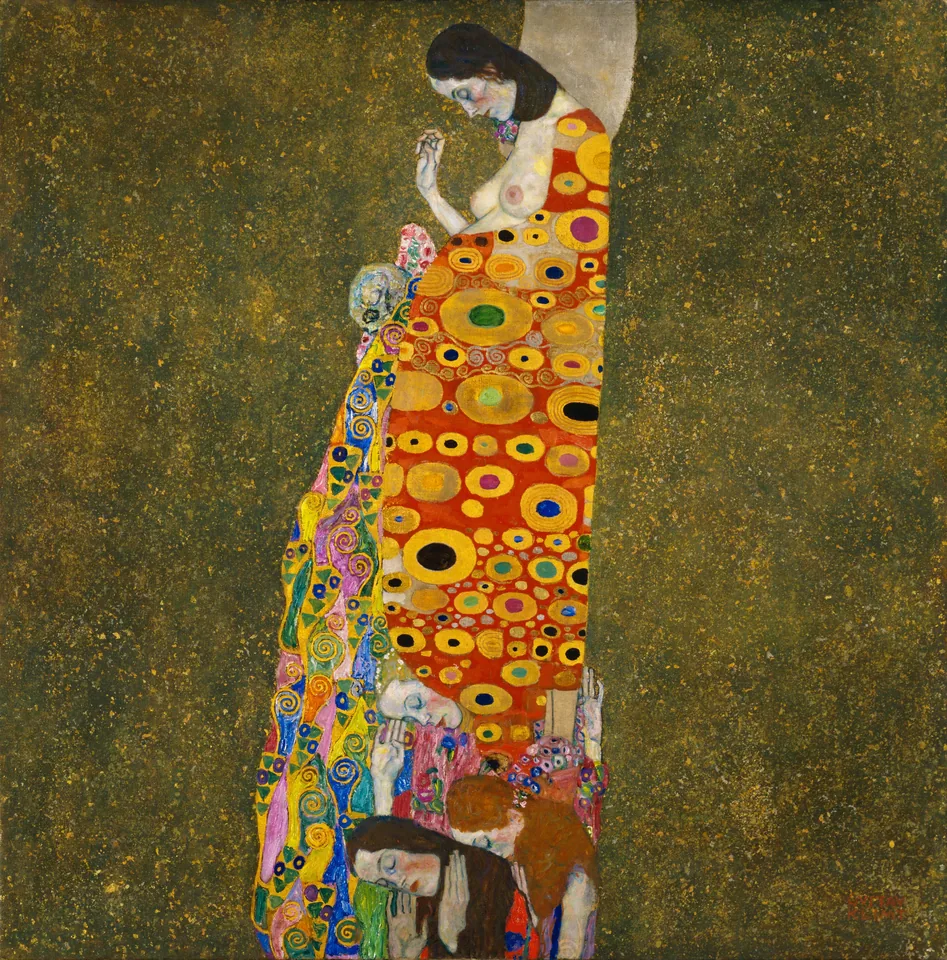
Hope I by Klimt, also known as Die Hoffnung I or Hope 1, is a vertical oil painting created in 1903 that depicts an expectant, unclothed woman confronting the viewer. Measuring 189 by 67 centimeters, the canvas uses a narrow format that emphasizes the standing figure from head to foot. The woman stands in full profile to the left while turning her head to look directly out at you. Her long, red curly hair flows down her back and shoulders, topped by a delicate wreath of blue forget-me-not blossoms. She holds her hands joined across her chest, positioned directly above her rounded belly.
Klimt painted the model entirely bare without drapery, displaying both her pregnancy and her pubic hair. Her pale skin stands out against a dark, threatening background. Directly behind her rises a patterned blue pillar filled with small geometric shapes and flecks, topped by a bare human skull resting just above her crown. The skull represents death and decay, referencing the traditional memento mori theme that reminds viewers of mortality even in the presence of new life.
Three sickly, deathlike faces loom behind the skull, symbolizing illness, old age, and madness. Below them, a dark sea monster fills the left portion of the canvas. The creature displays sharp teeth, glowing round eyes, and a claw-like hand stretched toward the woman’s belly and pelvis. A long tail curves down and coils across the bottom of the canvas around the woman’s feet, as if trying to trap her. Through these symbols, the composition brings together opposing ideas of life, death, and renewal in a format central to Klimt’s wider series of allegories.
The story behind it
The model for the painting was Herma, one of Klimt’s favorite studio models. Klimt admired her physical appearance, once remarking that her backside was more beautiful and intelligent than the faces of many other models. When Herma failed to arrive for a scheduled sitting because she was pregnant, Klimt insisted that she come to the studio regardless. He decided to use her current physical state as the direct subject for Hope I. Klimt reportedly had sexual relations with many of his models, though records do not confirm whether he fathered Herma’s child.
Personal tragedy shaped the emotional tone of the work. In 1902, the year before he painted this piece, Klimt’s infant son, Otto Zimmermann, died. In Klimt’s original preparatory sketch, a man stood beside the pregnant woman to comfort her. Art historians suggest that the grief following his son’s death led Klimt to remove the supportive male figure and replace him with the looming skull and monstrous forms.
The painting caused immediate friction with contemporary moral standards. Klimt intended to show the piece to the public at the Vienna Secession Exhibition in November 1903. He withdrew the canvas before opening day on the advice of the Austrian Minister for Culture and Education, who feared a public scandal. Two years later, in 1905, Klimt stated that outside authorities had prevented the work from appearing at his retrospective. He also told the writer Berta Zuckerkandl that he pulled the work himself to protect the Secession from embarrassment, even though he stood ready to defend the imagery. Exhibition records differ on its later appearance: one record notes it was shown in Berlin in 1905 at the second Deutscher Künstlerbund exhibition, while another states Klimt held it back until the Second Vienna Kunstschau in 1909. You can trace how this work connects to his wider output across every Klimt painting from the period.
Where to see it
Hope I is on display at the National Gallery of Canada in Ottawa. The museum holds the original 1903 oil on canvas within its international collection, where you can inspect its narrow proportions, contrasting color palette, and detailed surface brushwork in person.
Details of Hope I
Questions about Hope I
What does Hope I by Klimt show?
Hope I by Klimt shows an exposed, nude pregnant woman looking directly forward with her hands folded above her belly. Dark figures crowd around her, including three sickly faces, a grinning skull resting over a blue patterned pillar, and a dark sea monster with bared teeth and a claw-like hand whose tail coils around her lower legs.
When did Klimt paint Hope I?
Gustav Klimt painted Hope I in 1903 using oil on canvas. Klimt began working on the canvas after his favorite model, Herma, became pregnant. He originally intended to show the finished work at the Vienna Secession Exhibition in November 1903, though outside pressures delayed its public debut until exhibitions in 1905 in Berlin or 1909 in Vienna.
Where is Hope I by Klimt?
Hope I by Klimt is in the permanent collection of the National Gallery of Canada in Ottawa. The museum displays the original canvas, which stands 189 centimeters high by 67 centimeters wide. It remains one of the artist's most significant works, presenting an unvarnished view of human pregnancy contrasted against mortality and sickness.