Select the painting to see it full screen and zoom in.
What the painting shows
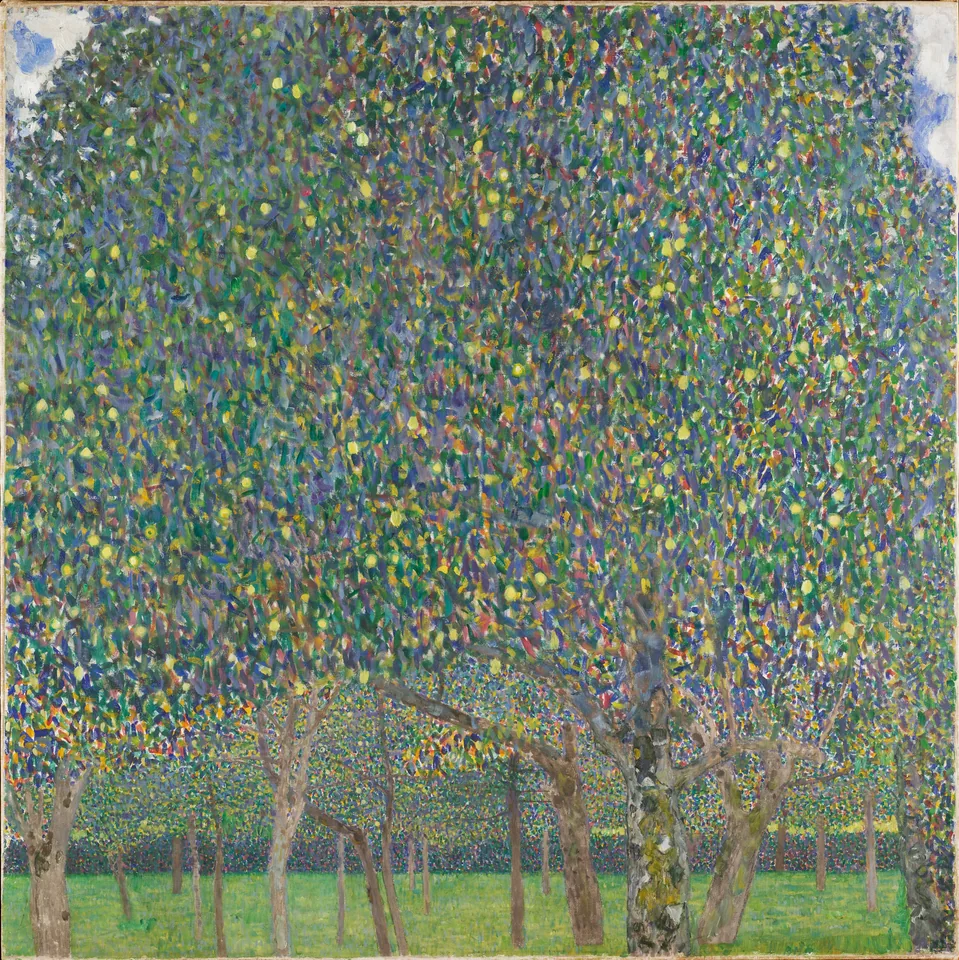
The Park by Klimt presents a view of trees where foliage fills almost the entire square picture plane. Klimt built this expanse from a dense mosaic of small, dabbed spots of paint in shades of emerald, deep green, yellow, and blue. Look closely at the surface and you can see how varied brushstroke directions produce a flickering visual effect across the canopy. The mass of leaves functions almost as an abstract composition, appearing planar and flat across the upper three-quarters of the canvas.
Only at the very bottom does the scene reveal the ground. A narrow strip of green grass anchors the composition, cut across by vertical tree trunks and a low, clipped hedge on the right. Through the spaces between these trunks, bright daylight filters into the scene, admitting light and creating an impression of distance where the pale surface of the Attersee may be visible. High up in the foliage on the upper left, a single slender tree trunk peeks through the mass of leaves, interrupting the otherwise continuous wall of color.
Art historians view this structure in different ways. Margaret Livingstone notes that the semi-repetitive leaf pattern generates an illusion of visual depth, while Angela Wenzel compares the small dots of color to Pointillism. Stephan Koja describes the layout as an orthogonal system built from rectangular zones of varying color density, demonstrating how Klimt evolved his personal Pointillist approach into a mosaic-like form. Tobias G. Natter notes that the canopy seems to stretch past the edges of the canvas, while later varnishing altered the original atmosphere and coloring of the work. Drawing on Freudian theory, Ruth Ronen suggests that the dense thicket and uncertain spatial structure produce an anxious viewing experience for the spectator despite the calm subject matter.
The story behind it
Gustav Klimt painted The Park between the summer of 1909 and April 1910. He found the subject on the land-facing side of Schloss Kammer, an estate on the Attersee in Upper Austria. Klimt spent his summer holidays in this lake region, using the grounds to develop his approach to landscapes and paintings of flowers and gardens. The expansive treatment of leaves in this work recalls the background foliage of his 1903 painting The Golden Knight.
The painting made its public debut at the Ninth Venice Biennale, where it hung from April to October 1910. Klimt showed it again at the 1911 International Exhibition of Art in Rome, and later included it in the 1917 Austrian Art Exhibition in Stockholm. You can explore where this work fits alongside paintings from throughout his career.
When Klimt died in 1918, the canvas remained in his studio. In 1928, the Neue Galerie in Vienna acquired it from Klimt’s companion Emilie Louise Flöge. By 1939, the painting had moved to Galerie St. Etienne in Paris. When the gallery relocated to New York in 1940, the painting crossed the Atlantic with its owner, Otto Kallir.
Where to see it
You can see The Park at the Museum of Modern Art in New York City. The museum purchased the oil painting from Otto Kallir in 1957. When it joined the collection, Klimt was little known to American museum visitors, making The Park his first significant painting to enter an American public institution. In the decades since, it has become one of the most popular paintings in the museum.
Details of The Park
Questions about The Park
What does The Park by Klimt show?
The Park by Klimt shows a stand of trees in the park at Schloss Kammer on the Attersee. Most of the canvas is covered by an expanse of leaves painted in small flecks of green, blue, and yellow. Along the lower edge, tree trunks, grass, and a clipped hedge appear, opening a view that may show the water of the Attersee.
When did Klimt paint The Park?
Klimt painted The Park between the summer of 1909 and April 1910. Although Gustav Klimt left the canvas undated, records place its creation between his summer holiday at the Attersee in 1909 and its first public showing in April 1910, when it debuted at the Ninth Venice Biennale.
Where is The Park by Klimt?
The Park by Klimt is in the permanent collection of the Museum of Modern Art in New York City. The museum acquired the painting from gallery owner Otto Kallir in 1957. It was Klimt's first significant work to enter an American public art museum.