Select the painting to see it full screen and zoom in.
What the painting shows
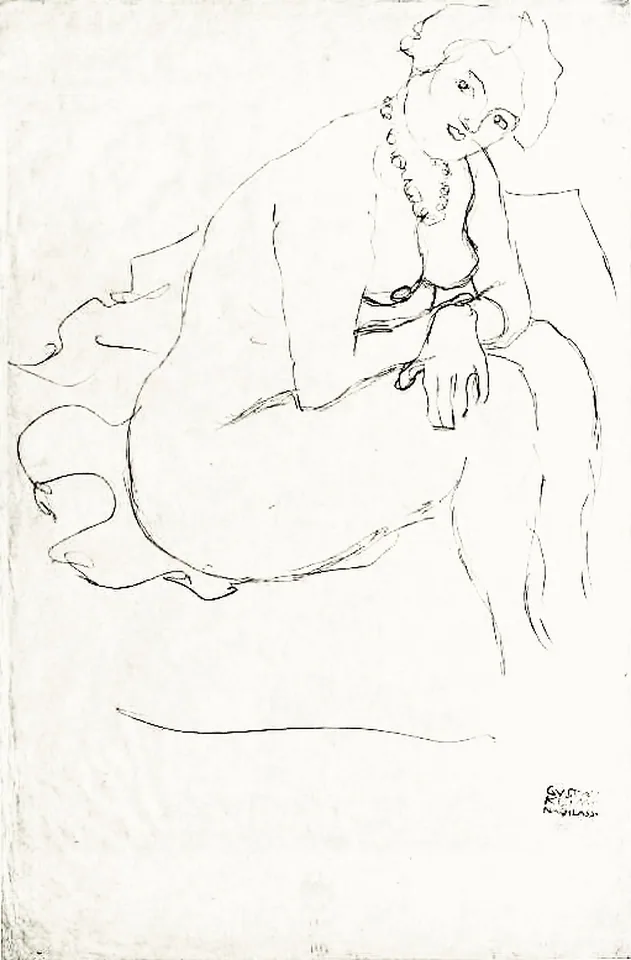
Curled Up Girl on Bed by Klimt is a delicate drawing rendered in fine pencil lines. A figure rests on a bed, turned away with her head resting on a soft pillow. Concentrated loops and curved graphite marks outline her mass of hair.
Next to her head, detailed linear folds describe bunched sheets or blankets. Some of the fabric shows faint geometric creases, while other areas sweep outward in loose contours. A broad, curved stroke sketches the edge of the mattress as it curves across the lower half of the composition. A vertical pencil line on the left marks the bedpost or frame. Most of the paper remains open and unshaded, directing your attention to the sleeping form. In the lower right corner, a small pencil monogram marks the sheet.
The story behind it
Klimt produced Curled Up Girl on Bed between 1916 and 1917. While he became famous for large oil paintings, works on paper formed a central part of his artistic process throughout his career.
This work sits within the artist’s late drawings. Rather than filling the page with dense color or heavy ornamentation, Klimt used minimal line work to suggest volume and rest. The drawing carries the museum inventory number NGA 54725.
Where to see it
You can find Curled Up Girl on Bed in the collection of the National Gallery of Art in Washington, D.C. The work measures 36.8 cm high by 55.8 cm wide.
Questions about Curled Up Girl on Bed
Where is Curled Up Girl on Bed by Klimt?
The National Gallery of Art in Washington, D.C., holds Curled Up Girl on Bed by Klimt in its permanent collection. Cataloged under entry number NGA 54725, this drawing on paper was produced between 1916 and 1917. The sheet measures 36.8 by 55.8 centimeters and presents a resting figure drawn with spare graphite outlines.
When did Klimt paint Curled Up Girl on Bed?
Gustav Klimt created Curled Up Girl on Bed between 1916 and 1917 as a drawing rather than an oil painting. The work depicts a person resting on a mattress amidst bunched fabric. Measuring 36.8 by 55.8 centimeters, this piece is preserved in Washington, D.C., at the National Gallery of Art under accession code NGA 54725.