Select the painting to see it full screen and zoom in.
What the painting shows
Adam and Eve by Klimt presents the biblical couple in a tall, narrow composition measuring 173 by 60 centimeters. Eve stands upright and dominates the center of the canvas, gazing directly out at you with pale blue eyes, rosy cheeks, and long, wavy blonde hair accented with golden highlights. Behind her stands Adam, whose head tilts to the side as he rests his face against Eve’s shoulder with his eyes closed in sleep. While Eve’s pale skin reflects delicate tints of light blue and yellow, Adam’s tanned, muscular torso forms a dark, protective foil behind her.
Klimt rendered Eve as a full, broad-hipped woman, evoking the archaic look of prehistoric idols and tribal art artifacts. Her figure represents a primal mother of life who stands on equal footing with the male figure rather than serving a secondary role. At the bottom of the picture, a dense cluster of red, purple, and white anemones blankets the ground over Eve’s feet. These colorful paradise flowers symbolize fertility, bringing bright accents to the lower edge of the canvas.
Draped across the lower portion of the figures is a spotted leopard skin, patterned with black rosettes and small stylized floral shapes. Art historians note that this animal pelt can be seen either as a dress worn by Eve or as an animalistic loincloth belonging to Adam. The painting remains visibly unfinished, leaving raw, unpainted areas of tan ground along the left side. An underlying drawing shows that Adam’s hands were already planned out, with his left hand probably intended to hold the apple.
The story behind it
This canvas is one of the few instances where Klimt chose a biblical narrative for his work. The composition does not depict a specific scene from Genesis, such as the expulsion or the Fall of Man, but rather uses the creation narrative as an artistic structure. By framing the scene through a biblical story, Klimt was able to portray complete female nudity with impunity.
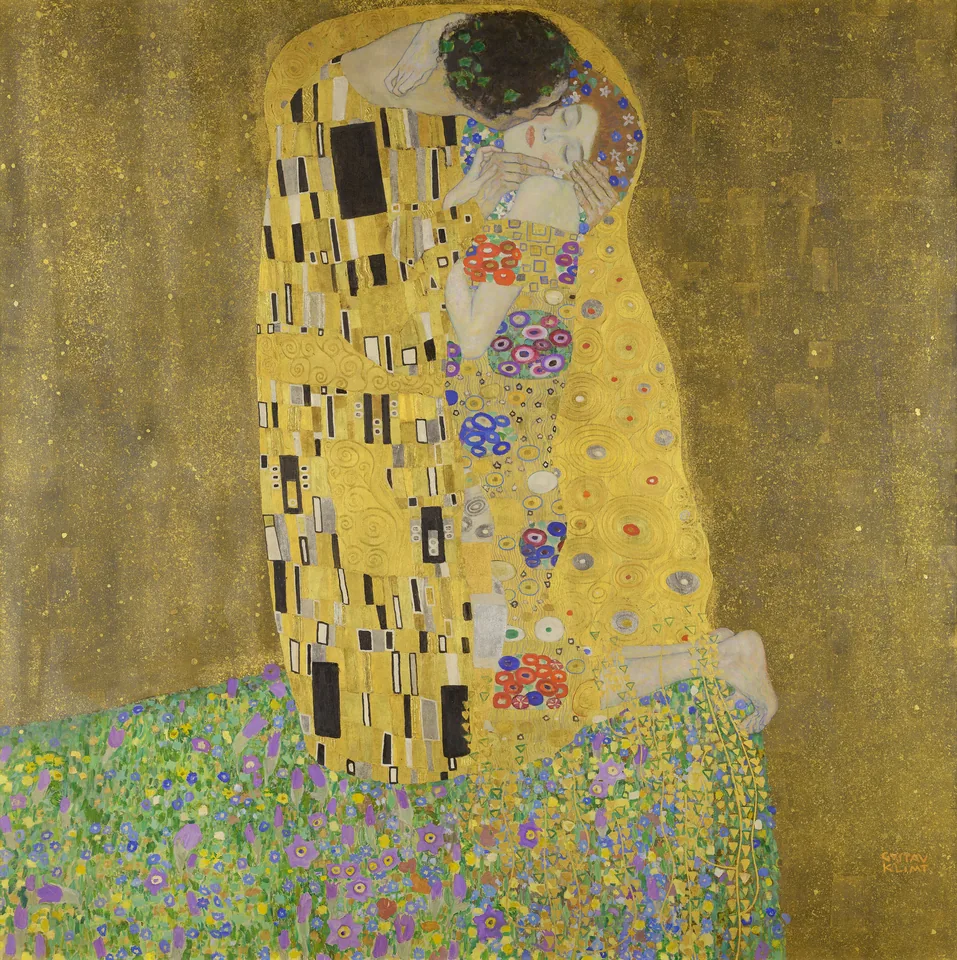
The canvas belongs to a line of earlier allegories in which Klimt explored the bond between man and woman, including works like The Kiss and The Embrace from the Stoclet Frieze. In Adam and Eve, Eve acts as the temptress in place of the biblical serpent. Some commentators interpret Eve as an alluring femme fatale who has lulled Adam into a passive, shadowy slumber. Under this reading, Eve has tasted the fruit of the Tree of Knowledge while Adam remains asleep and unaware of his sexuality.
Other scholars read the pair as personifications of day and night, capturing the moment of Eve’s creation from the sleeping Adam’s rib. The underdrawing reveals that Eve was intended to take Adam by the hand, initiating him into eroticism and physical sensuality. Drawing on Greek mythology, the leopard pelt reinforces these themes of untamed eros and calculating female desire. Modern critic Wendy Osgerby assessed the canvas as a decorative, self-absorbed relic of fin-de-siècle Vienna that reflected the spirit of a world before the First World War.
Klimt was still working on this piece in his studio when he suffered a stroke and died on February 6, 1918. One year later, on February 6, 1919, art dealer Gustav Nebehay included the canvas in an estate exhibition. Klimt’s friend Sonja Knips purchased the work directly from the artist’s estate shortly after the show.
Where to see it
You can see Adam and Eve in person at the Belvedere in Vienna, Austria. The museum holds an extensive gathering of Klimt’s works, making it a central destination on any where to see Klimt paintings itinerary. Visitors interested in tracing his career from early portraits to his final studio canvases can consult a complete guide to every Klimt painting to plan their museum visits.
Details of Adam and Eve
Questions about Adam and Eve
When did Klimt paint Adam and Eve?
Gustav Klimt worked on Adam and Eve between 1917 and 1918. The oil painting remained unfinished on an easel in his studio when he died on February 6, 1918. It was first presented to the public one year after his death, on February 6, 1919, during an estate exhibition organized by art dealer Gustav Nebehay.
Where is Adam and Eve by Klimt?
Adam and Eve by Gustav Klimt is located in Vienna, Austria, in the permanent art collection of the Belvedere museum. The work was initially bought from the painter's estate by his friend Sonja Knips shortly after his death before entering the public collection, where visitors can view the canvas today.
How big is Adam and Eve by Klimt?
Adam and Eve by Gustav Klimt measures 173 centimeters in height by 60 centimeters in width. This tall, narrow vertical format emphasizes the upright stance of Eve while allowing the figure of Adam to lean softly behind her shoulders within the slender boundaries of the composition.