Select the painting to see it full screen and zoom in.
What the painting shows
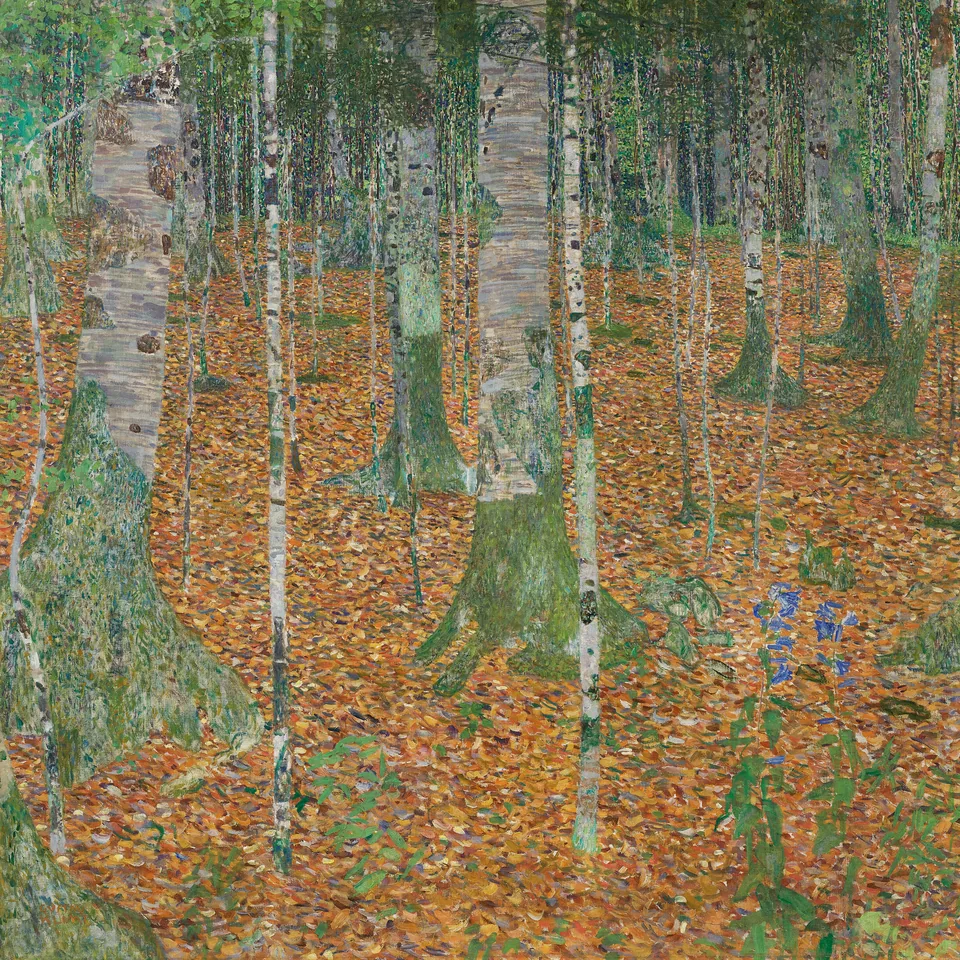
Beech Grove II by Klimt shows a dense forest of slender tree trunks rising from a sloping ground. A thick, multi-stemmed trunk dominates the center of the view, marked by textured bark, dark patches, and horizontal lines. Behind this central tree, straight trunks stand in close rows across the composition, filling the space from left to right. The forest floor rises steeply up the slope, covered in a dense carpet of fallen autumn leaves. Speckled marks and pale flecks create a mosaic across the leaf-covered earth, with no view of an open horizon or open sky. The composition crops the tops of the trees, keeping your attention entirely within the quiet interior of the grove.
The story behind it
Gustav Klimt painted Beech Grove II in 1903. The work also carries the German title Buchenwald II. It forms part of the artist’s series of landscapes, where he focused directly on natural forms, dense woods, and quiet outdoor settings. Klimt arranged the trees and ground into repeating textures and rhythmic patterns, focusing the eye on the wood itself rather than a distant vista. You can see how this piece fits into his career by viewing the full list of paintings.
Where to see it
Beech Grove II is held in a private collection. Because the work remains in private hands rather than hanging in a public art museum, it is not on continuous display for visitors.
Questions about Beech Grove II
What does Beech Grove II by Klimt show?
Beech Grove II by Klimt shows an interior view of a dense forest filled with slender tree trunks and fallen leaves. A large, divided trunk stands in the center foreground, surrounded by rows of vertical trees. The forest floor slopes upward, covered in a speckled ground of autumn foliage that completely fills the composition without showing the open sky.
Who owns Beech Grove II by Klimt?
Beech Grove II by Klimt is held in a private collection. The painting is owned privately rather than by a public gallery or civic art institution, which means it is not accessible to everyday museum visitors. It carries the alternative title Buchenwald II and stands as one of Gustav Klimt's 1903 landscape paintings held outside public collections.