Select the painting to see it full screen and zoom in.
What the painting shows
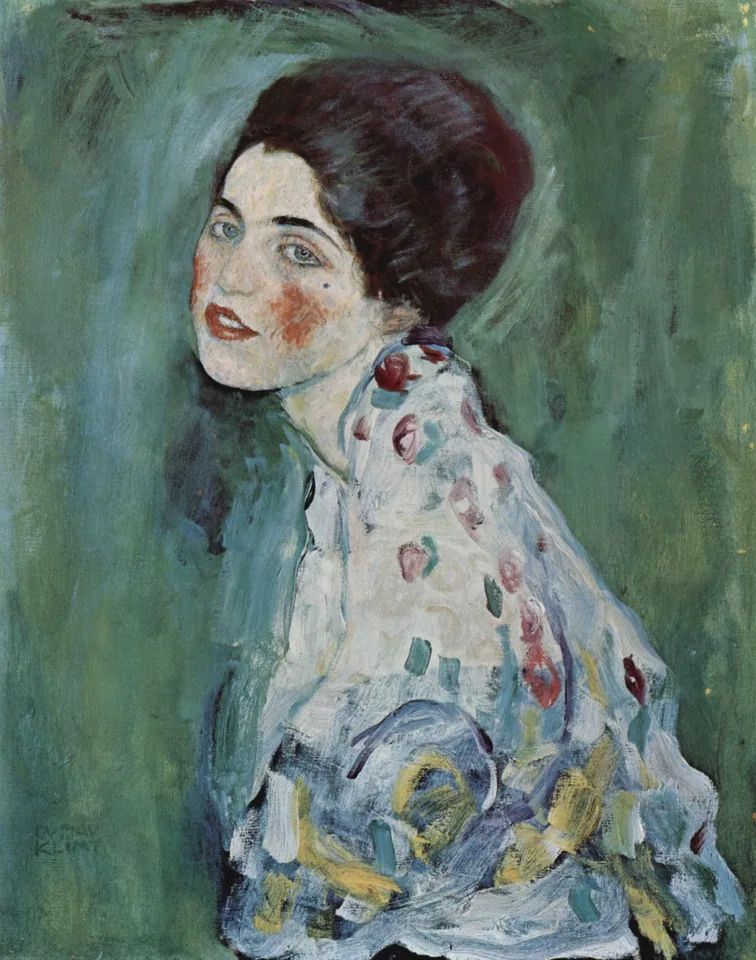
Portrait of a Woman by Klimt presents a standing figure viewed from the waist up against a pale, neutral wall. She wears a voluminous black dress with puffed shoulders, three-quarter sleeves, and dark beadwork lining the square neckline. Her dark hair is gathered high, and her pale profile turns toward the right edge of the frame.
Her left hand rests on the curved back of an upholstered chair, showing a slender ring and a bracelet on her wrist. A delicate gold chain with a small pendant hangs at her neck. On the left, a tall woven textile with red and ochre geometric patterns hangs down the wall. Klimt placed his signature in capital letters near the upper right corner.
The story behind it
Klimt painted this oil on canvas in 1894, placing it among his notable early works. The canvas is also recorded under the German title Frauenbildnis.
During this stage of his career, Klimt painted society portraits that combined precise academic technique with subtle interior settings. He balanced the dense black fabric of the dress against muted architectural tones, showing his careful handling of texture and light.
Where to see it
You can see the original painting in Vienna, Austria, where it belongs to the collection of the Belvedere. The Belvedere houses a major selection of works from across Klimt’s career.
Questions about Portrait of a Woman
When did Klimt paint Portrait of a Woman?
Gustav Klimt painted Portrait of a Woman in 1894 using oil on canvas. The work dates from the artist's early period, before he co-founded the Vienna Secession. In German, the painting is also known as Frauenbildnis. It shows his academic training and realistic rendering of society figures before his later decorative Gold Phase.
Where is Portrait of a Woman by Klimt?
Portrait of a Woman by Klimt is in the permanent collection of the Belvedere museum in Vienna, Austria. The Belvedere holds one of the most prominent collections of Gustav Klimt's paintings in the world, spanning his early academic portraiture, his landscape works, and his famous gilded canvases.