Select the painting to see it full screen and zoom in.
What the painting shows
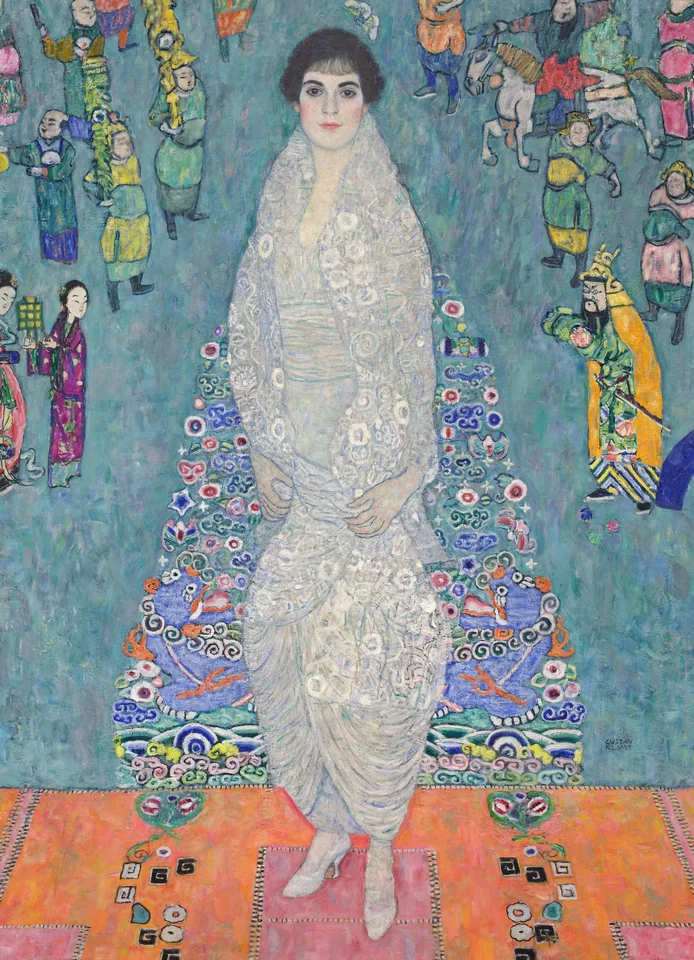
Portrait of Paula Zuckerkandl by Klimt shows the subject standing upright against a dark, heavily patterned backdrop. Her face is rendered with naturalistic softness, looking forward with a calm, neutral expression. Her hair is swept up into a soft pompadour framing her face.
She wears a light-colored, floor-length dress that flows down to a long fringe border near the floor. Over her shoulders rests an ornate shawl covered in dense floral and botanical motifs, with circular rosettes and scrolling shapes gathered over her arms. Her hands meet near her waist.
Behind her, the wall is filled with horizontal bands and stylized, curling cloud or wave patterns. A low geometric border separates the upper pattern from the lower floor area. Klimt signed the canvas in small capital letters in the lower right corner. The piece fits alongside the artist’s celebrated female portraits.
Who the sitter was
The sitter in this work is Paula Zuckerkandl. Klimt painted her during the early 1910s, focusing attention on her composed gaze while blending her figure into a decorative setting.
Where to see it
Portrait of Paula Zuckerkandl is currently held in a private collection. As a privately owned artwork, it is not on permanent view in any public museum or gallery. You can compare this composition with other works from the artist’s career across the catalog of Klimt paintings.
Questions about Portrait of Paula Zuckerkandl
When did Klimt paint Portrait of Paula Zuckerkandl?
Gustav Klimt painted Portrait of Paula Zuckerkandl between 1911 and 1912. The work belongs to the artist's later period of portraiture, where he combined realistic facial features with heavily patterned clothing and decorative wall designs. It represents one of several full-length female figures he completed during these years.
Who owns Portrait of Paula Zuckerkandl by Klimt?
Portrait of Paula Zuckerkandl by Klimt is held in a private collection. Because the painting is privately owned rather than housed in a public museum or state gallery, it cannot be viewed on public display. Information regarding temporary loans or public viewings is determined by the private owner.